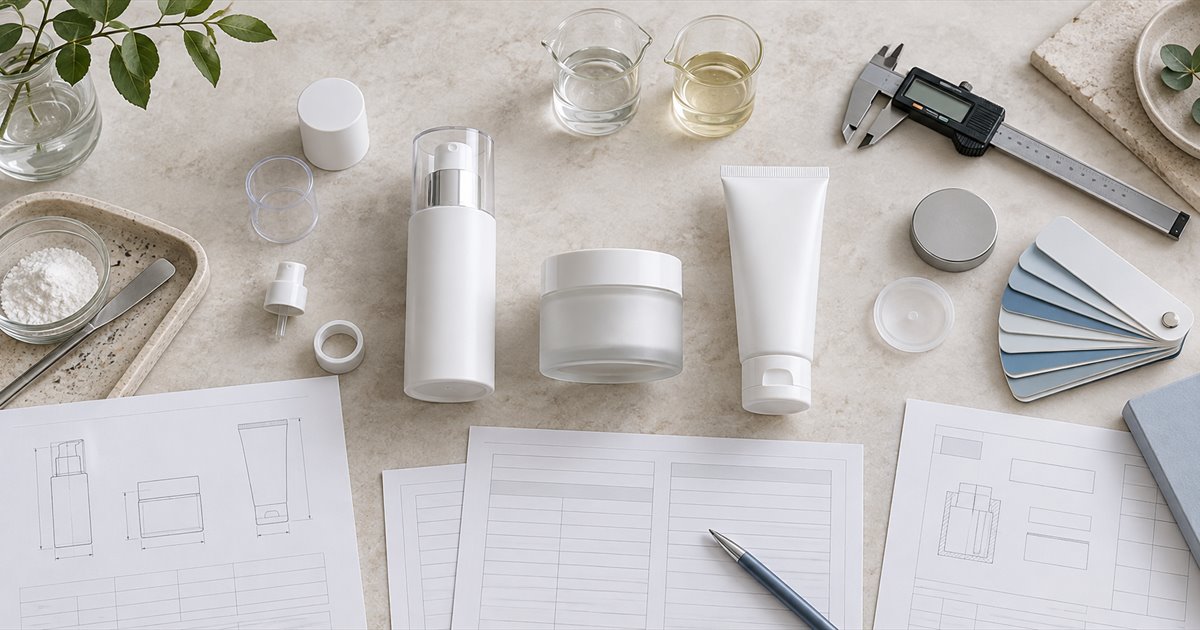
An accurate cosmetic manufacturing quote starts with a controlled RFQ, not a product idea in one sentence. Send one document that defines the target market, formula route, claims direction, fill size, packaging components, decoration, quantities, testing, documentation, delivery term and approval deadline. Ask every supplier to price the same scope and list exclusions, assumptions and buyer-supplied items.
Quick Answer: What Should a Cosmetic RFQ Include?
A cosmetic request for quotation should contain enough information for a manufacturer to define both the product and the commercial boundary. At minimum, include:
- Brand, contact person and decision owner.
- Destination market and sales channel.
- Product category, use area and intended user.
- Formula route: existing, modified or custom.
- Benchmark, sensory target, ingredient preferences and exclusions.
- Proposed claims and claims that must be avoided.
- Fill weight or volume and allowable tolerance.
- Every primary, secondary and shipping-pack component.
- Decoration method, artwork responsibility and color standard.
- Quantity breaks, forecast and acceptable component surplus.
- Required tests, specifications and market documents.
- Incoterms rule with a named place, currency and payment terms.
- Sample, artwork, production and delivery milestones.
Use the same RFQ version for every bidder. If one supplier prices a stock bottle and another prices a custom mold, their totals are not comparable.
Why Vague RFQs Produce Misleading Prices
Manufacturers price decisions, not adjectives. “Premium anti-aging serum, low MOQ, best price” leaves the formula, claim category, package, decoration, testing and logistics undefined. A supplier may fill the gaps with its cheapest assumptions, while another may include a more demanding scope. The lower figure can therefore represent less product rather than better value.
From a manufacturer’s perspective, five unknowns create most quotation risk: formula development effort, component minimums, decoration setup, quality/document requirements and the point at which delivery responsibility transfers. A useful quote states those assumptions visibly.
For an overview of development routes before you issue an RFQ, review INHI’s ready-formula, custom-formula and full-service options.
Cosmetic RFQ Decision Table
| RFQ input | What to specify | Why the quotation changes |
|---|---|---|
| Target market | Country or region, channel and responsible parties | Formula restrictions, label inputs and document scope differ by market |
| Formula route | Existing base, modification or custom development | Development work, sampling rounds and evidence needs change |
| Product specification | Format, use area, sensory target, fill quantity and tolerance | Controls formula, filling method, yield and inspection criteria |
| Primary packaging | Exact component, material, capacity, closure and compatibility needs | Component MOQ, tooling, lead time and filling-line suitability vary |
| Decoration | Print method, colors, finish, label or sleeve, and artwork ownership | Setup charges, scrap allowance and supplier minimums vary |
| Order quantities | First order plus two realistic reorder breaks | Reveals quantity-driven changes without inventing a volume forecast |
| Quality and documents | Tests, specifications, COA, SDS/MSDS, INCI and market files needed | These may be included, optional, third-party or buyer-managed |
| Commercial term | Currency, named Incoterms rule and place, tax/duty treatment | Defines which logistics costs and risks are inside the price |
| Timing | Required milestones and final delivery window | Shows whether component, testing and production paths fit the launch |
Section 1: Define the Market, Product and Claim Boundary
Start with where and how the product will be sold. “Online” is not a market. Name the destination country or region, Amazon/DTC/retail channel, intended user and use area. Identify whether the brand or another party will be the label owner or responsible person.
For the United States, proposed claims matter at RFQ stage. FDA explains that claims to treat or prevent disease, or to affect the structure or function of the body, can make a product a drug rather than only a cosmetic. FDA also states that cosmetics generally do not receive premarket approval, except that color additives are subject to specific approval requirements. A manufacturer needs the claims direction early because it affects formula screening, evidence planning and label review.
For the European Union, state who will be the EU Responsible Person and whether the quote must include inputs for the Cosmetic Product Safety Report, Product Information File, labeling and CPNP notification. The current consolidated EU Cosmetics Regulation requires a designated Responsible Person, good manufacturing practice, a safety assessment and specified label information before market placement. CPNP is a notification system, not a product-approval shortcut.
Copy-ready market block
- Destination market(s): [country or region]
- Sales channel(s): [Amazon, DTC, retail, distributor or professional]
- Intended user and use area: [describe]
- Proposed cosmetic claims: [list exact working claims]
- Claims to avoid: [list]
- Brand/regulatory decision owner: [name and role]
- Required market support: [label review inputs, testing, safety file inputs, notification/listing coordination]
Section 2: Make the Formula Brief Measurable
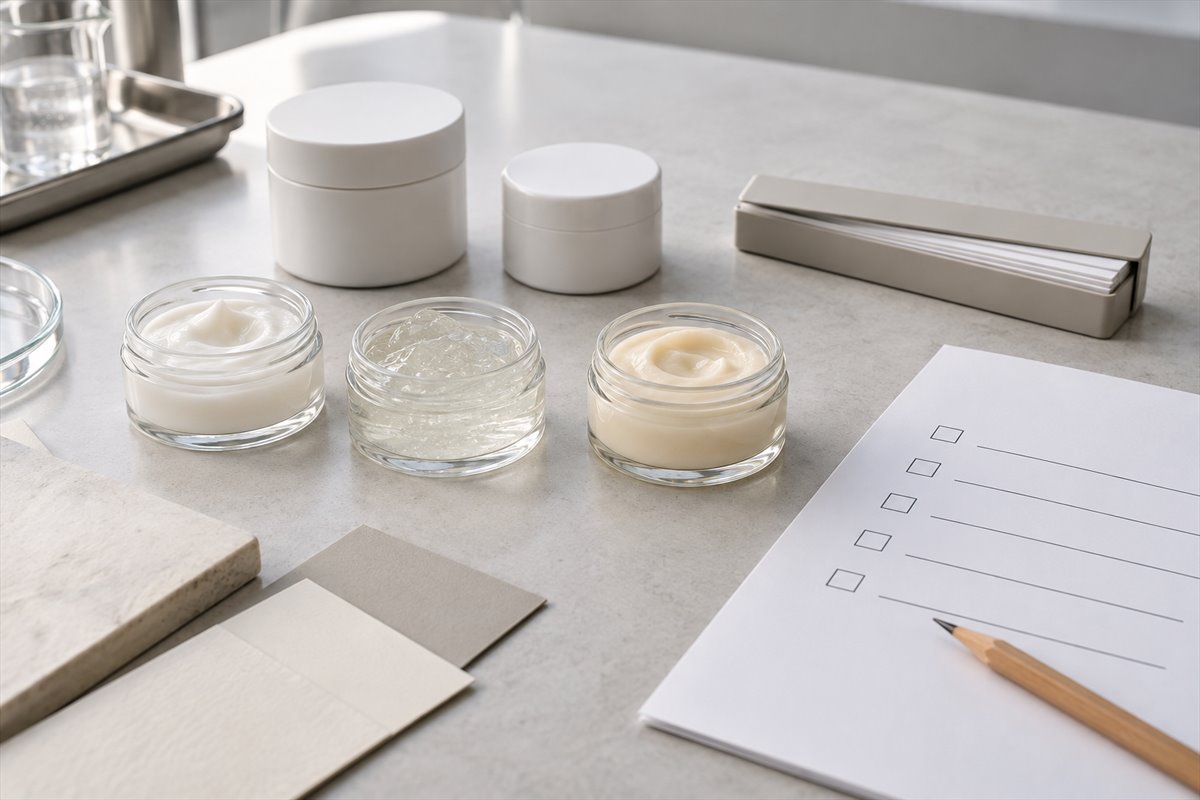
AI-generated formula-brief concept; not an INHI formula, laboratory, sample or client project.
Choose one development route before comparing prices. An existing formula can reduce development variables. A modified base may change fragrance, color, viscosity or selected ingredients. A custom formula begins from a written performance and sensory brief. Do not use those labels interchangeably.
Attach a benchmark only to explain measurable direction: texture, spread, absorption, finish, fragrance family, color and package experience. Do not ask a supplier to copy another brand’s protected formula, trade dress or claims.
The formula block should specify:
- Product format and intended use.
- Texture, viscosity range or dispensing behavior, if known.
- Color, opacity, fragrance direction and fragrance-free requirements.
- Ingredient preferences, exclusions and allergen or market restrictions to review.
- Target pH or other measurable attributes only when technically justified.
- Vegan, natural-origin or certification objectives, with the applicable standard named.
- Sample acceptance criteria and maximum revision rounds to price.
- Who owns the final formula and what information will be released to the buyer.
Avoid promising performance before the claims and evidence plan is defined. Ask the manufacturer to separate formulation work from claim-substantiation or third-party testing costs.
Section 3: Specify Every Packaging Layer
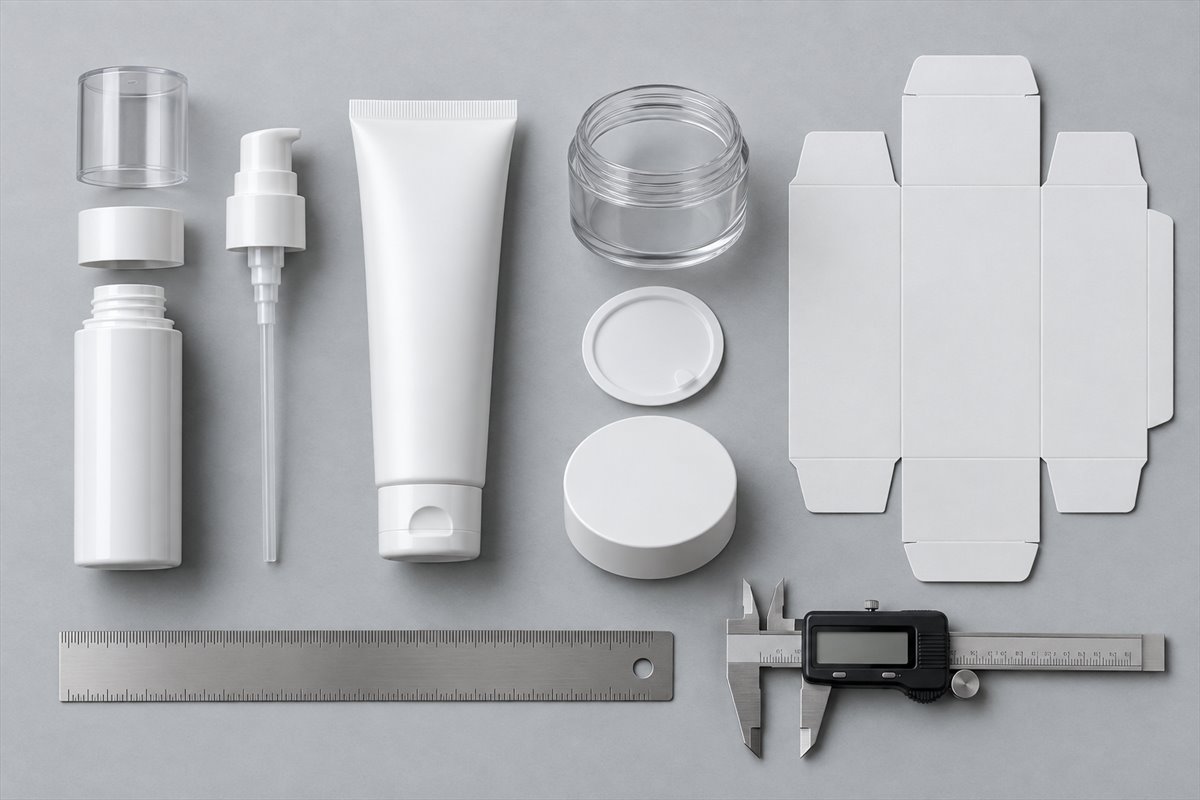
AI-generated packaging-specification concept; not an INHI component set, approved pack or production record.
Packaging often creates a different MOQ and lead time from the formula. List each component separately: bottle or jar, pump or cap, liner, wiper, sachet, label, folding carton, insert, master carton and any marketplace preparation.
For each component, request the material, nominal capacity, target fill, color, finish, dimensions, weight, component code and supplier status. State whether it is stock, customized by decoration or structurally custom. If a physical reference matters, send a sample and photographs with a scale; photographs alone do not prove neck finish, seal geometry or compatibility.
Ask who will test formula-package compatibility and dispensing performance, what sample configuration will be tested, and whether the work is included. Formula and primary package should be approved together.
Decoration needs its own specification: print process, number of colors, Pantone or other approved color reference, coating, foil, label material, artwork file format, proof method and acceptable defects. Request setup charges, tooling ownership, reorder applicability and decoration scrap assumptions as separate lines.
Section 4: Request a Comparable Cost and MOQ Breakdown
A total price without scope is not decision-ready. Ask for a line-item quotation that separates:
- Formula development or modification fees.
- Samples and courier charges.
- Bulk formula and filling cost.
- Each primary and secondary packaging component.
- Decoration, plates, screens, molds or other one-time tooling.
- Stability, compatibility, microbiological, claims or other agreed testing.
- Specifications, batch documents and market-support files.
- Inspection, assembly, kitting and marketplace preparation.
- Export packing, freight, insurance, duties and taxes as applicable.
MOQ must be reported by constraint, not as one unexplained number. Ask for the finished-goods MOQ, formula batch minimum, each packaging and decoration minimum, carton minimum, purchasing multiple, surplus-component policy and storage terms. Also request pricing at the first-order quantity and two realistic reorder quantities.
INHI’s public pages state that eligible ready-formula, custom-formula and selected custom-packaging projects can start from 100 units, subject to project feasibility, materials and process availability. This is an INHI-qualified starting point, not a universal cosmetic-industry MOQ.
Section 5: Lock Commercial Terms and the Timeline

AI-generated quote-comparison concept; not an INHI quotation, price list or client order.
Write the Incoterms rule, named place and version in the RFQ—for example, the selected Incoterms 2020 rule plus the exact port, warehouse or other place. ICC guidance shows that different rules divide carriage, insurance, clearance, cost and risk differently. “FOB price” or “delivered price” without the named place is incomplete.
Ask the supplier to state currency, quotation validity, deposit and balance terms, bank charges, tax treatment, tooling ownership, cancellation terms and the treatment of unused components.
The schedule should be milestone-based:
- Brief clarification complete.
- Initial quotation issued.
- Formula and packaging samples dispatched.
- Buyer feedback and sample approval.
- Testing and documentation gates complete.
- Artwork proof approved.
- Materials ready and production slot confirmed.
- Manufacture, filling and inspection complete.
- Batch release and shipment handoff.
Do not convert these gates into one universal lead-time promise. INHI’s current public Start a Project page says qualified inquiries receive an initial reply and quotation within 24 hours, and eligible samples can be prepared within 7 days after the brief is confirmed. Production timing still depends on formula, testing, packaging, quantity and approvals; the confirmed quotation must state the applicable schedule.
For a gate-by-gate view, read the published cosmetic product development timeline.
Common RFQ Mistakes and Procurement Risks
Comparing different scopes
Normalize bids before choosing. Move every included, excluded and optional item into one comparison sheet. A low unit price can omit cartons, decoration setup, tests, inspection or freight.
Treating a benchmark as a specification
A reference product communicates direction, not ownership rights or measurable acceptance criteria. Write what should be similar and what must be different.
Freezing artwork before formula and package data
Ingredient declarations, warnings, fill quantity, responsible-party details and dielines can change. Release artwork only after the relevant inputs are controlled.
Ignoring component surplus and purchasing multiples
Packaging suppliers may deliver above or below ordered quantities within an agreed tolerance. Define who owns, stores, pays for and may dispose of surplus components.
Sending confidential information before terms are clear
Use an NDA when appropriate, limit access to necessary information and mark confidential attachments. Do not place passwords, payment data or unrelated personal information in a broad sourcing email.
Manufacturer Quote Comparison Checklist
Before selecting a supplier, confirm that every bid answers the same questions:
- Is the formula route identical?
- Are fill quantity and allowable tolerance identical?
- Are all component materials, closures and decoration methods identified?
- Are tooling, testing, documentation and inspection itemized?
- Are MOQ constraints stated by formula, component and process?
- Are surplus and storage rules written?
- Is the Incoterms rule paired with a named place?
- Are assumptions, exclusions and buyer-supplied items visible?
- Are milestones tied to approvals and material availability?
- Is quotation validity long enough for the decision process?
FAQ
What is an RFQ in cosmetic manufacturing?
An RFQ is a request for quotation: a controlled document that asks suppliers to price the same defined formula, packaging, quantity, quality, documentation, commercial and delivery scope. It is more specific than an initial product inquiry.
Should I disclose my target cost?
Disclose a defensible target cost range when it helps the manufacturer choose a feasible formula and packaging route. Also ask for the assumptions behind any value-engineered option. A target should guide design decisions, not replace an itemized quote.
How many quantities should I request?
Request the planned first order and two realistic reorder breaks. More scenarios create work without improving the decision. Each quantity should use the same product specification so the price change is attributable to volume.
Can one MOQ cover formula and packaging?
Not reliably. Finished-goods MOQ can be constrained by the formula batch, bottle, closure, decoration, carton or purchasing multiple. Ask the supplier to identify the binding constraint and any surplus.
What documents should be included in the quote?
Name the target market and ask which specifications, INCI or ingredient files, COA, SDS/MSDS, test reports, safety-file inputs, labeling inputs and batch or shipping documents are included, optional or unavailable. Requirements vary by product, claims, market and responsible parties.
Conclusion: Send One Controlled Brief
The best next step is not to ask several factories for their “best price.” Freeze one RFQ version, attach the relevant references, choose realistic quantity breaks and require every supplier to list assumptions and exclusions. That produces a quotation you can audit and a development plan you can manage.
When your brief is ready, send the product, target market, quantity and launch timing to INHI for an initial scope and quotation. Do not include confidential formula details until the appropriate information-sharing terms are agreed.
Sources and References
- U.S. Food and Drug Administration, Registration & Listing of Cosmetic Product Facilities and Products, accessed September 11, 2026.
- U.S. Food and Drug Administration, Cosmetics Labeling Guide, accessed September 11, 2026.
- U.S. Food and Drug Administration, Cosmetics Labeling Claims, accessed September 11, 2026.
- U.S. Food and Drug Administration, Does the FDA approve cosmetics before they go on the market?, accessed September 11, 2026.
- EUR-Lex, Regulation (EC) No 1223/2009 on cosmetic products, consolidated version of May 18, 2026, accessed September 11, 2026.
- European Commission, Cosmetic Product Notification Portal, accessed September 11, 2026.
- International Organization for Standardization, ISO 22716:2007 Cosmetics — Good Manufacturing Practices, accessed September 11, 2026.
- International Chamber of Commerce, Incoterms 2020 checklist and flowcharts, accessed September 11, 2026.
- Google Search Central, Creating helpful, reliable, people-first content, accessed September 11, 2026.
- INHI Cosmetics, Solutions, Insights and Start a Project, accessed September 11, 2026.
Last updated: September 11, 2026.