Last updated: October 13, 2026
Cosmetic packaging MOQ is usually set by the highest minimum among the bottle or jar, pump or closure, decoration process and folding carton—not simply by the number of finished products you want to fill. A low finished-goods order can therefore require a larger component purchase, creating unused inventory, extra cash exposure and a longer path to artwork approval.
Quick Answer
Treat packaging as a bill of materials, not as one line item. Request a separate MOQ, unit price, setup charge, lead time and ownership rule for every bottle, pump, cap, label, decoration pass and carton. Then compare those purchase commitments with the planned filling quantity.
The practical launch quantity is the quantity at which the formula batch, components, decoration and assembly can all be supplied under one controlled specification. The practical cash requirement may be higher because some components must be purchased in quantities above the first filling run.
Cosmetic Packaging MOQ Decision Table
| Packaging decision | What can create the minimum | Lower-commitment route | Cost or risk to expose in the quote |
|---|---|---|---|
| Bottle or jar | Stock availability, resin or glass run, custom color, custom mold | Existing shape and standard color | Component overbuy, mold cost, color tolerance, storage |
| Pump, dropper or cap | Neck finish, dosage, actuator, spring path, liner or wiper | Qualified stock closure matched to the container | Compatibility, leakage, output variation, unmatched components |
| Label | Material roll, die, print setup and finishing | Digital or short-run pressure-sensitive label where suitable | Die/setup charge, waste, application tolerance |
| Direct decoration | Screen, pad, hot-stamp die, coating line and color passes | One-color decoration or applied label | Setup per color, registration, reject allowance, re-order consistency |
| Folding carton | Board purchase, printing method, cutting die and finishing | Standard structure with digital print where feasible | Die, plates, foil/embossing setup, minimum board purchase |
| Shipping pack | Case count, dividers, inserts and transit test configuration | Standard shipper sized around the finished pack | Empty space, damage, dimensional freight and rework |
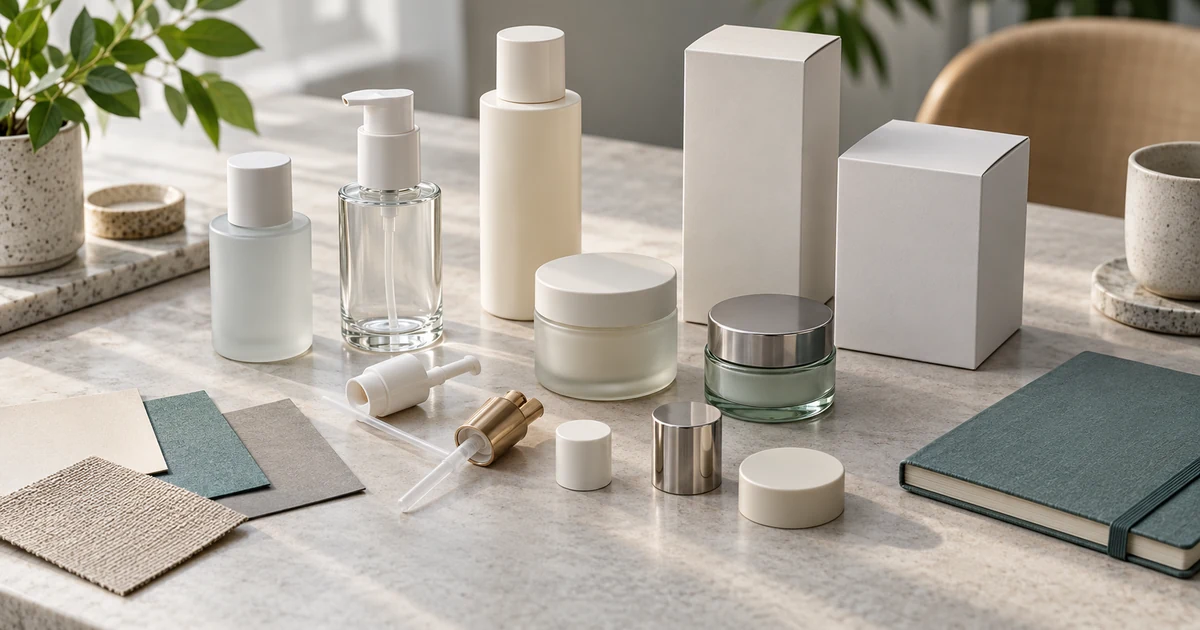
This table is a sourcing framework. It does not establish universal minimums. For example, Coradin publicly lists a 10,000-unit MOQ for its SERIDOSE packaging system, while Berlin Packaging describes a $10,000 minimum purchase for projects using its decorating support, plus setup and decorating charges. One is a unit minimum for a specific component system; the other is a spend threshold for a specific service. Neither should be applied to another supplier or package without a quotation.
AI-generated editorial comparison; the components are generic concepts, not approved INHI packaging.
Why Packaging MOQ Is Different from Finished-Product MOQ
A finished-product MOQ answers: “How many saleable units will the manufacturer fill and assemble?” A packaging MOQ answers: “How many units of this component or decorated item must be purchased or processed?” Those numbers can differ.
Suppose a project plans one filling run of 1,000 units. The selected stock bottle may be available by the case, the matching pump may require a larger component purchase, and the carton printer may require a separate setup quantity. The brand can still fill 1,000 units only if it agrees who buys, owns, stores and eventually uses the excess components.
Use four separate quantities in every packaging quotation:
- Finished-goods quantity: units filled, assembled and released now.
- Purchased component quantity: units the buyer is paying for now.
- Consumed component quantity: units expected to be used, including setup and quality loss.
- Residual inventory: usable components remaining after the run.
Residual inventory is not automatically an asset. It may become obsolete after an artwork change, formula change, closure revision, supplier discontinuation or regulatory update.
Bottles and Jars: Stock Shape, Color and Mold Choices
Stock packaging usually reduces commitment because the component already exists in a supplier's normal production or inventory system. “Stock” does not mean permanently available. Confirm the exact item code, material, capacity, neck finish, weight, color, tolerance and forecasted availability.
Custom color can move a project from warehouse inventory into a production run. Ask whether the color is achieved in the resin or glass, by coating or by a sleeve. Each route has a different setup, visual tolerance, durability question and reorder condition.
A custom mold is a development project, not only a larger order. Define ownership, cavity count, approval samples, maintenance, storage, useful life, transfer rights and what happens if the supplier relationship ends. A low mold quotation is incomplete if these rights are undefined.
The correct bottle or jar is also a technical decision. Capacity, headspace, wall stiffness, opening size and closure interface affect filling, sealing, consumer use and transport. A visually attractive component that cannot run consistently on the selected filling line is not a viable low-MOQ choice.
Pumps, Droppers and Closures Can Become the Real Constraint
Dispensing components combine more variables than their appearance suggests: neck finish, dip-tube length, dose, actuator geometry, gasket or liner, spring location, venting and lock design. The formula adds viscosity, particulates, alcohol, oil and surfactant exposure.
Aptar notes on current beauty-pump pages that transit or compatibility results may vary with container shape, container size and the sample formula. That limitation matters: a supplier's general component claim does not validate your final bottle–pump–formula system.
Before approving a pump or closure, specify:
- Bottle neck finish and dimensional drawing.
- Closure or pump item code and production version.
- Target dosage and acceptable output range.
- Dip-tube cut and assembly method.
- Locking, overcap, liner or tamper-evidence requirements.
- Formula compatibility and orientation testing.
- Leakage and transit acceptance criteria.
- Backup component and change-control process.
Do not buy the bottle and pump independently on appearance alone. A nominally matching neck description is not a substitute for assembled samples and an approved specification.
Printing and Decoration Add Setup Minimums
Applied labels, screen printing, pad printing, hot stamping, heat transfer, coating, metallization and embossing do not share one MOQ. The economic floor depends on equipment setup, tooling, curing, registration, color changes and expected spoilage.
A pressure-sensitive label can be practical for a controlled first run because the brand decorates finished stock components without committing to a custom container production cycle. It still requires the correct adhesive, facestock, varnish, die line, application direction and surface preparation.
Direct decoration may provide a more integrated finish, but each color or operation can add tooling and setup. Ask whether the quoted price includes screens, plates, dies, color matching, pre-production samples, adhesion testing and the planned reject allowance. Also ask whether the setup cost repeats on reorders.
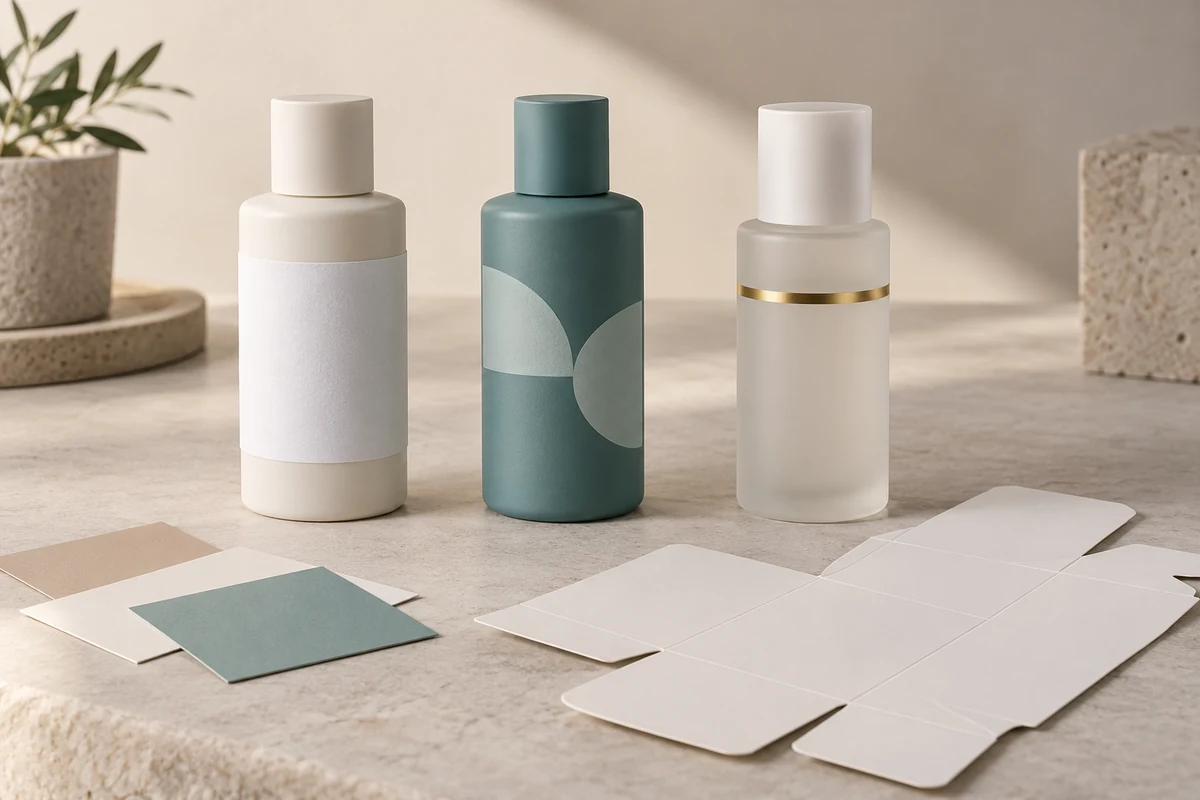
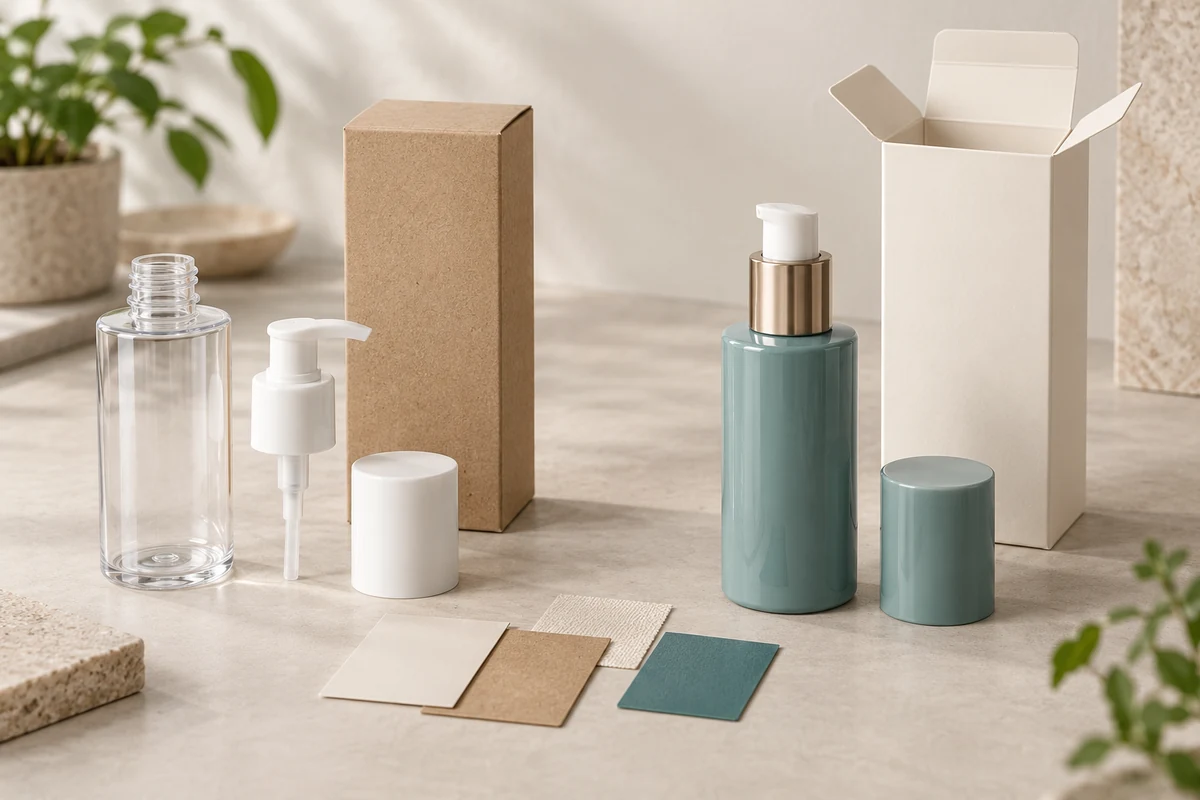
AI-generated editorial illustration of decoration-route concepts; no branded or compliant market pack is represented.
Folding Cartons Have Their Own Production Logic
A carton minimum can be controlled by board purchasing, imposition, printing method, cutting die, lamination, foil, embossing and gluing. One carton artwork per SKU, shade, fragrance or market can split a seemingly large order into several smaller print jobs.
Start with the physical product, not the artwork. Confirm the filled pack dimensions and orientation before locking the dieline. Leave room for required copy, legible type, batch coding and any market-specific symbols or warnings.
For the United States, FDA requires applicable cosmetic label information to be prominent and placed on the relevant principal display or information panel. The outer carton may carry required retail information, but it does not automatically remove requirements from the immediate container. For the EU, Article 19 labeling and product-specific requirements must be assessed for the intended market.
As of October 13, 2026, Regulation (EU) 2025/40 on packaging and packaging waste applies in the EU, with provisions phased over time. Brands selling into the EU should evaluate role-specific packaging, minimization, labeling and producer-responsibility obligations rather than treating “recyclable” as an unsupported artwork claim.
Calculate Total Packaging Exposure, Not Only Unit Price
Use this model before approving the lowest quoted unit cost:
First-order packaging cash exposure = component purchases + decoration purchases + tooling/setup + pre-production samples + testing + freight/duty + storage + expected loss
Then separate the cost per filled unit from the cost carried in unused inventory.
| Cost view | Calculation | Decision it supports |
|---|---|---|
| Consumed packaging cost | Cost of components expected to be used, including normal approved loss | Product margin for the current run |
| Residual packaging value | Cost of usable components left after production | Working capital and reorder planning |
| At-risk residual value | Residual components likely to expire, change or become obsolete | Downside exposure |
| Effective first-run packaging cost | Total first-order cash exposure divided by saleable units in the first run | Cash needed to launch |
If 5,000 pumps must be purchased for a 1,000-unit filling run, dividing the pump invoice across 5,000 planned future units can make the first-run economics look better than the cash position. Report both views.
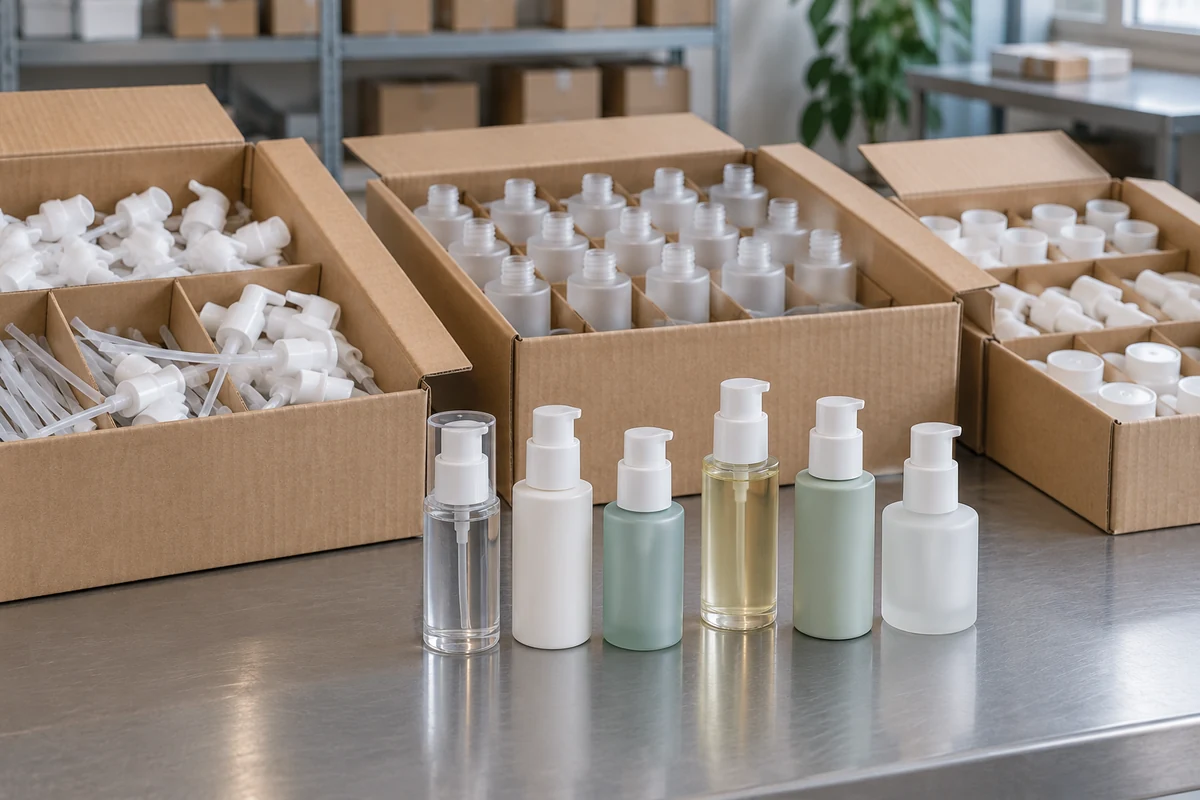
AI-generated editorial illustration of component overbuy and residual inventory; not an INHI warehouse or production batch.
A Manufacturer-Side Workflow for Controlling Packaging MOQ
- Freeze the target market and channel. Retail, Amazon, DTC and distributor projects can require different labels, transit protection and case configurations.
- Create one controlled packaging brief. Record product type, formula route, fill size, target cost, preferred material, dispensing requirement, decoration and launch quantity.
- Request stock options first. Ask for exact component codes, current availability and drawings—not only catalogue photos.
- Build the full bill of materials. Include bottle, pump, cap, liner, label, carton, insert, shipper and assembly items.
- Quote each constraint separately. Require MOQ, price breaks, setup, lead time, sample charge, excess quantity and ownership for every line.
- Approve assembled samples. Evaluate appearance, filling, closure fit, dispensing, leakage and transit configuration with the intended formula.
- Lock artwork to the approved component. Use the supplier's controlled dieline and print area; record color and finish standards.
- Define residual inventory rules. State where excess components are stored, how they are identified, who insures them and how long they will be held.
INHI publicly states that eligible projects can start from 100 units. That is an eligibility statement, not a promise that every custom bottle, pump, decoration or carton can be purchased at 100 units. The practical route at a small quantity is normally an eligible formula plus packaging and decoration that fit current supplier and process constraints.
Use the published INHI project capabilities page to understand the packaging and supplier-coordination scope. For a broader view of formula, component and decoration constraints, see Cosmetic MOQ Explained and the cosmetic manufacturer RFQ template. The Insights hub collects related manufacturing guidance.
Common Packaging MOQ Mistakes
Asking for one MOQ before defining the pack
“What is your MOQ?” cannot be answered accurately without the formula, fill size, component, decoration, quantity by SKU and market. A low number quoted before specification is a lead, not a controlled offer.
Comparing prices with different inclusions
One supplier may include pump, decoration and carton; another may quote only the bottle. Normalize the bill of materials, quality requirements, freight term and setup charges before comparing.
Treating every variant as one combined order
Five carton artworks, three bottle colors or four fragrances may trigger separate setups. Ask which quantities can be aggregated and which minimum applies per SKU, artwork, color or production lot.
Ordering components before compatibility work
Large component inventory does not reduce technical risk. Packaging can interact with the formula through migration, absorption, corrosion, evaporation or loss of barrier performance. Cosmetics Europe recommends evaluating the product in packaging made from the same materials and as close as possible to the marketed pack.
Ignoring the reorder path
The lowest first-order price may depend on a one-time stock opportunity. Confirm whether the exact component and finish are repeatable, how colors are controlled and what happens if the supplier changes tooling or material.
Packaging RFQ Checklist
Send these fields together:
- Destination market, sales channel and desired launch date.
- Product category, formula status, viscosity and relevant compatibility concerns.
- Fill quantity, container capacity and target dimensions.
- Bottle or jar material, shape, color and neck finish.
- Pump, dropper, cap, liner, wiper or applicator requirements.
- Decoration method, number of colors, finish and artwork status.
- Carton structure, board, print, finish, insert and coding area.
- Finished quantity by SKU plus 12-month forecast.
- Required samples, compatibility, leakage and transit checks.
- Target incoterm, ship-to country and storage plan for excess components.
- Separate component, decoration and finished-goods MOQs.
FAQ
What usually sets cosmetic packaging MOQ?
The controlling minimum is the highest binding requirement among the container, closure, decoration, carton and assembly process. It can also be SKU-specific when artwork, color or component changes.
Can a brand fill fewer units than the packaging MOQ?
Sometimes. The brand or manufacturer may purchase a larger component quantity and use only part of it in the first run. The agreement must identify ownership, storage, usable shelf life, change control and the cost of residual inventory.
Are stock bottles always low MOQ?
No. Stock status reduces development work, but case quantities, inventory availability, regional supply and matching closures still apply. Confirm the exact item code and current allocation before approving artwork.
Do labels always have a lower MOQ than screen printing?
Not universally. Digital labels often reduce setup for short runs, but the label material, die, finish, application process and durability requirements can change the economics. Compare a specific label route with a specific direct-decoration route.
Should packaging compatibility be completed before ordering commercial quantities?
Yes, the intended formula and final package should be assessed together. The test plan should reflect materials, orientation, temperature, time, dispensing and transport risks. Supplier claims about a component do not replace product-specific evaluation.
Does a carton solve all cosmetic labeling requirements?
No. Required information depends on the market and whether the product has an outer container. FDA and EU requirements allocate information across the outer and immediate containers under defined conditions. Review the complete marketed configuration.
Conclusion
Cosmetic packaging MOQ is a system of component and process commitments. A reliable quote identifies the constraint behind every minimum, separates filled units from purchased components, and shows setup, testing, residual inventory and reorder conditions. To scope one packaging route against your formula, market and first-order quantity, send INHI a controlled project brief.
Sources and References
Accessed October 13, 2026.
- FDA: Summary of Cosmetics Labeling Requirements
- FDA: Cosmetics Labeling Guide
- ISO 22715:2006 — Cosmetics — Packaging and labelling
- EUR-Lex: Guidance for Regulation (EU) 2025/40 on packaging and packaging waste
- European Commission: Packaging waste
- Cosmetics Europe: General approach for cosmetic packaging
- Cosmetics Europe: Guidelines on Stability Testing of Cosmetics
- Aptar Beauty: HDP dispensing pump
- Coradin: SERIDOSE packaging system
- Berlin Packaging: Custom Decorating Services
- Google Search Central: Creating helpful, reliable, people-first content
- INHI: Capabilities
- INHI: Cosmetic MOQ Explained
- INHI: Cosmetic Manufacturer RFQ Template