Last updated: October 14, 2026
A cosmetic factory audit checks whether the specific manufacturing site can consistently make your product to agreed specifications and support the evidence your market requires. Overseas buyers should verify site identity, material controls, production records, testing, batch traceability and corrective actions. Approve the supplier only after unresolved risks have an owner, an acceptable resolution and documented follow-up.
Quick Answer: What Should a Cosmetic Factory Audit Establish?
Your audit should produce a purchasing decision supported by evidence. It should establish which site and processes were assessed, whether that scope fits your proposed product, and what must happen before an order proceeds.
Use three evidence channels: observe an operation, inspect its records and ask the person responsible to explain it. A discrepancy between those channels deserves investigation. An attractive showroom, a certificate or one excellent sample cannot answer every question about routine production.
This checklist is a buyer's operational framework, not a certification scheme or product-specific legal opinion. Pair it with your product specification and destination-market requirements. For the wider selection process, see our questions to ask before choosing a cosmetic manufacturer.
Define the Site, Product and Audit Scope First
Record the legal entity, physical manufacturing address and proposed production activities before booking travel. Distinguish the company signing your contract from the site blending the bulk, the site filling it and any external laboratory or subcontractor.
Specify the product family, formula route, packaging format, target markets and intended claims. A review of lotion filling does not automatically establish competence for hydrogel patches or a different filling process. Ask which activities will occur elsewhere and how changes to those assignments are approved.
Agree access to relevant production areas, records and staff in advance. Confidential information can be redacted or reviewed under an NDA, but essential evidence must remain assessable. If access is limited, record the resulting uncertainty rather than marking the item as passed.
Understand What Standards and Certificates Can Establish
ISO 22716 concerns cosmetic manufacturing quality
ISO 22716:2007 covers production, control, storage and shipment of cosmetics. Its scope excludes research and development and distribution of finished products; it does not comprehensively cover worker safety or environmental protection. ISO's official page identifies the edition as current. A separate review may therefore be needed for concerns outside that scope. ISO 22716
For any certificate presented, check the named organization, address, scope, issuer, validity and the activities actually covered. Resolve mismatches with the issuer using independently verified contact details. A certificate belonging to a related company or another site is not evidence for the proposed production location.
EU GMP and US registration are different matters
Article 8 of the EU Cosmetics Regulation requires good manufacturing practice. It provides a presumption of compliance when manufacturing follows relevant harmonised standards published in the Official Journal. The Commission's cosmetics list identifies EN ISO 22716:2007. This does not replace the product's wider safety, documentation and market requirements. EU Cosmetics Regulation · European Commission standards list
For US projects, distinguish applicable facility registration and product listing from government approval. FDA reiterated on September 9, 2026 that it does not issue cosmetic registration compliance certificates, and registration or listing numbers do not signify approval. Request appropriate underlying records and an explanation of any claimed exemption. FDA clarification
FDA's cosmetic GMP inspection checklist is a useful technical reference, but contains legacy material. Its separate 2013 GMP guidance remains labelled draft, not for implementation. Neither should be presented as a newly effective MoCRA final rule. FDA inspection checklist · FDA draft guidance
Cosmetic Factory Audit Checklist: Evidence and Decisions
Use these 12 audit areas to plan the assessment. The questions are procurement recommendations; they are not an official regulator's pass/fail scoring system.
| Audit area | Evidence to request or observe | Question before approval |
|---|---|---|
| Site and scope | Contract entity, site address, process map, subcontractor list | Will the assessed location perform the proposed work? |
| Personnel | Role-specific training and staff explanations | Can operators explain their own acceptance criteria? |
| Materials | Receipt records, identity, lot status and segregation | Can an unapproved item enter production? |
| Cleaning and equipment | Relevant cleaning records and equipment checks | Does evidence match the line observed? |
| Water and contamination controls | Applicable specifications, results and investigations | Are adverse findings recognized and resolved? |
| Production | Approved instructions and completed batch records | Does recorded work match the agreed formula and process? |
| Packaging | Approved artwork, component specifications and line checks | How are wrong components or labels prevented? |
| Testing and release | Results, deviations and release authorization | Who can stop a batch from shipping? |
| Traceability | Links between ingredients, bulk, packs and shipments | Can the business identify affected stock and recipients? |
| Complaints and recall readiness | Anonymized complaint investigations, escalation contacts and a withdrawal exercise | Can the team connect a reported defect to affected batches and buyer notifications? |
| Suppliers and change control | Approved-supplier records, recent change requests and buyer notification terms | Who reviews a material, process or site change before it affects the order? |
| Corrective actions | Findings, owners, deadlines and effectiveness evidence | Has the cause been addressed, not just the visible defect? |
FDA's checklist supports reviewing facilities, equipment, personnel, materials, manufacturing controls, laboratory work and records as connected activities. Use the table to test how those activities work for your proposed supply arrangement. FDA inspection checklist
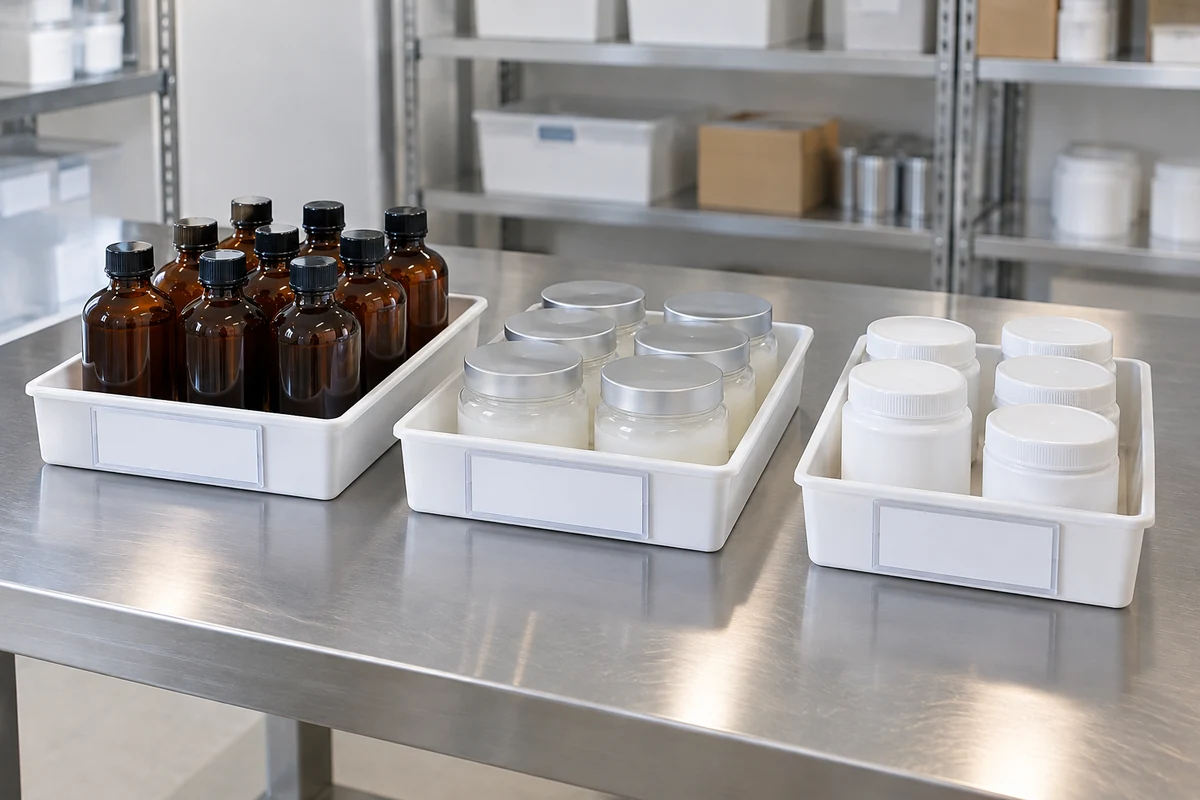
AI-generated editorial illustration of physical segregation; actual status identification must be verified during the audit.
Trace One Real Batch Through the Factory
A batch walkthrough connects separate documents into a testable story. Agree a representative, recently completed batch that the factory is permitted to share. Where necessary, conceal client names while preserving identifiers needed to follow the records.
- Start with a finished unit. Identify its batch code, pack specification and release status.
- Work back to filling and bulk manufacture. Check that quantities, dates and identifiers connect logically.
- Follow a selected material. Connect its supplier lot and acceptance record to the quantity used.
- Review exceptions. Ask how adjustments, rejected units, rework or unusual results were investigated and authorized.
- Follow the batch forward. Check which stock remains and which shipment records identify its destination.
Then reverse the exercise: choose a material lot and ask which finished batches used it. This can expose gaps that a prepared forward demonstration misses.
Record the documents actually examined and any parts that could not be reconciled. Do not invent a universal completion time or claim that one successful exercise proves every batch is traceable. Your report should describe the sample and its limitations.
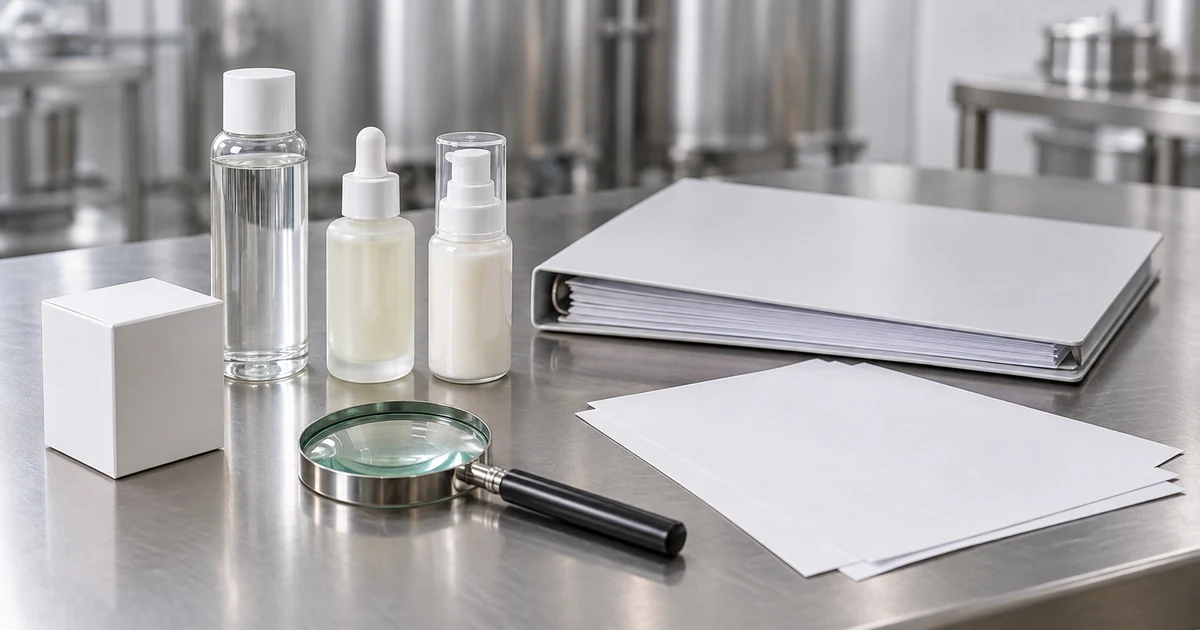
AI-generated editorial illustration of traceability checkpoints; no actual batch or retained-sample record is shown.
Check Whether Testing Fits the Product and Package
Ask what each test is intended to establish, which specification applies, and how the submitted sample relates to the proposed formula and packaging. A report for another formulation or container needs a documented technical justification before it supports your project.
Microbial risk deserves particular attention for relevant products. FDA identifies materials, water, manufacturing conditions, inadequate preservation, packaging, storage and consumer handling as possible contamination routes. Ask the technical team how its assessment addresses the actual product and foreseeable use. FDA microbiological safety
Avoid turning a generic test list into a promise of safety. FDA states that it does not prescribe one specific test set for every cosmetic; evidence and any additional testing must support the product concerned. FDA product testing
Clarify who commissions testing, who reviews results and who approves release. For external laboratories, ask how competence and relevant methods were assessed. For documentation terminology, use our guide to COA, SDS, INCI and PIF documents.
Turn Findings into Corrective Actions and an Approval Decision
Write each finding as an evidence-backed gap: the agreed criterion, what was observed, the relevant record or location, and why the discrepancy matters. Separate an inaccessible record from a demonstrated failure; both affect confidence, but they mean different things.
For each action, identify containment, the cause, the proposed correction, an owner, a completion date and how effectiveness will be checked. A replacement label or a newly written procedure may fix the immediate issue without proving that the process now works.
Use a buyer-agreed decision framework:
- Approve: evidence supports the defined product, site and process scope, with no unresolved issue that prevents proceeding.
- Approve with conditions: limited, manageable gaps have explicit restrictions and closure requirements before the relevant production or shipment milestone.
- Hold approval: unresolved safety, identity, traceability or evidence-integrity concerns prevent a supported decision.
These categories are recommended purchasing controls, not ISO or FDA grading rules. Do not average a serious unresolved risk into a passing overall score. State who can authorize progression and what evidence that person must review.

AI-generated editorial illustration of corrective-action review; no completed checklist or approval is represented.
Plan Audit Cost, Timing and Follow-Up Around Scope
There is no verified universal audit price or duration suitable for every cosmetic supplier. Obtain a written quote covering site count, product and process scope, auditor competence, travel, translation, report preparation and follow-up. Specify whether laboratory testing, sample transport or a return visit is included.
Agree the sequence: document review, on-site or remote assessment, findings, corrective-action review and supplier decision. Place the approval gate before the commercial commitment or production stage it is intended to control. Audit completion alone does not establish a feasible MOQ or production lead time; those need separate, product-specific confirmation.
For remote work, define the live walkthrough, records access and interviews in advance. Record what the camera cannot establish and when on-site verification is needed. ISO 19011:2026 provides current guidance on audit programmes, conducting audits and auditor competence; it is guidance, not a certification award. ISO 19011
Common Overseas-Buyer Mistakes
The most consequential mistakes disconnect the evidence from the purchase: auditing one site while another makes the goods, accepting an unrelated certificate, or reviewing samples without defining the production specification.
Another mistake is letting the purchasing deadline become the closure criterion. Keep the proposed shipment date visible, but document what remains unverified and its consequence. Replacing an unknown with an optimistic assumption does not reduce that uncertainty.
Finally, avoid treating supplier approval as permanent. Define change-notification expectations for manufacturing location, formula, critical materials, packaging and outsourced activities. Decide which changes trigger additional review. Keep the approved specification, audit report and action records together so that a new buyer can understand the original decision.
Applying the Checklist to an INHI Project
INHI's public project and manufacturing coordination capabilities describe a commercial and project-management model supported by a manufacturing network. Facility assignment depends on product, process, quantity and market requirements.
Accordingly, request the proposed project-specific site and activity scope before planning an audit. Agree which party supplies the evidence, coordinates access, closes findings and authorizes batch release. This article does not certify a particular facility or establish that every partner holds the same credentials. Our manufacturing and product-development insights provide related planning resources.
Frequently Asked Questions
Is an ISO 22716 certificate enough to approve a factory?
It is useful evidence within its verified scope. Buyers should still establish whether the certified site and activities match the order and whether current records support the proposed work. Certificate review and product-specific due diligence answer different questions.
Does FDA registration mean the factory is FDA-approved?
No. FDA explicitly states that cosmetic facility registration and product listing are not approval programmes. It also does not issue the cosmetic registration compliance certificates sometimes requested in supplier onboarding. FDA clarification
Can an overseas buyer conduct the audit remotely?
A remote assessment can examine documents and support live interviews or walkthroughs when access is adequate. Record its limitations and decide whether important unanswered questions require an on-site visit. A prerecorded promotional tour provides little opportunity to test a specific concern.
Should small first orders skip the factory audit?
Order size alone is an incomplete basis for that decision. Consider product risk, supplier history, process complexity and the evidence already available. Choose a proportionate qualification approach and document what must be established before the order proceeds.
What should happen after an unsuccessful audit?
Identify the unresolved findings and the conditions for reconsideration. Request evidence of correction and effectiveness, then decide whether document review is sufficient or another visit is necessary. An unanswered finding should remain visible in the supplier decision.
Conclusion: Make the Approval Traceable
A useful cosmetic factory audit leaves a clear record of what was checked, what remains uncertain and why the buyer decided to proceed, impose conditions or hold approval. Connect that decision to the actual site, product specification and subsequent batch-release controls.
To define the supplier-review scope for an INHI project, send your product brief, target market and proposed packaging to the project team.
Sources and References
Primary sources reviewed October 14, 2026:
- FDA: Cosmetic GMP Guidelines/Inspection Checklist.
- FDA: Draft Guidance for Industry—Cosmetic Good Manufacturing Practices.
- ISO 22716:2007: Cosmetic Good Manufacturing Practices, public scope and status.
- ISO 19011:2026: Guidelines for Auditing Management Systems, public scope and status.
- Regulation (EC) No 1223/2009, Article 8.
- European Commission: Harmonised Standards for Cosmetic Products.
- FDA: Cosmetic Registration Certificate Clarification, September 9, 2026.
- FDA: Microbiological Safety and Cosmetics.
- FDA: Product Testing of Cosmetics.