Last updated: October 15, 2026
To work effectively with a China cosmetics manufacturer, agree one product specification, identify who approves each decision, and link production and shipment to documented release criteria. Separate the factory's responsibilities from those of your brand, importer and logistics partners. Manage quality, communication and delivery through traceable evidence and written changes, rather than relying on a sample or promised shipping date alone.
Quick Answer: What Should Buyers Control?
Control the handoffs between specification, sampling, production approval, batch release and transport. Each handoff should identify the current revision, the evidence required, the approver and what happens if requirements are not met.
For an Amazon launch, DTC range or retail program, begin with the destination market and product brief. A supplier's attractive sample does not establish that the finished formula, packaging, claims and documentation are ready for that market. Nor does a carrier booking establish that the batch should be released.
The workflow below is a procurement framework, not a certification scheme. Use it alongside product-specific technical and regulatory advice. INHI's cosmetic development and manufacturing solutions provide a starting point for defining the project scope.
Identify the Contracting Company and Manufacturing Site
Record the legal entity signing the contract, the production address and which party performs bulk manufacturing, filling, decoration and packing. If an intermediary coordinates the project, establish how it controls subcontracted work and obtains the records your product requires.
Match any claimed certification to the actual site, activities, issuer and validity period. ISO 22716 covers cosmetic production, control, storage and shipment; its scope does not cover research and development or distribution of finished products. A certificate therefore needs a scope check, and cannot substitute for product evidence. ISO 22716
Use a separate cosmetic factory audit checklist when assessing the site. Here, the operational question is what the supplier will deliver for this order, which evidence will accompany it, and who has authority to resolve a discrepancy.
Assign Destination-Market Responsibilities Early
United States: distinguish registration from approval
Imported cosmetics must meet applicable U.S. requirements, including safety and labeling. FDA generally does not approve cosmetics before sale, with exceptions relating to color additives; a product classified as a drug follows a different framework. FDA: Cosmetics Importers
Under MoCRA, the responsible person must ensure and maintain adequate safety-substantiation records. Applicable facility registration and product listing obligations, and any exemptions, must be assessed separately. FDA states that registration or listing does not indicate approval and that it does not issue certificates verifying this compliance. Avoid accepting an “FDA certificate” as evidence that the finished product is cleared for sale. FDA: MoCRA · FDA: Registration and Listing
European Union: name the responsible person and document owner
For imported cosmetics, Article 4(5) makes each importer the responsible person for the product it places on the market, unless it designates another EU-established person through a written mandate accepted in writing. Articles 10, 11 and 13 address safety assessment, the product information file and notification. These responsibilities should be assigned before production commitments. EU Cosmetics Regulation, consolidated 18 May 2026
Ask who supplies technical inputs, who assesses them and who maintains the required records. The Commission describes CPNP as a notification system; submission is not a product-approval certificate. A manufacturer's assistance does not by itself complete the brand's or importer's obligations. European Commission: CPNP
Turn the Brief Into One Approved Specification
A useful specification connects the formula, the pack and the intended market. Include the formula identifier, intended use, claims, fill quantity, packaging component references, artwork revision and agreed acceptance criteria. Define how criteria will be measured instead of relying on phrases such as “premium finish” or “good pump performance.”
For a pump pack, for example, identify the bottle and closure combination, dispensing expectations, closure requirements and the evidence needed for compatibility and leakage assessment. Do not infer compatibility from matching appearance or neck dimensions alone.
Keep a controlled reference set
Retain agreed reference samples with an approval record identifying what was accepted. A sample may approve texture while the carton remains provisional. Record that distinction explicitly; approval of one attribute should not silently approve every component.
From a manufacturing-planning perspective, missing decisions create dependencies: purchasing cannot confidently commit to the correct component revision, and quality staff cannot judge a batch against an undefined requirement. Before release, ask the supplier to acknowledge the complete current specification and list any unresolved exceptions.
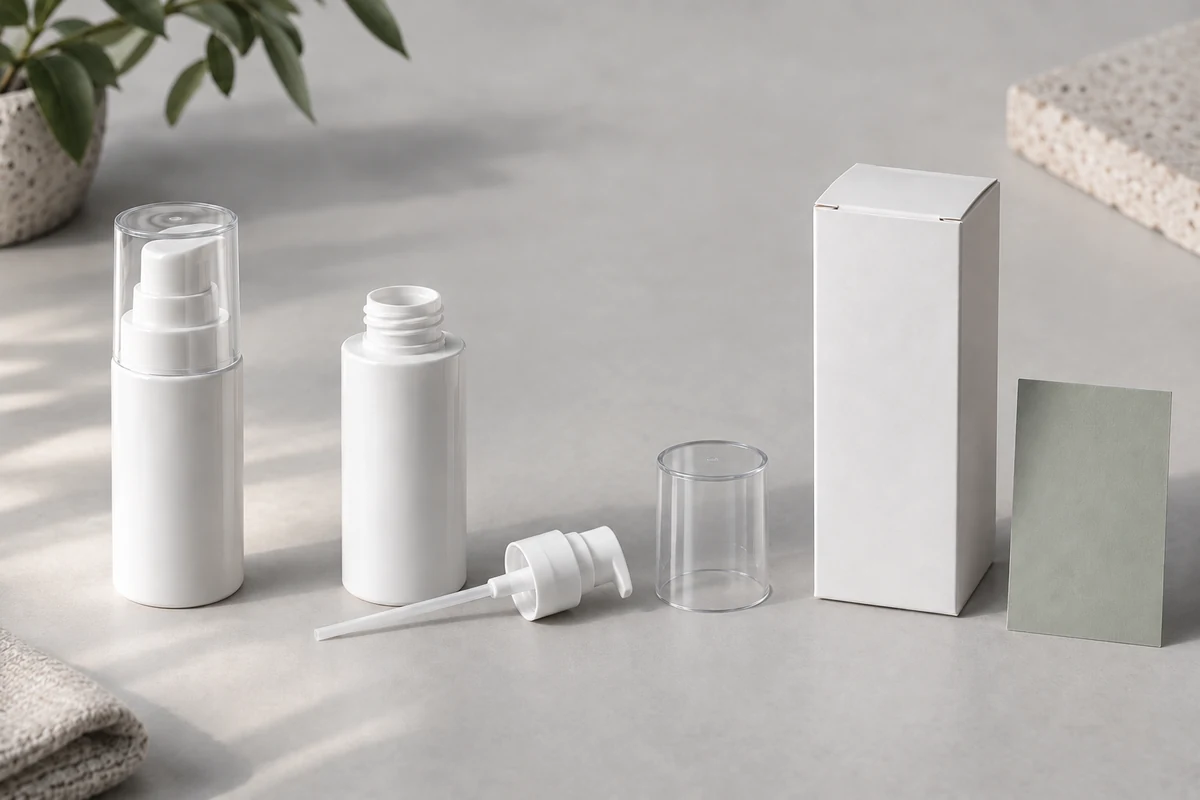
AI-generated editorial illustration of a packaging reference set; it does not establish component compatibility or sample approval.
Use Approval Gates Before Releasing Production and Shipment
The following gates are recommended purchasing controls. Agree their scope with the manufacturer and relevant specialists; they are not a regulator's mandatory testing sequence.
| Decision gate | Evidence to review | Buyer decision |
|---|---|---|
| Scope agreed | Product brief, destination, site and responsibility map | Is the proposed route suitable for this project? |
| Specification approved | Formula and pack revisions, samples, artwork, acceptance criteria | Which attributes are approved, and which remain open? |
| Production authorized | Required development evidence, approved materials and unresolved-change review | Can production start under the agreed conditions? |
| Batch released | Applicable batch records, test results, inspection findings and deviation decisions | Does this lot meet the agreed release criteria? |
| Shipment authorized | Released quantity, packing details, shipping documents and handover plan | Are product and transport requirements both satisfied? |
Match the evidence to the product risk
Discuss microbiological quality, preservation, stability, packaging compatibility and claim support as applicable to the product. FDA explains that safety substantiation requires adequate scientific evidence; it does not prescribe one identical test package for every cosmetic. A generic laboratory report should be checked for sample identity, methods, scope and relevance to your actual formula and pack. FDA: MoCRA safety substantiation
Final visual inspection answers different questions from safety or stability work. Sampling also cannot establish that every unit is defect-free. Agree defect definitions, inspection scope, escalation and disposition before production, so a failed result prompts an agreed decision rather than a dispute over standards.
Make Supplier Communication Traceable
Choose one accountable coordinator on each side, while identifying the people who can approve technical, artwork and commercial decisions. Use a shared decision log with the item, revision, owner, due date, evidence link and approval status. Confirm meeting decisions in writing.
Separate a question from an instruction. “Can the pump be changed?” is a feasibility request. Production should receive a clear approved instruction only after effects on compatibility, cost, stock and timing have been assessed.
Write change requests around consequences
For each proposed change, record the old and new component or formula revision, reason, affected orders, required reassessment and approval authority. Ask whether purchased materials become unusable and whether retained samples or artwork must be replaced.
A practical escalation message names the blocked decision and its consequence: the carton proof remains unapproved, printing cannot start, and the schedule needs revision unless approval is received by the agreed checkpoint. Avoid describing every delay simply as a supplier communication problem.
Use precise calendar dates and time zones for commitments. Where translated instructions are needed, verify critical technical terms and specify which approved version controls production. Chat can speed discussion, but the final specification should remain easy to identify outside a message history.

AI-generated editorial illustration of organized project records; the folders contain no real supplier documents.
Compare Costs, MOQ and Timing on the Same Scope
There is no verified universal price, MOQ or delivery range for the projects covered by this guide. Request a dated quotation for the exact formula, components, decoration, quantities and destination. Record the quote's validity and assumptions before using it in a launch budget.
Separate product charges from tooling, decoration setup, testing, documentation support, inspection and transport where applicable. Ask which costs are one-time, which recur and which are excluded. Compare total project exposure, including unused custom components, rather than treating the filled-unit price as the entire commitment.
MOQ can arise at different purchasing stages. Ask whether a component minimum exceeds the initial filling quantity, who owns the balance and how storage or future use is handled. Our cosmetic packaging MOQ guide explains the decisions to clarify when bottles, pumps, printing and cartons have different constraints.
Separate production readiness from arrival
Request a schedule that states dependencies: final specification approval, material availability, applicable testing, production, release, carrier handover and destination receipt. Distinguish an estimate from a committed milestone and identify what event starts the quoted lead time.
If artwork or a component changes, obtain the revised schedule before accepting the change. Do not convert “production complete” into an Amazon inventory-available date; transport, customs clearance, receiving and channel-specific preparation are separate activities whose timing needs its own confirmation.
Define Shipping Terms and Receiving Controls
Specify the chosen Incoterms rule, precise named place or port and version in the agreement. ICC explains that Incoterms allocate responsibilities, costs and risk, but do not settle specifications, payment terms, ownership transfer or most remedies for delay and breach. Those issues require separate contractual terms. ICC: Incoterms and Commercial Contracts
Confirm who arranges transport, insurance where applicable, customs documentation and destination handling. Ensure the batch identity, quantities and packing information align across product records and shipment documents. A commercial delivery term does not demonstrate that the physical packaging can withstand the chosen route.
Before dispatch, agree protective packing and any product-appropriate transport evaluation. At receipt, document damage, shortages and lot identities against the agreed receiving procedure. Escalate discrepancies promptly and keep affected stock identifiable while its disposition is decided. Payment, rejection, rework and replacement terms should be agreed before a problem occurs.
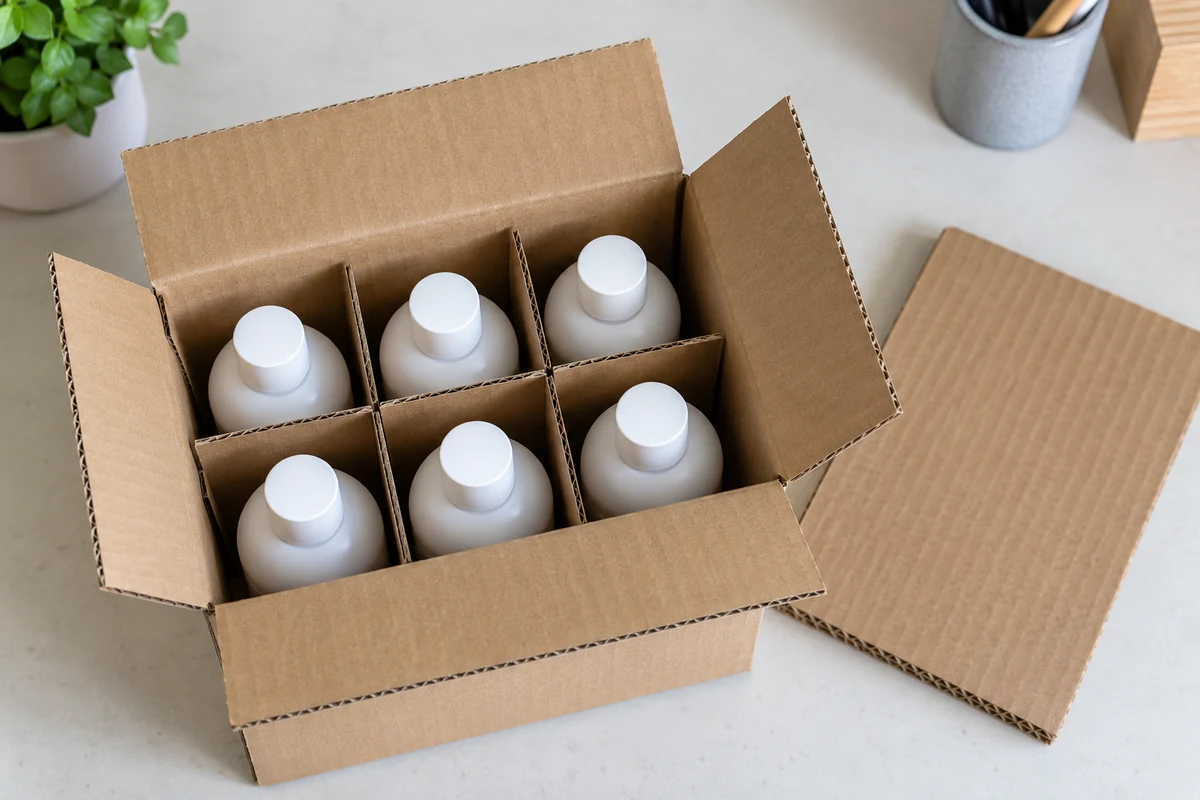
AI-generated editorial illustration of protective packing; this is not an actual INHI shipment or proof of transport-test performance.
Common Purchasing Mistakes
- Comparing unlike quotations. Different formula, pack, testing or shipping assumptions can make unit prices misleading. Normalize the scope first.
- Treating a sample as complete approval. Identify exactly which attributes are approved and which evidence remains outstanding.
- Accepting silent substitutions. Require documented review of changes affecting the formula, components, artwork or manufacturing assignment.
- Assuming paperwork transfers responsibility. Check the relevant product, market, legal role and underlying evidence.
- Leaving failed-batch decisions until shipment. Agree acceptance, escalation and remedies while both parties can still plan around them.
Frequently Asked Questions
How do I verify a China cosmetics manufacturer?
Confirm the contracting entity, actual manufacturing site and activities, then examine evidence relevant to your product. Check certification scope and investigate inconsistencies. Use a site assessment and product-specific approval process together; neither a website nor a sample alone establishes suitability.
Is FDA registration proof that a cosmetic is approved?
No. FDA states that cosmetic facility registration and product listing do not constitute approval. Evaluate applicable registration and listing obligations separately from safety, labeling and other product requirements. FDA: Registration and Listing
What should be approved before bulk production?
Approve the relevant specification, samples, component references, artwork and release requirements. Identify any development evidence that must be completed first. Record exceptions explicitly instead of allowing a general “sample approved” message to authorize an unfinished project.
How can I reduce communication problems?
Assign decision owners, keep one current specification and confirm changes in writing. Use dated checkpoints, clear technical terminology and a decision log that records consequences. This makes it easier to distinguish missing information, unresolved approvals and production problems.
How long does manufacturing and delivery take?
Obtain a project-specific schedule after the supplier reviews the formula, packaging, evidence needs and material availability. Separate production, release, handover and destination receipt. Use the agreed project schedule, rather than a generic lead time, for launch planning.
Build the Brief Before Requesting a Firm Commitment
A manageable sourcing project begins with clear definitions and ends with evidence-backed release decisions. Keep technical approvals, commercial commitments and transport responsibilities connected to the same order. For additional background, use the INHI cosmetics development insights hub.
Next step: Send INHI your product brief for a project-specific feasibility review. Include the intended product, destination markets, claims, packaging concept, target order quantity and desired launch date so the required decisions and open questions can be identified.
Sources and References
Primary sources checked October 15, 2026. Procurement controls and examples are editorial recommendations; they do not assert that INHI holds a particular certification or offers a universal MOQ, price, test package or delivery promise.
- FDA — Cosmetics Importers: imported-product safety, labeling and approval distinctions. Registration guidance is taken from the current MoCRA sources below.
- FDA — Modernization of Cosmetics Regulation Act of 2022: responsible-person safety-substantiation requirements.
- FDA — Registration and Listing of Cosmetic Product Facilities and Products: obligations, exemptions and nonapproval status.
- European Commission — Cosmetics Legislation: regulatory framework and amendment information.
- EUR-Lex — Regulation (EC) No 1223/2009, consolidated 18 May 2026: Articles 4, 10, 11 and 13. Consolidation is a documentation aid; authentic legal acts are published in the Official Journal.
- European Commission — Cosmetic Product Notification Portal: notification roles and scope.
- ISO — ISO 22716:2007: cosmetic GMP scope and exclusions.
- ICC — Incoterms and Commercial Contracts: allocation of obligations, costs and risks, and matters outside the rules.
Editorial transparency: This article was prepared with AI-assisted research and writing. Its original AI-generated images illustrate concepts and do not depict INHI facilities, personnel, products, customer projects or test results.