The cost to start a beauty brand is not one factory price. A lean one-product validation launch may require several thousand dollars, while a custom formula, custom packaging, extensive testing or multiple SKUs can move the budget into tens of thousands. The reliable answer is an itemized, landed-cost model built from current supplier quotes and target-market requirements.
Quick Answer: What Should a Beauty Product Budget Include?
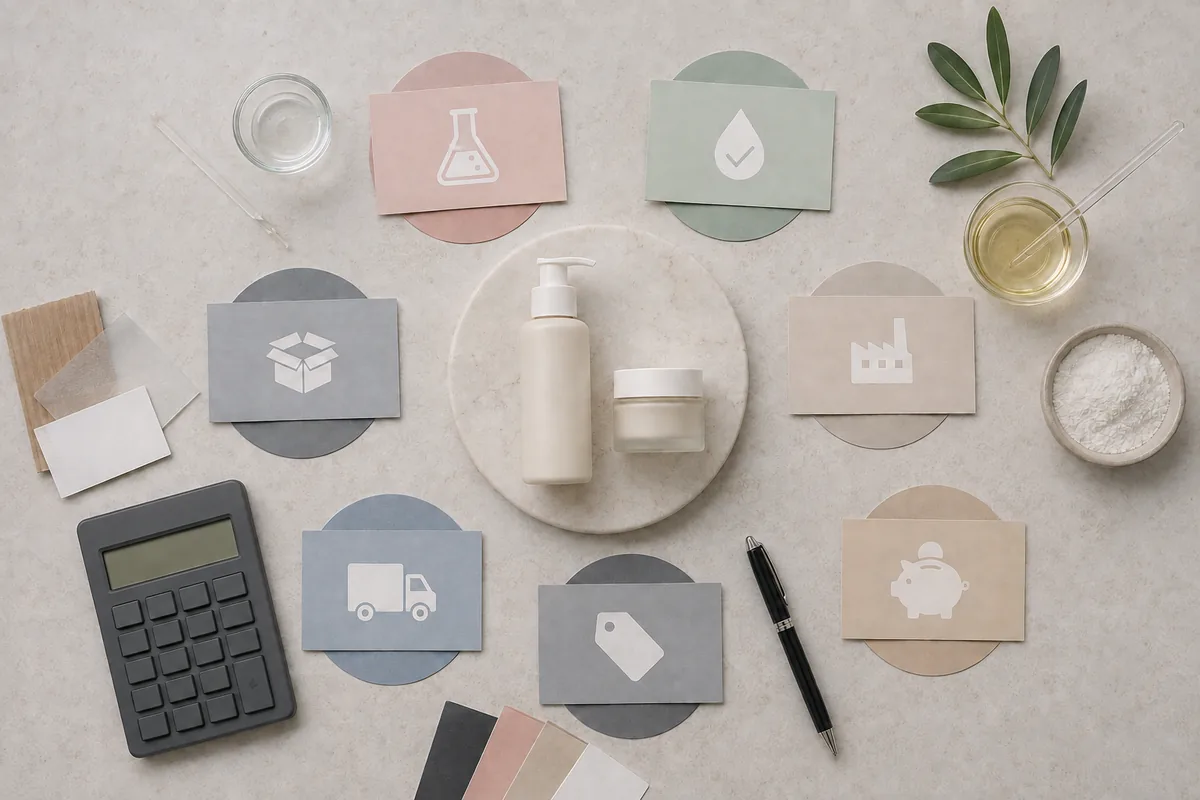
Budget for seven layers, not just finished units:
- Product development: brief, samples, formula work and approvals.
- Testing and market files: safety support, stability, compatibility, microbiology, claims work, labels and required notifications or listings.
- Packaging and artwork: primary pack, decoration, labels, cartons, design and pre-production proofs.
- Production inventory: bulk manufacture, filling, assembly, inspection and expected overrun.
- Freight and import: export packing, transport, insurance, duty, tax and destination handling.
- Brand and channel setup: trademark, barcodes, storefront, marketplace and product content.
- Working capital: launch marketing, returns, defects, storage and reorder cash.
The practical budgeting equation is:
Launch cash required = one-time development costs + first-order landed cost + channel setup + launch reserve + contingency.
Do not use a low unit price as a launch budget. A quote can exclude tooling, decoration, tests, freight, duty, marketplace fees and the cash needed for the next order.
A Decision Table for Beauty Brand Startup Costs
| Cost block | What it may include | Main cost driver | What to request before committing |
|---|---|---|---|
| Formula and samples | Ready formula, modified base or custom development; sample rounds; courier | Development route, number of revisions, ingredients and format | Sample policy, revision allowance, ownership and courier quote |
| Testing and compliance | Stability, compatibility, microbiology, preservative work, safety support, label review and market files | Product risk, claims, destination market and final pack | Written test plan, responsible party, laboratory, acceptance criteria and itemized fee |
| Primary packaging | Bottle, jar, tube, pump, cap, sachet or applicator | Stock versus custom component, material, mold and component MOQ | Component codes, samples, MOQ, tooling, compatibility plan and lead time |
| Decoration and secondary pack | Printing, labels, foil, coating, cartons, inserts and cases | Number of colors, process, artwork, setup and print MOQ | Proof process, setup charges, tolerance, wastage and final artwork responsibility |
| Production | Bulk, filling, assembly, coding, inspection and batch files | Formula batch size, fill quantity, labor, quantity and quality plan | Unit-price ladder, production MOQ, overrun terms and release documents |
| Logistics | Export carton, freight, insurance, customs, duty and local delivery | Incoterm, weight, volume, route and destination | Pack dimensions, gross weight, Incoterm and freight quote with exclusions |
| Brand and channel | Trademark, GTIN, website, Amazon plan, content and launch assets | Number of markets, classes, SKUs and channels | Current official fees plus vendor quotes for optional services |
| Working capital | Ads, promotions, storage, returns, defects and reorder deposit | Sell-through, payment terms and replenishment lead time | Cash-flow model and contingency policy |
Three Illustrative Beauty Launch Budgets
The examples below are calculation models, not INHI quotations, supplier averages or promises. Every dollar amount except the cited official fees is a hypothetical input chosen to show how scope changes cash needs.
| Planning model | Hypothetical scope | Example inputs | Illustrative total |
|---|---|---|---|
| Lean validation | One SKU, eligible ready formula, stock packaging, 100–300 units, limited launch content | Product and samples $1,500; testing/files $500; design $750; freight $500; one GS1 US GTIN $30; one USPTO class $350; launch reserve $1,000 | $4,630 |
| Retail-ready first run | One SKU, formula adjustments, decorated stock pack, 500–1,000 units, broader testing and content | Product $5,000; testing/files $2,000; packaging/artwork $2,000; freight/import $2,000; identifiers/trademark $380; reserve $3,000 | $14,380 |
| Custom product program | Custom formula and pack, 1,000+ units, tooling or multiple components, expanded test plan | Development/production $15,000; testing/files $5,000; packaging/tooling/design $5,000; freight/import $5,000; identifiers/trademark $380; reserve $8,000 | $38,380 |
These totals illustrate why “several thousand” and “tens of thousands” can both be reasonable planning answers. Replace every hypothetical line with a dated quotation, official fee or internally approved allowance before funding the launch.
As of September 7, 2026, GS1 US lists one GTIN at $30 with no annual renewal fee and a prefix for ten items at $250 initially plus $50 annually. The USPTO base electronic trademark application fee is $350 per class, with possible additional fees.
What Makes Manufacturing Cost Rise or Fall?
1. Ready formula versus custom formula
A ready-formula route usually reduces development work because the base already exists. A modified or fully custom formula adds briefing, bench work, sample rounds, raw-material review, specifications and potentially new testing. “Custom” is not a fixed price category; the cost depends on what is changed and what evidence the final product needs.
Before comparing routes, review the commercial differences among private label, OEM and ODM cosmetics. Ask who owns the formula, what changes are included and which files transfer if you change suppliers.
2. Packaging architecture
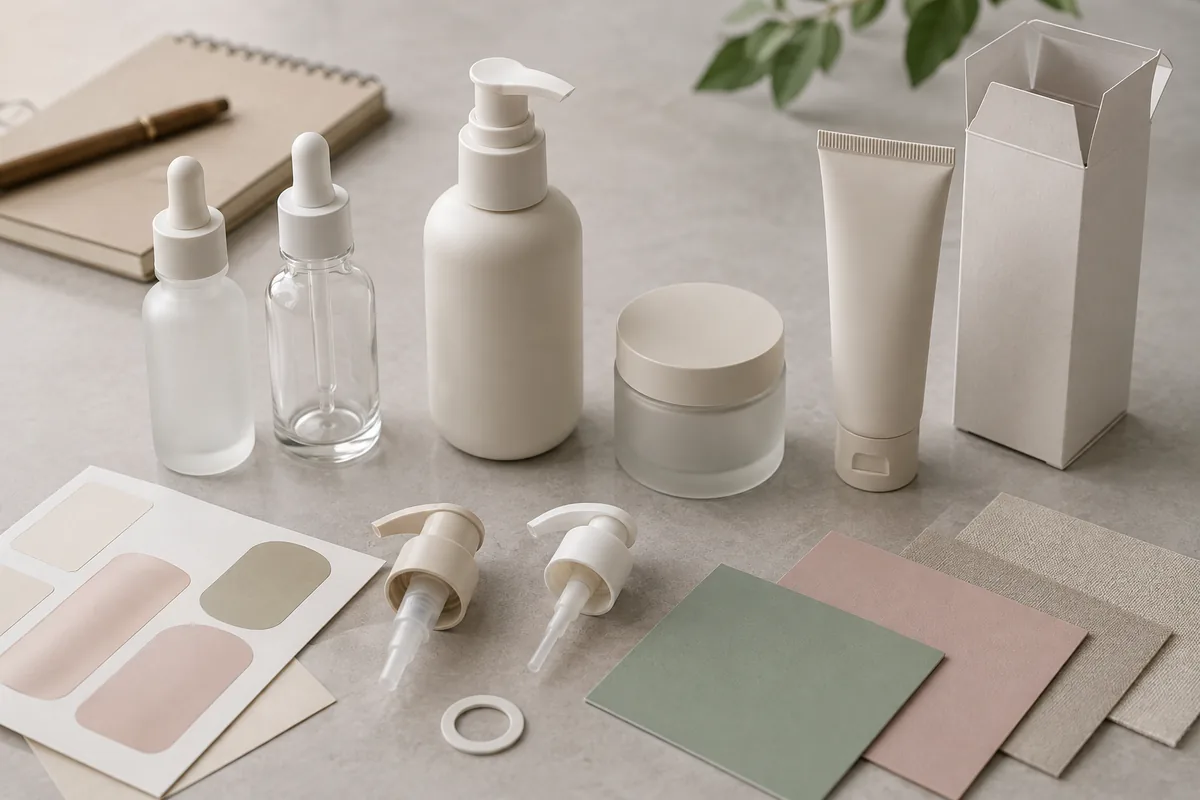
Stock bottles with labels usually require less setup than custom colors, direct printing, specialty coatings, molded components or multi-piece applicators. The cheapest-looking component can become expensive if it leaks, dispenses poorly, reacts with the formula or forces a higher decoration MOQ.
Budget packaging as a system: container, closure, gasket, liner, pump or sprayer, decoration, carton, shipper and compatibility work. Approve component codes and a packed sample, not a reference photo.
3. Quantity and component minimums
Formula manufacture, filling, bottles, pumps, labels and cartons may each have different minimums. A supplier may fill 100 units while a printed component vendor requires far more pieces. Leftover packaging ties up cash and may become obsolete if artwork changes.
INHI’s public development solutions state that eligible ready-formula, custom-formula and selected custom-packaging projects can start from 100 units, subject to feasibility, materials and process availability. This is not a universal MOQ for every component or decoration method. Obtain the exact project quotation before treating 100 units as the total purchasing commitment.
4. Destination market and product classification
Market requirements change the budget. In the United States, most cosmetics and ingredients do not receive FDA premarket approval, except color additives; that does not remove the brand’s safety, labeling and MoCRA responsibilities. FDA says the responsible person must ensure and maintain records supporting adequate safety substantiation.
In the European Union, CPNP notification itself is free, but a product still needs an EU responsible person, a Cosmetic Product Safety Report and Product Information File, compliant labeling and other work under Regulation (EC) No 1223/2009. “Free notification” therefore does not mean “free compliance.”
Claims can also change classification. U.S. claims to treat disease or affect body structure or function may cause a product to be regulated as a drug. Confirm classification before paying for packaging or claim-specific content.
5. Testing and evidence
There is no single universal test bundle for every cosmetic. The formula, preservative system, packaging, use pattern, claims and market determine what is appropriate. Define the protocol, sample stage, laboratory, acceptance criteria and payer before production.
Do not reuse a report from a different formula or package without a documented scientific basis. Failed compatibility or stability work can force reformulation, packaging replacement and artwork changes.
6. Freight, duty and Incoterm
EXW, FOB, CIF and DDP prices allocate responsibilities differently. Compare quotations only after normalizing the same destination, shipment mode, insurance, customs, duty, tax and local delivery assumptions. Obtain packed carton dimensions and gross weights early, because freight depends on the actual shipment rather than the cosmetic’s fill weight alone.
The Manufacturer’s View: How to Get an Accurate Quote
A manufacturer cannot price “a premium serum” accurately. A quote-ready brief should specify:
- product format and benchmark;
- target market and sales channel;
- intended claims and prohibited claims;
- ready-formula, modified or custom route;
- fill quantity and first-order quantity;
- packaging format, material and decoration;
- required tests and documents;
- target launch date and approval deadline;
- delivery destination and Incoterm; and
- target retail price or landed-cost ceiling.
Use INHI’s planning insights hub to organize these inputs. INHI publicly states that qualified inquiries receive an initial response and quotation within 24 hours, eligible samples can typically be prepared within seven days after the brief is confirmed, samples are free and international courier is paid by the client. Final feasibility, cost, MOQ and production timing remain project-specific.
Convert the Quote Into a Landed Unit Cost
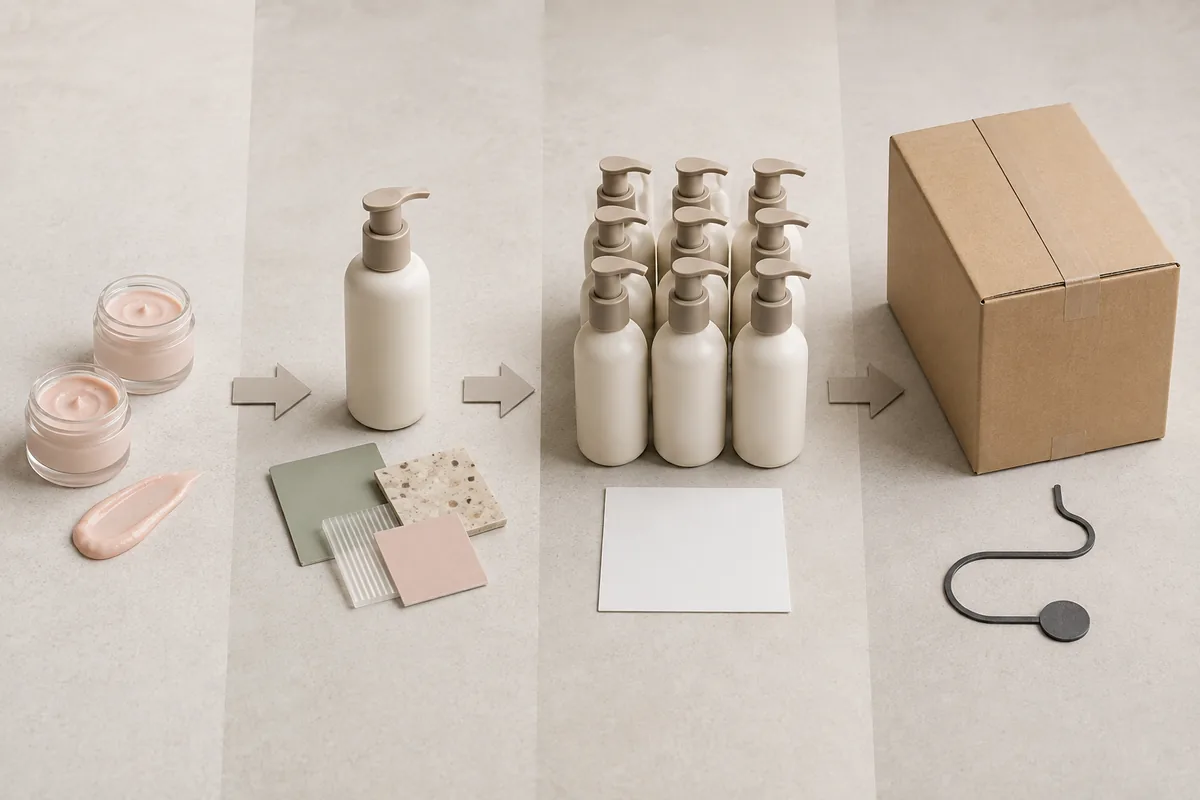
The useful number for pricing is not the factory unit price. Calculate:
Landed unit cost = (finished goods + packaging setup + testing + inspection + freight + insurance + duty + destination charges) ÷ saleable units.
Then model channel economics. Amazon currently lists a Professional selling plan at $39.99 per month. For Beauty, Health and Personal Care, the referral fee is 8% for products priced at $10 or less and 15% above $10, with a $0.30 minimum. FBA, storage, advertising, returns and optional services can add further costs, so use Amazon’s current revenue calculator for the exact size, weight, price and fulfillment route.
For a DTC store, include payment processing, pick-and-pack, shipping subsidy, returns and customer service. Keep these selling costs separate from product cost so channel changes do not distort supplier comparisons.
The U.S. Small Business Administration expresses break-even units as:
Fixed costs ÷ (selling price per unit − variable cost per unit).
Run this calculation before approving the order. If the contribution margin cannot repay development, launch and overhead costs at a plausible sales volume, revise the product, channel or price before adding inventory.
Timeline: When Does the Cash Leave the Business?
| Stage | Typical cash commitment | Release gate |
|---|---|---|
| Brief and feasibility | Sample courier, paid development if applicable | Written scope and sample plan |
| Formula and pack approval | Revisions, testing deposits, artwork and component samples | Approved formula, pack and test protocol |
| Purchase order | Production deposit, packaging and tooling commitments | Signed specifications, quote, schedule and remedies |
| Production and release | Balance payment, inspection and final documents | Batch evidence and agreed acceptance checks |
| Shipment | Freight, insurance, duty, tax and destination charges | Shipping documents and delivery plan |
| Launch and reorder | Channel fees, promotion, storage and next deposit | Sell-through and cash-flow trigger |
Do not spend the entire budget on the first order. A reorder deposit may be due before the first batch has fully sold.
Common Budgeting Mistakes and Procurement Risks
Treating MOQ as total commitment
Separate minimums for bulk, fill, components, decoration and cartons. Ask who owns and stores excess materials.
Comparing different quote scopes
One supplier may include filling and cartons while another excludes testing, tooling and freight. Normalize each quote line by line.
Designing packaging before confirming compatibility
Artwork and decoration costs can be lost if the formula requires a different pump, liner or barrier material.
Assuming registration equals approval
FDA facility registration and cosmetic product listing are not product approvals or certifications. Do not pay for an “FDA certificate” presented as evidence that a cosmetic is approved.
Underfunding compliance and claims review
Product classification, color additives, warnings, ingredient labeling and claim support should be reviewed before printing.
Forgetting defects, returns and delays
Set a contingency tied to project risk rather than a universal percentage. Custom packs, novel formulas, untested lanes and aggressive deadlines justify more reserve.
Launching too many SKUs
Each shade, scent, size or bundle can add inventory, artwork, GTIN, testing or forecasting complexity. One well-defined hero product often gives cleaner learning than a broad first range.
Frequently Asked Questions
Can I start a beauty brand with $5,000?
It may be possible for a tightly scoped one-SKU validation project using an eligible ready formula, stock packaging and a small first order. The illustrative model above totals $4,630, but it is not a quote. Replace every assumption with current project prices and preserve cash for freight, selling costs and reorders.
What is the biggest cost when launching a cosmetic product?
It depends on scope. Inventory often dominates a simple private-label project, while formula development, testing, tooling or custom packaging can dominate a differentiated program. Build the budget by cost block rather than assuming one universal largest item.
Does FDA charge to approve a cosmetic?
Most cosmetics and ingredients are not subject to FDA premarket approval, except color additives. That means there is generally no cosmetic “approval fee,” but applicable businesses still have safety, labeling, registration, listing, adverse-event and recordkeeping responsibilities under U.S. law.
Should I spend more on formula or packaging?
Spend according to the product’s commercial promise and failure risk. A formula-led serum may justify more development and testing; an applicator-led product may depend on component performance. Neither investment is useful if the formula and package are incompatible.
How much cash should I keep for reorders?
Base the reserve on your supplier’s payment milestones, component lead time, freight time and expected sell-through. Model when the next deposit is due, not only when the first order becomes profitable.
Conclusion: Budget the Whole Launch, Then Ask for a Quote
The cost to start a beauty brand is the cash required to move an approved product through testing, packaging, production, delivery and a viable sales channel—not simply MOQ multiplied by a factory unit price. Start with one SKU, define the destination market, normalize quotes to the same scope and keep reorder cash visible.
If you can share the product category, target market, quantity, packaging direction and launch date, send INHI a single project brief for an itemized route and initial quotation. Final price, MOQ, tests, documents and timing are confirmed against the specific project.
Sources and References
- U.S. Food and Drug Administration, Modernization of Cosmetics Regulation Act of 2022 (MoCRA)
- U.S. Food and Drug Administration, Does FDA approve cosmetics before they go on the market?
- U.S. Food and Drug Administration, Summary of Cosmetics Labeling Requirements
- European Commission, Cosmetic Product Notification Portal
- U.S. Patent and Trademark Office, How much does it cost?
- GS1 US, UPC, Barcodes & Prefixes
- Amazon, Selling plans and referral fees
- U.S. Small Business Administration, Break-even point calculator
- Google Search Central, Creating helpful, reliable, people-first content
- INHI Cosmetics, Solutions, Insights and Start a Project
Last updated: September 7, 2026.