A qualified peel off mask manufacturer develops a spreadable cosmetic gel that dries into a continuous, removable film inside a compatible package. A launch-ready product needs more than a fast-drying sample: the formula, application thickness, drying method, peel behavior, microbiological control, packaging, directions and claims must work as one documented system.
Last updated: September 23, 2026.
Quick Answer: What Should a Brand Specify to a Peel-Off Mask Manufacturer?
A useful peel-off mask brief specifies the target market, intended cosmetic use, application area, film appearance, spreadability, application amount, drying-time test method, peel pattern, residue, fragrance and color direction, pack type, fill quantity, claims boundary, quantity breaks and required documents. The manufacturer should then connect those targets to a controlled formula, defined test methods, final-package compatibility, safety substantiation and a batch-release plan.
There is no universal “correct” drying time or polymer percentage. Published formulation studies show that film-former level, solvent composition and rheology can change application and drying behavior, but their laboratory formulas are not universal commercial specifications. A brand should approve measured performance for its own formula, dose, package, use directions and market.
INHI publicly includes peel-off concepts within its custom face-mask development scope. This guide is a procurement and product-development framework, not a formula recipe or a claim-substantiation report.
Peel-Off Mask Development Decision Table
| Decision | What the buyer should define | What the manufacturer should demonstrate | Common sourcing risk |
|---|---|---|---|
| Product position | Cosmetic purpose, application area and market | Formula and directions match intended use | Therapeutic language appears later |
| Film system | Appearance, flexibility and peel target | Continuous film at approved dose | A thin showroom swatch passes but normal use fails |
| Drying endpoint | Surface, dose, temperature, humidity and endpoint | Repeatable results under one method | A stopwatch number lacks conditions |
| Sensory profile | Spread, drip, odor, tightness and residue | Recorded observations and limits | Speed is favored over comfort or stability |
| Package | Format, fill, closure and decoration | Final-pack dispensing, leakage and compatibility | Selection is based on appearance alone |
| Quality and safety | Stability, microbiology and market evidence | Test plan, specification and release status | A certificate is mistaken for product approval |
| Commercial route | Ready, modified or custom formula | Assumptions, exclusions, quantity breaks and gates | Headline MOQ hides component minimums |
What Is a Peel-Off Mask?
A peel-off mask is a topical cosmetic system applied as a wet layer and removed after it forms a coherent film. Unlike a sheet mask, the film is created on the user’s skin; unlike a rinse-off clay or cream mask, normal removal depends on film formation and peel behavior.
The wet product must dispense and spread without excessive dripping. The applied layer must dry at a practical rate, while the film must lift without crumbling, excessive tearing or residue. Stability and microbiological control must also hold through shelf life and normal use.
Formula Architecture: Build a Film System, Not an Ingredient Story
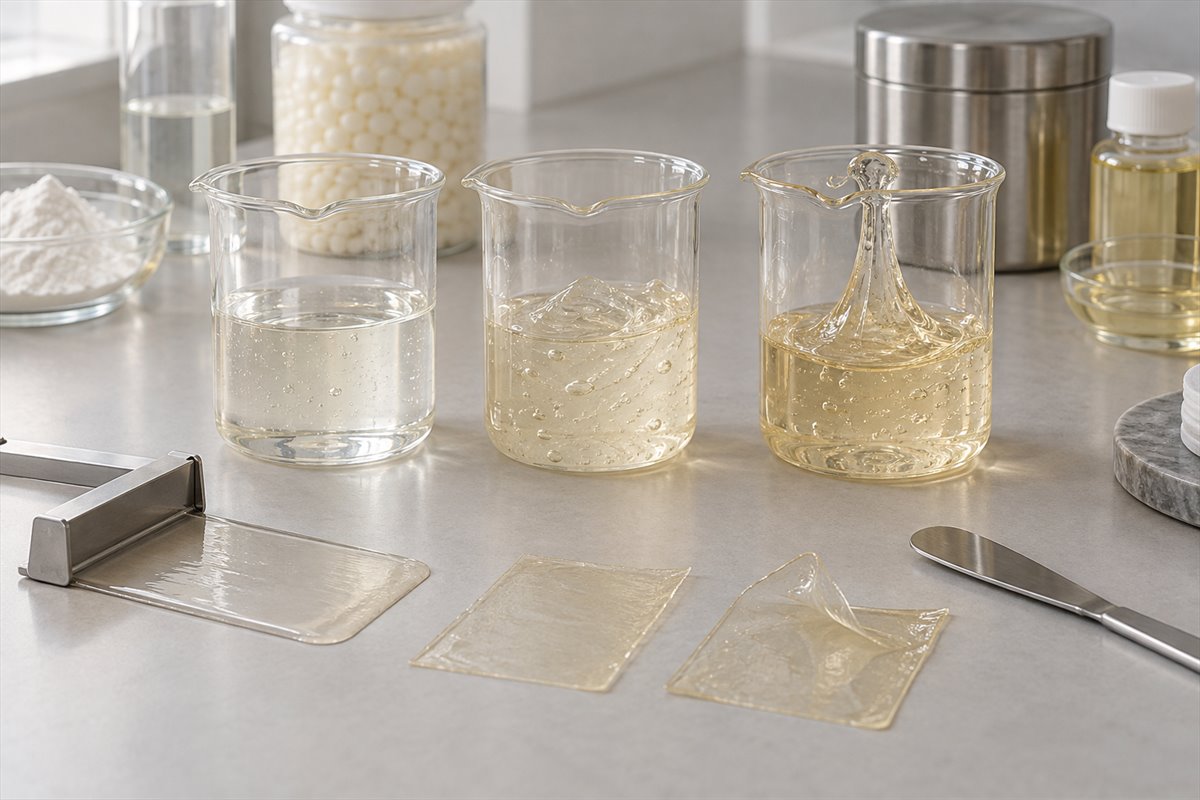
AI-generated educational illustration of generic formula development; not an INHI formulation, laboratory, employee or approved test.
Film former and liquid phase
The film former creates the removable layer after the liquid phase evaporates. Polyvinyl alcohol is used in published research, but polymer name alone is not a specification. Grade, level, hydration process and formula interactions affect viscosity, strength, flexibility and removal.
The liquid phase affects processing, spread and drying. Changing volatile content may also change odor, flammability controls, packaging loss and user tolerance. Ingredient levels require safety, regulatory and manufacturing review for the intended markets.
Rheology, humectancy and flexibility
Rheology controls dispensing, leveling and sag. A thin gel may drip; a thick one may resist pumping or spread unevenly. In published formulas, PVA and carbomer levels affected applicability through viscosity.
Humectants and other nonvolatile materials also affect the dry film. Excess retained moisture may delay drying or leave tack; insufficient flexibility may create a brittle film. These are trade-offs, not reasons to maximize one ingredient.
Color, fragrance and highlighted ingredients
Color, fragrance and highlighted ingredients can change stability, claims, drying or film integrity. Approve the complete formula version; a decorative change is not automatically risk-free.
Drying Time: Define the Test Before Comparing Numbers
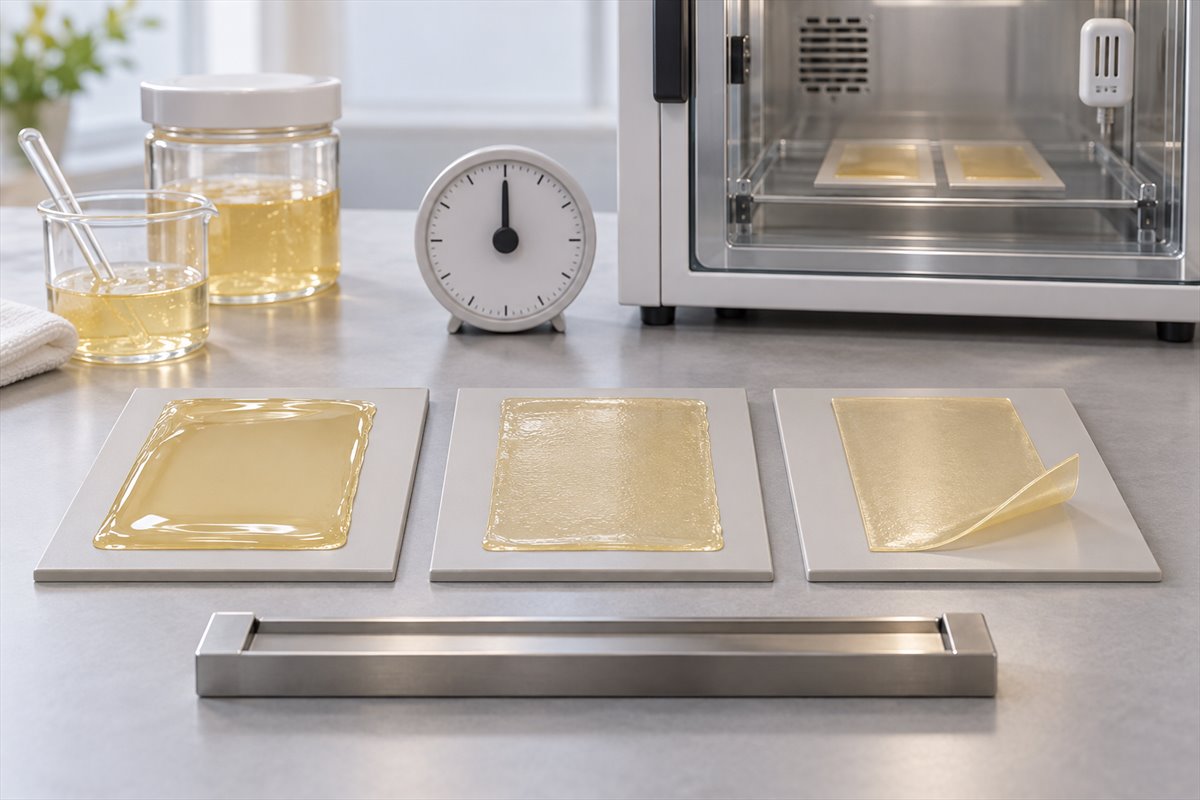
AI-generated scientific editorial illustration of a generic drying-time method; not an INHI protocol, facility or test result.
Drying time is the interval between a defined application and a defined film endpoint under stated conditions. Without those conditions, a number is not comparable. At minimum, record:
- The formula version and batch or sample code.
- The application surface and preparation.
- The wet amount, area or controlled layer thickness.
- Temperature, relative humidity and relevant airflow.
- The start point and the endpoint definition.
- Whether the film is only touch-dry or also removable as one coherent layer.
- Replicate results and any deviations.
Consumer use adds variation: a thick layer or humid bathroom may differ from a laboratory drawdown. Directions should state an application amount and removal cue instead of an unsupported universal minute claim.
Diagnose the failure mode, not just the stopwatch
| Observation | Possible contributors to investigate | Evidence to request before changing the formula |
|---|---|---|
| Dries unevenly | Variable application thickness, poor leveling, localized airflow | Wet-film uniformity, environmental record and repeat test |
| Remains tacky | Endpoint too early, nonvolatile balance, thick dose, high humidity | Mass-loss or endpoint data and controlled-condition comparison |
| Cracks or crumbles | Brittle film, layer too thin, insufficient flexibility | Film integrity and removal observations at defined doses |
| Tears into many pieces | Low cohesion, uneven layer or formulation interaction | Replicate peel results and retained sample comparison |
| Leaves heavy residue | Incomplete drying, poor film continuity or incompatible emollient/solid balance | Surface assessment using the approved removal method |
| Drying varies after storage | Volatile loss, package interaction, viscosity or formula instability | Stability trend, package weight loss and dispensing data |
A 2013 study found that alcohol affected drying time in its formulas, while PVA and carbomer affected applicability. A 2024 study also evaluated PVA and solvent levels. Both support formula-specific testing, not a universal target.
Stability, Microbiology and Safety Substantiation
A peel-off mask is often water-containing and repeatedly opened. Preservation, water quality, sanitation, packaging and use pattern should be assessed together. FDA says cosmetics need not be sterile, but they must not contain harmful microorganisms; it does not prescribe one test list for every cosmetic.
The plan may include stability, microbiological quality, preservative-performance work, package compatibility and safety substantiation. Methods and limits depend on formula, pack, exposure and market. A generic certificate does not replace product-specific evidence.
Potential use around hairlines, eyebrows, facial hair or sensitive areas should be addressed through directions, warnings and safety review. Do not convert a cosmetic positioning brief into a medical, wound-care, acne-treatment or skin-structure claim without qualified regulatory assessment.
Packaging: Protect Volatiles and Dispense a Viscous Gel
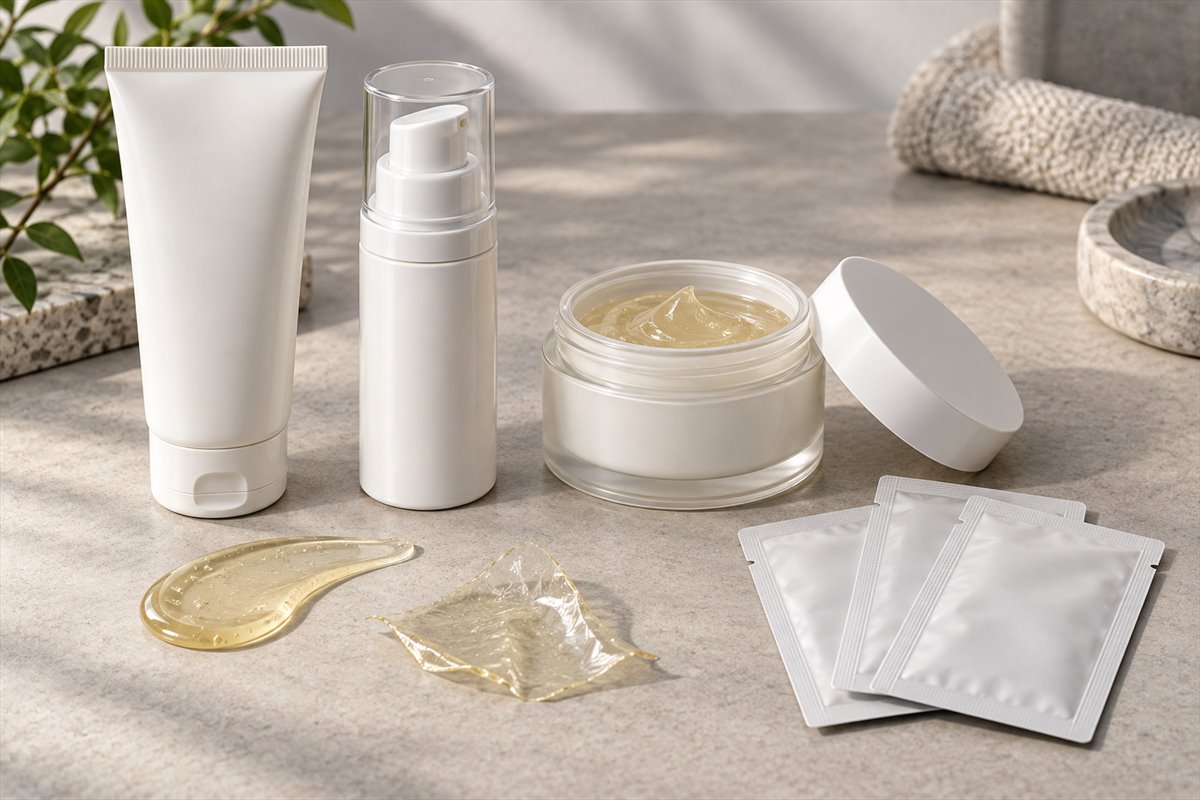
AI-generated product-development illustration; not approved INHI packaging, a customer SKU or a packaging-compatibility result.
Tube
A tube can suit viscous gel. Evaluate material, shoulder and cap compatibility, decoration, leakage, dispensing force and drying around the orifice.
Pump or airless package
A pump can control dose and reduce finger contact, but the formula must prime and dispense across the intended temperature range. Viscosity, stringing, air pockets, actuator drying or seal incompatibility can cause failure. “Airless” does not eliminate compatibility or preservation work.
Jar
A jar gives easy access to thick product but increases open surface and consumer contact. Review preservation, rim drying, liner interaction and closure sealing.
Single-use sachet
A sachet controls one application, but fill, tear performance, barrier, seal, decoration and carton create their own minimums and tests.
Run compatibility with the final formula, intended fill, decorated component and closure—not an unprinted look-alike. Check appearance, odor, viscosity, dispensing, leakage, weight change, component deformation and other risk-based attributes across the approved program.
Peel-Off Mask Manufacturing Process and Release Gates
- Approve the brief. Define market, use, claims, directions, pack and commercial targets.
- Select a development route. Compare ready, modified-base and custom options by evidence gaps.
- Develop the film system. Record materials, process, rheology, drying method and peel observations.
- Choose the package with the formula. Assess dispensing and barrier needs before artwork.
- Approve the final-system sample. Freeze formula, application method, pack and acceptance observations.
- Run safety, stability and compatibility work. Resolve failures through controlled changes.
- Scale up under a batch record. Control order, temperature, mixing, hold time, yield and sanitation.
- Fill, close, code and inspect. Control fill, closure, leakage, coding and line clearance.
- Review finished-product evidence. Release only when records and results meet specification.
- Retain samples and control changes. Trace formula, component and artwork revisions.
ISO 22716:2007 remains current as GMP guidance for cosmetic production, control, storage and shipment. Confirm how the actual site applies it; a quotation reference is not audit evidence.
MOQ, Cost and Timeline: Ask Which Constraint Binds
The binding minimum may come from the formula batch, a film-former or highlighted raw material, the primary package, custom color, printed decoration, label or carton. A low finished-unit headline does not prove every component can be customized at that quantity.
Cost may include development, samples, materials, testing, compatibility, decoration setup, filling, secondary packaging, inspection, freight and surplus components. Compare the same specification and landed saleable unit, with one-time charges and exclusions separated.
INHI’s current public project pages state that eligible ready-formula, custom-formula and packaging projects can start from 100 units, eligible samples can be prepared within seven days after the brief is confirmed, and an initial scope and quotation are provided within 24 hours. These are qualified entry and response statements, not guarantees that every custom peel-off formula, package, decoration, test program or commercial batch fits those figures.
For the broader sequence, read the face-mask production workflow. For landed-cost logic, use the sheet-mask manufacturing cost guide, while accounting for a different filling system.
Claims, Labeling and Market Responsibilities
In the United States, cosmetic labeling must be truthful and not misleading. Disease-treatment or body structure/function claims can make the product a drug. Do not assume that “detox,” acne-treatment, collagen-regeneration, anti-inflammatory or lifting language is acceptable because it is common online.
U.S. labels need required identity, net contents, business, ingredient and other applicable information. Under MoCRA, required facilities renew registration biennially, while responsible persons update product listings annually. Registration or listing is not FDA approval.
For the EU, Regulation (EC) No 1223/2009, consolidated through May 18, 2026, addresses GMP, the safety report, Product Information File, responsible person, notification and claims evidence. Assign ownership before printing.
Common Procurement Mistakes
- Requesting a minute target without defining thickness, environment or endpoint.
- Optimizing for speed while ignoring spreadability, comfort and removal.
- Approving a beaker sample before the final package is tested.
- Treating highlighted ingredients as proof of finished-product efficacy.
- Copying competitor claims without market-specific legal and evidence review.
- Treating a COA, SDS, ISO reference, FDA registration or listing as approval.
- Printing packaging before formula, INCI, warnings, directions, fill and claims are frozen.
- Comparing prices built on different formula, pack, testing and freight assumptions.
- Booking launch without time for samples, testing, components, release and freight.
Frequently Asked Questions
What is the best peel-off mask drying time?
There is no universal best time. Define formula, layer thickness, surface, temperature, humidity, airflow and endpoint, then confirm repeatability. Faster is not better if the film becomes brittle, uncomfortable or inconsistent.
Which ingredient makes a peel-off mask form a film?
A film-forming polymer creates the removable layer. PVA appears in published research, but grade, level, processing and formula interactions determine performance. Do not copy a research percentage into a commercial formula.
Should a peel-off mask use a tube, pump, jar or sachet?
Choose after final-formula testing. Tubes often suit viscous gels; pumps can struggle with viscosity or actuator drying; jars increase exposure; sachets add laminate and seal decisions.
What tests does a peel-off mask need?
The plan depends on formula, package, use, claims, exposure and market. It may include stability, microbiology, preservative performance, compatibility, safety substantiation and claim evidence. FDA has no universal cosmetic test list.
Can a peel-off mask claim to treat acne or remove toxins?
Do not assume so. In the United States, disease-treatment or body structure/function claims can make a product a drug, while cosmetic claims must be truthful and not misleading. “Detox” also needs a clear, supportable meaning. Obtain market-specific regulatory review before using such language.
What should a peel-off mask RFQ include?
Include market, intended use, claims direction, benchmark, film and sensory targets, drying test method, pack, fill, quantity breaks, decoration, testing, documents, delivery destination and required Incoterm. Ask the supplier to list assumptions and exclusions separately.
Conclusion: Request a Formula–Drying–Package Development Plan
A dependable peel-off mask is a controlled formula–application–drying–removal–package system. The most useful supplier response is not one drying-time claim; it is a gated plan showing what will be formulated, measured, approved, tested, packaged and released.
Send one controlled brief through INHI’s Start a Project page and request a recommended formula route, drying-time method, package shortlist, test plan, quantity breaks and commercial exclusions. That is the single next step toward a quotation-ready peel-off mask project.
Sources and References
- INHI Cosmetics, Products — public custom face-mask scope, development routes and qualified entry statements. Accessed September 23, 2026.
- INHI Cosmetics, Golden Dual-Defense Collagen Peel-Off Mask — verified live peel-off product-concept page; referenced only to confirm the product format and project route, not its efficacy claims. Accessed September 23, 2026.
- INHI Cosmetics, News & Insights — verified content hub and related published articles. Accessed September 23, 2026.
- INHI Cosmetics, Start a Project — public eligible MOQ, sampling and initial-response statements. Accessed September 23, 2026.
- U.S. Food and Drug Administration, Product Testing of Cosmetics — safety responsibility, microbiological position and product-specific testing. Accessed September 23, 2026.
- U.S. Food and Drug Administration, Microbiological Safety and Cosmetics — contamination risks and microbiological responsibility. Accessed September 23, 2026.
- U.S. Food and Drug Administration, Cosmetics Labeling Claims — truthful claims and the cosmetic–drug boundary. Accessed September 23, 2026.
- U.S. Food and Drug Administration, Summary of Cosmetics Labeling Requirements — current U.S. label requirements. Accessed September 23, 2026.
- U.S. Food and Drug Administration, Registration & Listing of Cosmetic Product Facilities and Products — current MoCRA registration, listing and non-approval statements. Accessed September 23, 2026.
- European Union, Regulation (EC) No 1223/2009, consolidated text of 18 May 2026 — GMP, safety report, PIF, notification and claims evidence requirements. Accessed September 23, 2026.
- International Organization for Standardization, ISO 22716:2007 Cosmetics — Good Manufacturing Practices — current guidelines for production, control, storage and shipment. Accessed September 23, 2026.
- Vieira et al., Green Clay and Aloe Vera Peel-Off Facial Masks: Response Surface Methodology Applied to the Formulation Design, AAPS PharmSciTech 2013 — experimental evidence that tested polymer, carbomer and alcohol levels affected applicability and drying behavior. Accessed September 23, 2026.
- Nemati et al., Formulation and Evaluation of Antioxidant and Antibacterial Activity of a Peel-Off Facial Mask Moisturizer, Journal of Cosmetic Dermatology 2024 — formula-specific drying-time and film evaluation. Accessed September 23, 2026.
- Google Search Central, Creating Helpful, Reliable, People-First Content — original, useful and well-sourced content guidance. Accessed September 23, 2026.