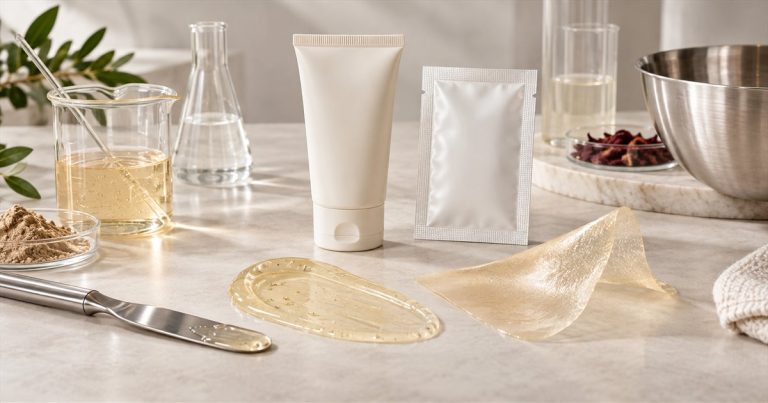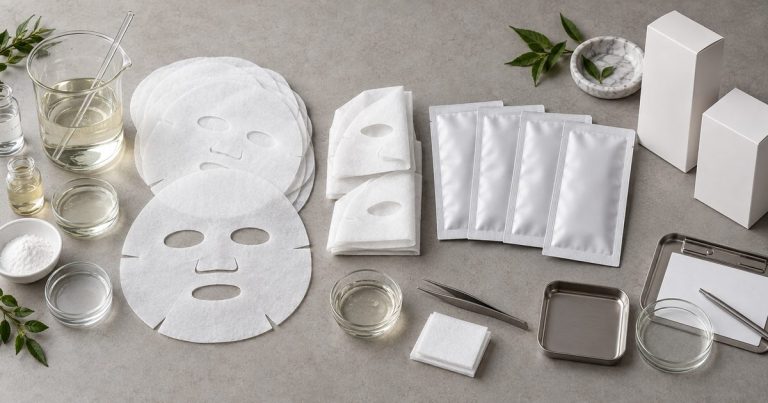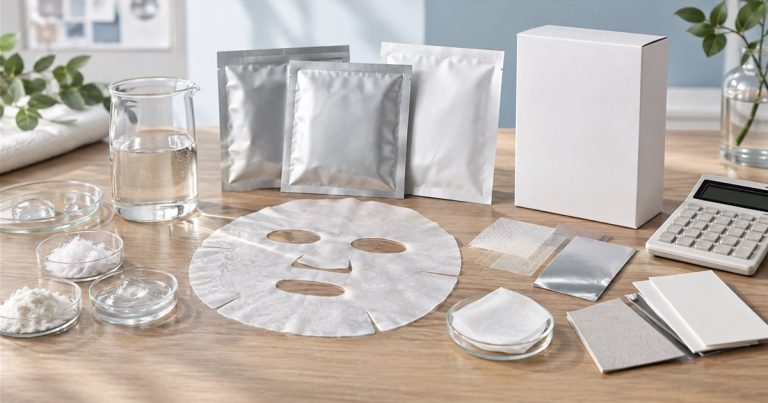
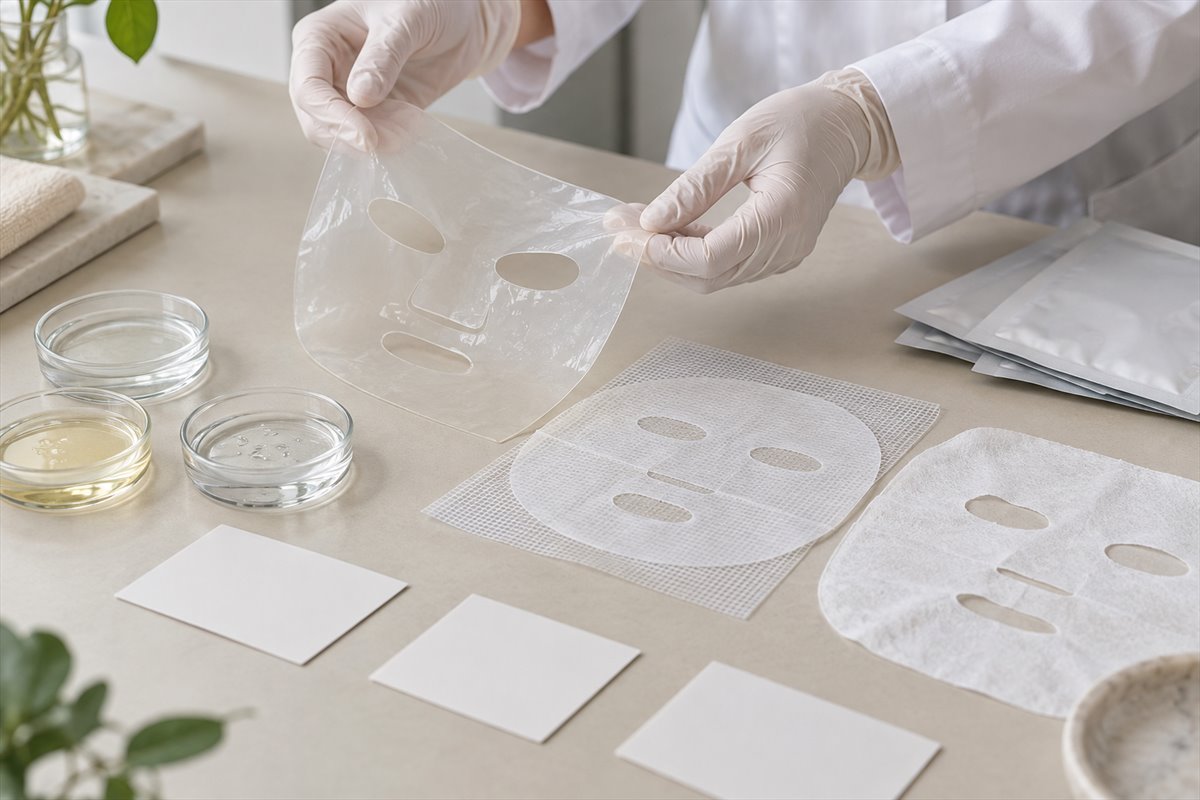
Hydrogel, bio-cellulose and nonwoven masks are different product systems, not interchangeable sheet upgrades. Hydrogel suits a cooling, gel-led experience; bio-cellulose supports a thin, close-fitting wet membrane; and nonwoven offers broad material and cost flexibility. The right choice depends on formula compatibility, handling, packaging, evidence, quantity and target price—not a universal material ranking.
Last updated: September 20, 2026.
Quick Answer: Which Facial Mask Format Should a Brand Choose?
Choose the format that delivers the intended consumer experience within a controllable manufacturing system. A hydrogel mask can create a distinctive cooling, translucent format but may need dedicated forming, carriers and careful handling. Bio-cellulose can provide close skin contact and high wet strength, while nonwoven substrates offer the widest range of fibers, weights and sourcing routes. Sample every candidate with the actual serum, die line, fill, sachet and labeled use time.
INHI publicly lists sheet and hydrogel face-mask concepts within its custom face-mask product scope. That confirms a category direction, not that every material, claim, package or quantity is feasible. A useful brief asks the manufacturer to recommend one complete formula–substrate–package route and to disclose the minimum attached to each component.
Decision Table: Hydrogel vs Bio-Cellulose vs Nonwoven
| Decision factor | Hydrogel | Bio-cellulose | Nonwoven |
|---|---|---|---|
| Basic structure | Water-rich polymer gel formed as the mask | Bacterial-cellulose membrane, usually supplied wet and often handled with carriers | Fiber web made without weaving or knitting; composition and construction vary |
| Typical experience | Cooling, smooth, translucent and visually distinctive | Thin, wet, close-fitting and conformable | Soft to structured, depending on fiber, weight, bonding and finish |
| Development focus | Gel composition, tear strength, shrinkage, mold/die, carriers and package | Membrane identity, thickness, wet handling, carriers, serum loading and package | Fiber composition, basis weight, wet strength, absorption, stretch and die line |
| Handling risk | Tearing, deformation, slipping or drying at edges | Folding onto itself, carrier removal, membrane variability or difficult unfolding | Wrinkling, uneven saturation, weak wet strength or poor facial fit |
| Cost/MOQ tendency | Can add process, tooling or dedicated material constraints | Can be supplier- and membrane-batch dependent | Often offers more stock-material routes, but custom fibers or shapes still add minimums |
| Best fit when | The gel format is central to positioning and the system has been validated | Close contact and a premium wet membrane support the brief | The brand needs flexible specifications, broad sourcing options or a controlled first run |
These are screening tendencies, not quotations or guarantees. Base the final choice on supplier specifications and samples made with the same formula and evaluation method.
What Each Mask Material Actually Is
Material names are only a starting point. A 2025 peer-reviewed review describes substantial variation in facial-mask materials, fabrication methods and functional properties. Procurement therefore needs composition, construction and finished-system evidence rather than a marketing label alone.
Hydrogel masks
A hydrogel is a water-swollen polymer network. In a facial mask, the gel forms the flexible sheet rather than soaking a separate textile. Polymer choice, water content and gel-setting process affect strength, flexibility, transparency and moisture behavior.
“Hydrogel” does not identify one formula or process. Ask how it is formed, whether it is one piece or split, which carriers are required, and how dimensions, thickness and breakage are controlled. A glossy sample can still tear, slide or change in the sachet.
Bio-cellulose masks
Bio-cellulose generally means bacterial cellulose: a fine cellulose network produced by microorganisms and processed into a wet membrane. Reviews describe water retention and skin adhesion as useful properties. A study published online in 2017 reported formulation-dependent results, but it does not validate every membrane, serum or claim.
Specify membrane source, composition, thickness, wet strength, dimensions, carriers, storage and microbiological controls. “Coconut bio-cellulose” is not a complete specification, and environmental claims require final-material evidence.
Nonwoven masks
Nonwoven masks use a bonded fiber web rather than woven yarns. Fibers and forming methods vary, so two sheets with the same sales name can differ in basis weight, feel, absorption, wet stiffness, stretch and strength.
A 2022 study of 17 cosmetic nonwoven sheets evaluated weight, tensile strength, surface properties, absorption and wet stiffness, illustrating why material selection cannot be reduced to fiber name. Request the full substrate specification and compare saturated samples. Nonwoven is not automatically “basic,” nor is it automatically the lowest-cost option when custom blends, textures or die lines are introduced.
Match the Material to the Brand Brief
Translate the intended consumer experience into acceptance checks. Use hydrogel when translucency, cooling feel and gel-format theater are central. Consider bio-cellulose when a thin, conformable wet membrane supports the positioning and the brand can manage carriers and supplier-specific sourcing. Use nonwoven when the project benefits from broad fiber, weight and stock-material options. “Premium” does not prove better fit, stability, safety, acceptance or margin.
Develop the Formula, Substrate and Die Line Together
The substrate changes how the serum is picked up, distributed, retained and released. Viscosity, pH, salts, solvents, surfactants, fragrance, botanical color and solids can change handling or appearance. A hydrogel matrix may have formulation constraints that a soaked nonwoven does not. A bio-cellulose membrane may hold and release a serum differently from a thicker fiber web.
Compare candidates with the same intended formula whenever technically possible. Define facial coverage, eye and mouth openings, slits, dry and wet dimensions, loading target, unfolding sequence, carrier removal, drip, edge lift, movement and condition at the end of the labeled use time. A substrate that looks elegant on a tray can behave differently after filling, storage and shipping.
The mask pattern also matters. A 2024 textile-design study used a three-dimensional face model to improve slit and opening placement, highlighting that fit is a geometry decision as well as a material decision. Test on representative users and record observations; do not infer universal fit from one face or one photo.
Packaging Is Part of the Material Choice
Hydrogel and bio-cellulose may require carriers that affect packing, instructions, waste and sachet size. Nonwoven masks may fold more easily, but load, thickness and edge placement still affect seal cleanliness.
Specify the sachet laminate, dimensions, seal width, tear feature, print and code areas, fill orientation and carton count. Then evaluate the final packed system for seal integrity, leakage, opening, unfolding, component identification and transit exposure. A flat artwork proof cannot reveal a folded mask trapped in a seal or a carrier that consumers remove in the wrong order.
Cost, MOQ and Timeline: Identify the Binding Constraint
There is no universal price, MOQ or lead time. Quotes change with material, formula, size, load, carriers, forming or die work, packaging, testing, quantity, freight and delivery term.
Ask the manufacturer to separate minimums and charges for:
- Formula or gel development and its production batch.
- Substrate stock, custom composition, membrane batch or forming process.
- Mask die line, mold, cutting and carrier layers.
- Serum or gel weight, filling and finished-unit conversion.
- Sachet film, printing, setup and cartons.
- Samples, stability, compatibility, microbiology, claims and transport work.
- Inspection, freight, duties, surplus components and storage.
INHI's published project guidance states that eligible ready-formula, custom-formula and selected custom-packaging projects can start from 100 units, eligible samples can be prepared within seven days after the brief is confirmed, and qualified inquiries receive an initial response and quotation within 24 hours. Those statements describe eligible starting routes and response windows. They do not guarantee that a custom hydrogel, bio-cellulose membrane, printed sachet or complete production schedule fits those numbers.
For planning, request dated milestones for brief confirmation, material screening, first sample, final-system sample, testing, artwork approval, component arrival, production, release and shipping. Record which revision resets each date.
Manufacturer-Side Sampling and Approval Flow
- Freeze the commercial brief. Define market, channel, quantity, target price, consumer, claims and launch window.
- Shortlist feasible systems. Ask for one hydrogel, bio-cellulose or nonwoven route that fits the brief—not an uncontrolled catalog of options.
- Compare material specifications. Review composition, thickness or basis weight, wet strength, dimensions, carriers and supplier documents.
- Screen formula compatibility. Check appearance, odor, pH, viscosity, loading, distribution, staining, tack and end-of-use behavior.
- Approve fit and handling. Evaluate unfolding, placement, openings, slits, adhesion, drip, edge lift and removal on representative users.
- Pack the intended system. Use the final substrate, formula, load, carriers, sachet and carton rather than stand-ins.
- Complete named tests. Match stability, compatibility, microbiological, preservative, seal, transport and claims work to the final SKU where applicable.
- Freeze specifications and artwork. Control changes before component production and document acceptance criteria.
- Inspect and release. Check incoming materials, in-process conditions, finished packs, codes, counts and records.
Safety, Claims and Market Files
For the United States, FDA states that the manufacturer or distributor is legally responsible for a cosmetic's safety under labeled or customary use. MoCRA also requires the responsible person to maintain records supporting adequate safety substantiation. FDA does not prescribe one universal test list for every cosmetic, so the plan should address the risks of the actual formula, substrate, pack and use directions.
For the EU, the consolidated Cosmetics Regulation dated May 18, 2026 requires an EU Responsible Person, good manufacturing practice, a safety assessment, a Product Information File and premarket notification. ISO 22716:2007 remains current after ISO's 2022 review and provides GMP guidance for production, control, storage and shipment; it does not replace product-specific specifications or legal responsibility.
Do not turn material properties into unsupported efficacy claims. Close fit, water retention or a cooling sensation does not by itself prove wrinkle reduction, ingredient delivery or long-term skin benefit. Claims need evidence for the final product and its conditions of use.
Common Sourcing Mistakes and Procurement Risks
- Treating “hydrogel,” “bio-cellulose” or “nonwoven” as a complete specification.
- Ranking materials from cheapest to premium without comparing the finished system.
- Approving the serum and mask material in separate sample rounds.
- Ignoring carrier layers, folding sequence and consumer opening instructions.
- Comparing quotes with different mask sizes, loads, sachets, cartons or tests.
- Assuming the finished-unit MOQ is the only minimum.
- Claiming biodegradability, compostability or superior delivery without SKU-level evidence.
- Approving fit on one person or from a flat photograph.
- Using a stability or microbiology report that does not identify the final formula and package.
- Treating a sample window as the full production lead time.
For quantity strategy, see INHI's published guide to what can be customized at 100, 500 and 1,000 units. For adjacent patch decisions, the private-label eye-mask guide shows how material, serum and packaging constraints interact.
Questions to Ask a Hydrogel Mask Manufacturer
- What exactly is the substrate or gel composition, construction and forming process?
- Which stock and custom options fit my quantity, target price and destination market?
- What tolerances apply to thickness or basis weight, dimensions, load, wet strength and visual defects?
- Are carrier layers required, and how are folding, removal order and package size controlled?
- Which formula properties can change the material's strength, appearance, release or stability?
- Which minimum applies separately to material, formula, forming or die work, printed film and cartons?
- Which tests are included, what final SKU is tested and what evidence will the brand receive?
- How are substitutions and post-approval supplier or process changes controlled?
Frequently Asked Questions
Is hydrogel better than bio-cellulose for face masks?
Not universally. Hydrogel can support a cooling, translucent gel experience, while bio-cellulose can provide a thin, conformable wet membrane. “Better” depends on the formula, fit, handling, packaging, test results, price and brand proposition for the final SKU.
Is bio-cellulose the same as a nonwoven cellulose sheet?
No. Bio-cellulose is generally a bacterial-cellulose membrane. A nonwoven cellulose sheet is a bonded fiber web and may use viscose, lyocell or other cellulose-derived fibers. Ask for composition and construction instead of relying on the word “cellulose.”
Which facial mask material is best for a low MOQ?
A stock nonwoven route may offer more sourcing flexibility, but there is no guaranteed winner. Existing hydrogel or bio-cellulose formats may also be feasible. The binding minimum can come from formula batches, substrate supply, carriers, printed film or cartons, so request component-level MOQs.
Can the same serum be used with all three mask types?
Do not assume so. The formula may interact differently with a gel matrix, wet cellulose membrane and fiber web. Compare compatibility, loading, distribution, appearance, pH, handling and stability in the intended package before approval.
Which mask material is most sustainable?
No material name proves sustainability. Review feedstock, processing, carriers, sachet, carton, transport, disposal conditions and credible supplier evidence. A biodegradable substrate inside a complex multilayer pack should not be presented as an automatically sustainable finished product.
How long does development take?
Timing depends on material availability, formula work, tooling or die changes, carriers, printed packaging, tests, approvals and production booking. Ask for milestone dates tied to an approved specification rather than one unsupported total.
Conclusion: Request One Finished-System Comparison
Choose a mask format by testing the complete product, not by ranking material names. Fix the target market, claims boundary, consumer experience, quantity, price, formula, fit and package; then compare feasible hydrogel, bio-cellulose and nonwoven systems against the same acceptance criteria.
Send that brief through INHI's Start a Project form and request one recommended formula–substrate–package route with component-level MOQ, quantity-break pricing and named approval milestones. This is the single next step for checking feasibility; it does not replace brand-side safety, claims or legal review.
Sources and References
- INHI Cosmetics, Products — public product scope for sheet and hydrogel face-mask concepts. Accessed September 20, 2026.
- INHI Cosmetics, Solutions — public development routes and project-scope guidance. Accessed September 20, 2026.
- INHI Cosmetics, Insights — public conditions for eligible 100-unit starts, seven-day samples and 24-hour initial quotations. Accessed September 20, 2026.
- U.S. Food and Drug Administration, Modernization of Cosmetics Regulation Act of 2022 — responsible-person duties and safety-substantiation records. Accessed September 20, 2026.
- U.S. Food and Drug Administration, Product Testing of Cosmetics — marketer responsibility and FDA's product-testing position. Accessed September 20, 2026.
- U.S. Food and Drug Administration, Summary of Cosmetics Labeling Requirements — U.S. cosmetic labeling and safety statements. Accessed September 20, 2026.
- European Union, Regulation (EC) No 1223/2009, consolidated text of May 18, 2026 — Responsible Person, GMP, safety assessment, PIF and notification requirements. Accessed September 20, 2026.
- International Organization for Standardization, ISO 22716:2007 Cosmetics — Good Manufacturing Practices — current GMP guidelines for production, control, storage and shipment. Accessed September 20, 2026.
- Saeed, H.A.M. and Yang, H., The versatile world of cosmetic facial masks in skincare: Fabrication, properties, and future directions, Journal of Drug Delivery Science and Technology 108 (2025), 106895 — review of mask types, materials and fabrication methods.
- Lima, N.F. et al., Bacterial cellulose in cosmetic innovation: A review, International Journal of Biological Macromolecules 275 (2024), 133396 — bacterial-cellulose structure and cosmetic applications.
- Pacheco, G. et al., Bacterial cellulose skin masks—Properties and sensory tests, Journal of Cosmetic Dermatology 17(5) (2018), 840–847 — material characterization and formulation-specific sensory and hydration observations.
- Choi, S. and Kwon, M., Analysis of physical properties for the development of non-woven fabric sheet for mask pack, Journal of the Korea Fashion & Costume Design Association 24(1) (2022), 35–43 — comparison of weight, strength, absorption and wet stiffness in cosmetic nonwovens.
- Rudolf, A., Šterman, S. and Cupar, A., Development of a textile sheet mask design for facial care based on a 3D face model of an average woman, Journal of Engineered Fibers and Fabrics 19 (2024) — face-pattern, opening and slit design.
- Google Search Central, Creating helpful, reliable, people-first content and Optimizing for generative AI features — content quality, source transparency and structural guidance. Accessed September 20, 2026.