A DHA self-tanner should be developed as a formula-and-package system, not by choosing a DHA percentage alone. The target shade depends on dose, vehicle, guide color, skin and use instructions; odor has both formula and on-skin causes; stability depends on ingredient compatibility, process and storage; and the final package must preserve and dispense the product consistently.
Last updated: September 27, 2026
Quick Answer
A self tanning manufacturer should translate the brand's shade language—such as gradual, medium, deep or olive-leaning—into measurable prototype targets and a repeatable application method. Then the technical team must screen DHA compatibility, pH behavior, color and odor change, viscosity, microbiological quality and package performance over the intended shelf life.
Do not ask only, “What DHA percentage gives a dark tan?” Ask: which controlled formula, dose, pack and instruction set achieves the intended result in the target market?
DHA self-tanner formulation decision table
| Development decision | What the brand must define | What the manufacturer must verify | Common failure mode |
|---|---|---|---|
| Developed shade | Depth, undertone, development time, body or face use and relevant skin-tone range | Controlled application, instrumental or standardized visual comparison, repeatability and fade | Approving a marketing shade name from one uncontrolled swatch |
| Guide color | Clear or tinted, transfer tolerance and rinse expectations | Dispersion, staining, rub-off, package staining and separation | Treating the instant tint as the final DHA result |
| Odor direction | Fragrance-free, low-fragrance or fragranced; acceptable smell at fill and during wear | Raw formula odor, on-skin odor, fragrance compatibility and change during storage | Adding more fragrance without testing stability or sensitization implications |
| Stability | Intended shelf life, storage markets and package | Appearance, color, odor, pH, viscosity, DHA or suitable chemical markers, microbes and pack function | Declaring shelf life from a base formula or short bench observation |
| Packaging | Format, dose, decoration, shipping route and user environment | Barrier, leakage, component compatibility, output, evacuation and transport behavior | Changing the pump, dropper or bottle after formula approval |
1. Separate the Four Kinds of “Color”
Document four color decisions separately: bulk formula color in the container; optional guide color visible during application; later developed DHA shade at the skin surface; and the fade profile as surface cells are shed.
FDA explains that dihydroxyacetone, or DHA, darkens skin by reacting with amino acids at the skin surface. Peer-reviewed formulation literature describes this as a Maillard or Maillard-like reaction that forms brown melanoidin pigments in the stratum corneum. A cosmetic guide tint can appear immediately, but it does not prove the later DHA result.
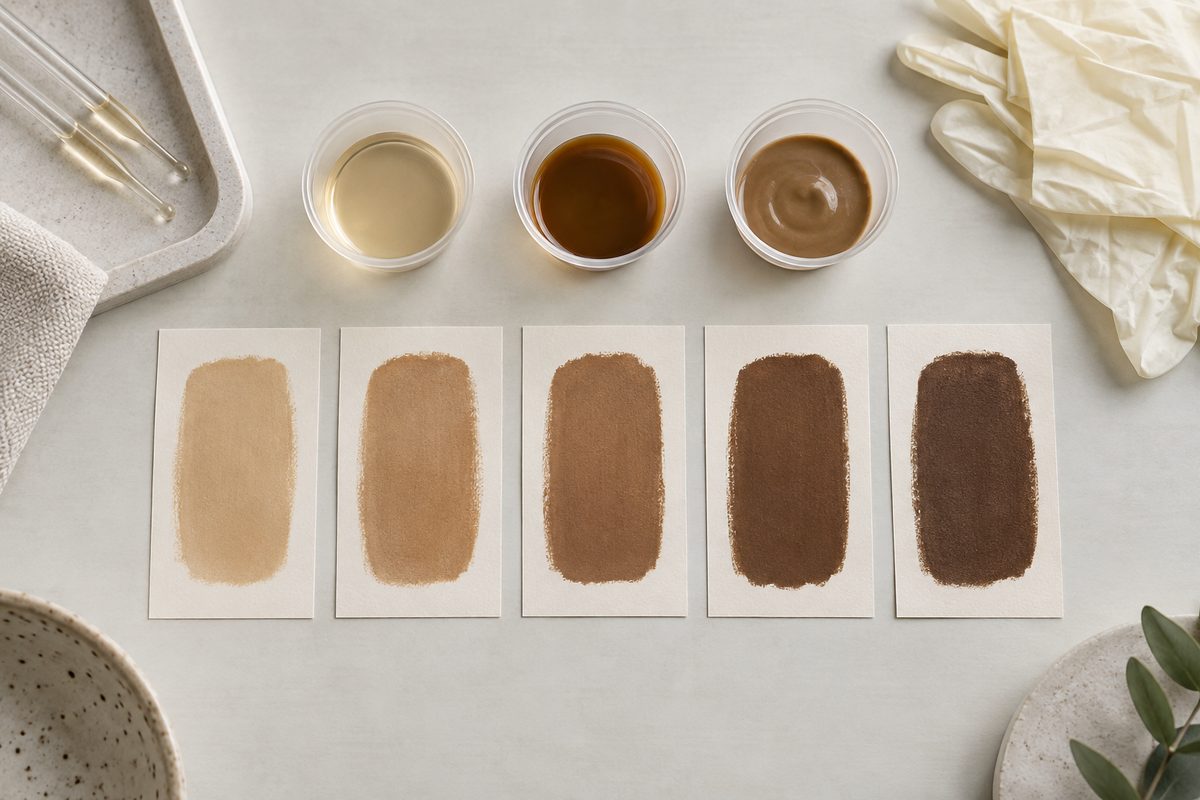
AI-generated editorial illustration of a generic shade-development workflow; no swatch represents a verified formula or consumer result.
Build a shade brief that can be tested
Replace vague requests such as “dark but not orange” with a controlled brief:
- Name the format, application area, applicator and dose per defined area.
- Define preparation, development time and rinse instructions.
- Set target depth and undertone with approved references.
- State whether the product is clear or guide-colored.
- Define acceptable transfer, streaking, fade and the skin-tone range evaluated.
Higher DHA exposure does not translate linearly into a better shade. A 2023 review reports that stronger DHA effects may shift measured color toward more yellow; vehicle, dose, skin and development conditions also matter. Approve shade with a fixed test method, not one concentration claim.
2. Treat Odor as Two Problems, Not One
Brands often use “DHA smell” to describe different phenomena. One is the odor of the formula in the package, which can change as ingredients or the formula age. The other appears after application as DHA reacts with amino-acid species at the skin surface. A fragrance may alter perception, but it cannot be assumed to eliminate the underlying on-skin reaction.
If a retained sample changes before application, review raw-material quality, process, storage, microbes and chemical stability. If only the worn product develops an objectionable note, compare controlled on-skin evaluations, dose, timing and fragrance direction. A 2024 review also identified fragrances and essential oils among contact-allergen concerns in marketed self-tanners, so fragrance selection and “fragrance-free” claims need evidence.
Use an odor scorecard
Record odor at filling, storage intervals, opening, application, development and rinse-off where relevant, using consistent temperature, dose, timing and assessors. Define whether “low odor” means low formula odor, reduced on-skin odor, low fragrance, no declared fragrance or a sensory score.
3. Design Ingredient Compatibility Around DHA
DHA is reactive, so a technically attractive ingredient list can still fail as a system. The 2023 formulation review identifies primary and secondary amines, amino acids, oxidizing agents and certain metal contamination as compatibility concerns. It also describes DHA solutions as tending to become more acidic over time and notes that the starting pH must balance product stability with appropriate skin use.
Do not copy one pH number or exclusion list into every formula. Composition, grades, impurities, addition order, temperature, water, preservation and packaging all matter; a qualified formulator should assess the actual formula and supplier documents.
Useful controls include:
- raw-material identity, lot, storage and water-quality records;
- documented addition sequence and temperature limits;
- pH, viscosity, color, odor and degradation checks;
- change control for fragrance, colorants, thickeners and packaging.
Technical literature describes DHA as heat-sensitive, so it is commonly added during cool-down. This is not a complete manufacturing instruction: mixing time, temperature, shear and sequence require formula- and equipment-specific validation.
4. Build a Stability Program That Answers Commercial Questions
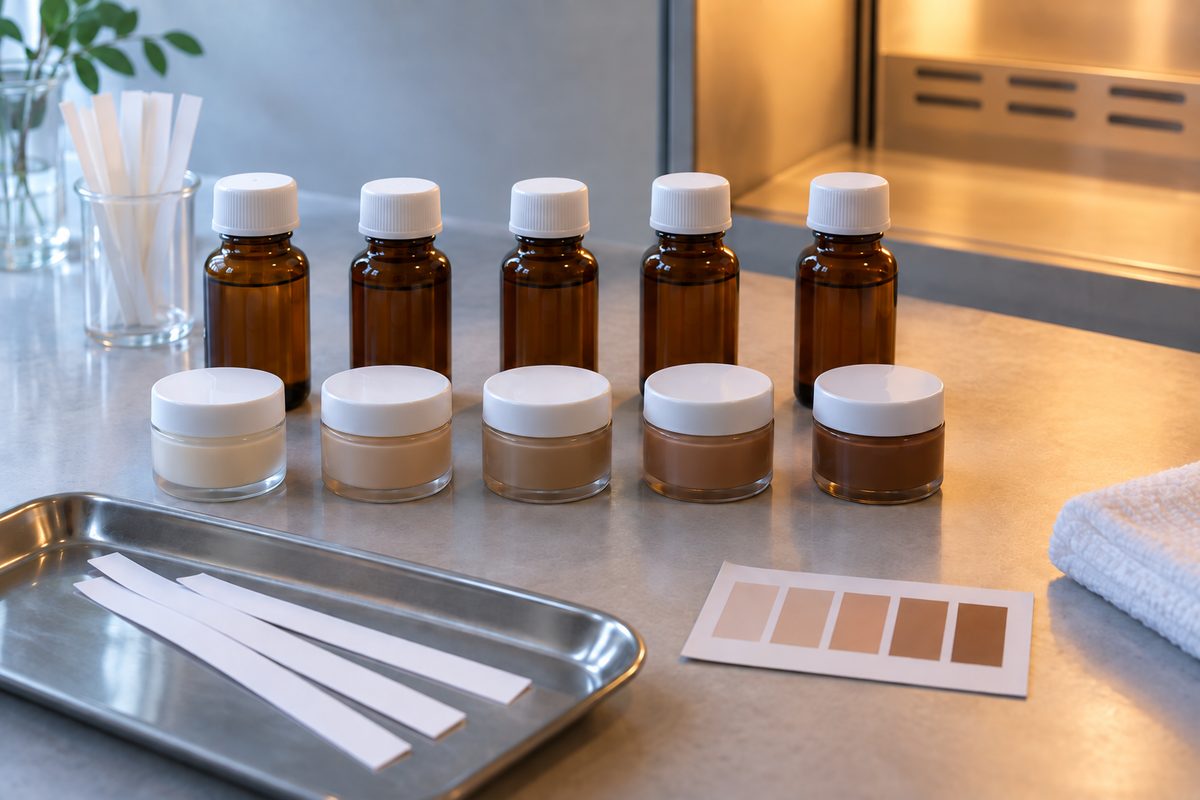
AI-generated editorial illustration of generic stability and sensory review; it is not an INHI stability chamber, laboratory record or test result.
No supplier can infer a universal shelf life from “DHA mousse” or “self-tanning lotion.” FDA prescribes no universal cosmetic test list; the manufacturer or distributor remains responsible for safety under labeled and customary use. Microbial risk can arise from materials, water, manufacturing, preservation, packaging, storage and consumer use.
A risk-based protocol should connect each condition to a decision:
| Study element | Observe or measure | Commercial question answered |
|---|---|---|
| Real-time storage in final pack | Appearance, odor, color, pH, viscosity, microbial quality, dispensing and leakage | Does the product remain within specification through the proposed shelf life? |
| Accelerated or elevated-temperature exposure | Direction and rate of physical or chemical change; package distortion or leakage | Which failure modes may emerge sooner, and what needs confirmation at real time? |
| Low-temperature and cycling work | Separation, crystallization, viscosity recovery, closure and pump behavior | Can the product tolerate distribution and seasonal temperature changes? |
| Light exposure when relevant | Formula and package discoloration, odor and performance change | Does the pack provide suitable light protection for the intended channel? |
| In-use or simulated-use assessment | Output, contamination risk, closure cleanliness and residual product | Does consumer use change preservation or package function? |
| Transport simulation | Leakage, foamer or dropper recovery, carton damage and decoration rub | Is the saleable unit ready for the chosen fulfillment route? |
Accelerated data can guide development, but it is not an automatic conversion into shelf-life months. Agree the acceptance criteria, methods, sampling points, final package and decision responsibility before production.
5. Make Packaging Part of the Formula Specification
The package controls more than appearance. Foamers influence mousse density and dose; droppers affect output and air exchange; pumps affect priming and evacuation; tubes affect flow and closure cleanliness. Resin, liner, gasket, spring, dip tube, coating and decoration can all affect compatibility.
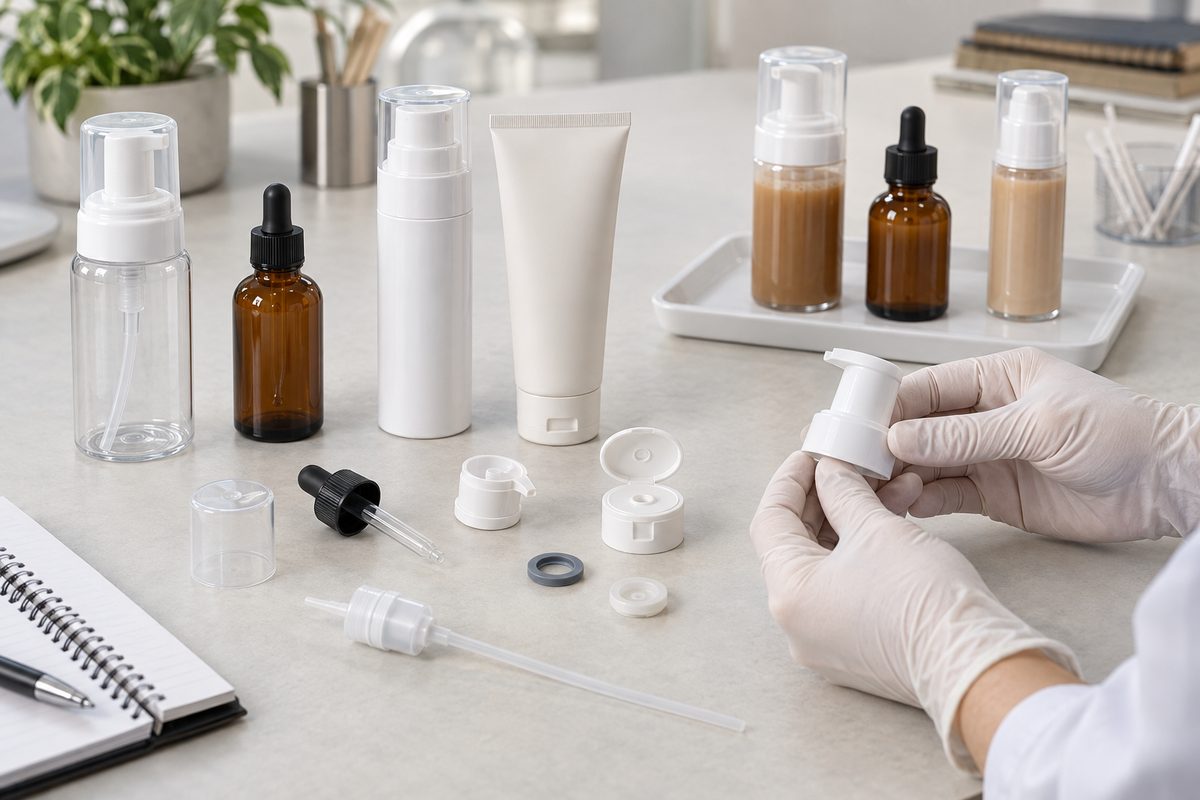
AI-generated editorial illustration of generic package-compatibility review; it is not an INHI facility, employee, approved component or inspection record.
Test the marketed components with the final formula. Check leakage, deformation, staining, corrosion, clogging, output, dose repeatability, foaming, closure, evaporation, label adhesion and decoration rub. Recheck after storage and transport rather than approving from an empty-package sample.
For a small first order, stock packaging with a low-setup label or carton may be commercially sensible. Custom bottle color, metallization, direct printing, special foamers and custom droppers can create component minimums separate from the formula batch. INHI's published cosmetic MOQ guide explains why finished-product, component, decoration and variant minimums can differ.
6. Control Sample Approval and Change Management
A gold-standard sample is useful only when linked to a version-controlled formula, process, package and test record. Approve bulk appearance, pH, viscosity, odor, colors, application, developed shade, transfer, fade, pack output and directions.
Keep an approved retain and written specification. Changes to the DHA source, fragrance, guide color, preservative, thickener, pump, resin or decoration need a documented impact review.
The published cosmetic product development timeline is useful for separating formula approval, packaging confirmation, verification, artwork, production and release milestones. For DHA projects, do not compress these into one sample-approval date.
Brand teams can use INHI's cosmetics manufacturing insights hub to compare related development, packaging and procurement decisions before freezing the brief.
7. Plan Cost, MOQ and Timing Without False Precision
There is no verified universal cost, MOQ or production time for a DHA self-tanner. The quote depends on the development route, DHA and other raw materials, guide color, fragrance, format, package, decoration, carton, shade or scent variants, verification program, documents, freight and order quantity.
INHI's public Products page describes self-tanning mousses, gels, creams and drops coordinated around shade, finish, fragrance and destination market. Its public pages also state that eligible projects may start from 100 units, eligible samples may be prepared within seven days after the brief is confirmed, and qualified inquiries receive an initial response and quotation within 24 hours. These are eligibility and response statements, not guarantees for every formula, package, test program or delivery date.
[INHI REVIEW REQUIRED: Confirm the exact eligible DHA formula route, format, stock package, first-order quantity, sample scope and commercial timeline before quoting this project.]
Ask the supplier to separate formula or development charges, bulk and filling, primary components, decoration, carton, testing, documents, freight and surplus components. Request milestone dates for brief acceptance, samples, formula freeze, pack freeze, verification, artwork, production, quality release and shipment.
8. Keep Regulatory Boundaries Inside the Brief
In the United States, current 21 CFR 73.2150 permits DHA in amounts consistent with good manufacturing practice in externally applied cosmetics intended to impart color to the human body. FDA defines the external-use boundary to exclude lips and mucous membranes and states that the industry has not provided data supporting exposure routes such as misting in tanning booths. Claims, directions and application areas must reflect the intended use.
In the European Union, Commission Regulation (EU) 2021/1099 added DHA to Annex III of the Cosmetics Regulation with a maximum concentration of 10% in self-tanning products. The current consolidated Cosmetics Regulation must still be checked for the complete formula, product responsibilities, safety assessment, PIF, notification and labeling.
The FDA limit is not expressed as the same 10% number used by the EU. Do not merge the two systems into one global rule. Neither FDA facility registration nor product listing is product approval, and a supplier statement does not replace the responsible company's market-specific review.
[INHI REVIEW REQUIRED: Have a qualified regulatory reviewer confirm the final formula, DHA use level, intended application areas, warnings, directions, claims, responsible-party duties and market-specific artwork before production release.]
Manufacturer-Side RFQ: What to Send
Send the self tanning manufacturer one brief covering market, format, application area, target consumer, shade, guide color, fragrance policy, dose, routine, pack, quantity, benchmark, target cost, claims, documents and launch date.
Ask for one recommended route identifying what is validated, customized or still requires testing. The quote should name the formula version, components, decoration, carton, sampling, verification duties, delivery term and exclusions.
Common Mistakes and Procurement Risks
- Selecting a DHA percentage before defining dose, format, market and shade target.
- Calling the guide color the “final shade.”
- Using fragrance as the only odor-control strategy.
- Setting a shelf life from a short accelerated observation alone.
- Launching an untested decorated pack after formula-only testing.
- Changing a pump, dropper, liner or resin after approval without impact assessment.
- Quoting only finished units while ignoring component and decoration minimums.
- Treating FDA registration, product listing or a supplier certificate as product approval.
Frequently Asked Questions
What DHA percentage makes a self-tanner dark?
There is no universal percentage-to-shade conversion. DHA exposure matters, but vehicle, dose, application, skin surface, development time and other formula choices also affect the result. Approve shade using a controlled method and confirm market-specific limits for the final product.
Why does self-tanner smell different after application?
DHA reacts with amino-acid species at the skin surface, and that chemistry can produce a characteristic on-skin odor. This is different from odor already present in the packaged formula. Evaluate both separately and verify any fragrance or “low-odor” direction in the finished product.
What pH should a DHA self-tanner have?
Do not copy one number into every formula. Peer-reviewed literature describes acidic conditions and pH drift as important to DHA stability, but the suitable specification depends on the complete composition, safety assessment, format and test data. A qualified formulator should set and validate the range.
Does a dark guide color mean the DHA tan will be dark?
No. Guide color is an immediate cosmetic tint that can help users see coverage. The developed DHA appearance forms later at the skin surface. Both should be specified and evaluated, but they are different product attributes.
Which package is best for a DHA self-tanner?
The best package is the one that protects the final formula and delivers the intended dose throughout storage, transport and use. A foamer, dropper, pump or tube can all work in the right system; each must be tested with the marketed formula and decoration.
How long does DHA self-tanner development take?
There is no reliable universal timeline. A ready or previously validated route may be faster than a custom shade, fragrance, guide color or package. Build the schedule around separate formula, packaging, verification, artwork, production and release gates.
Conclusion: Approve a Controlled System
A commercially sound DHA self-tanner links shade, odor, stability, packaging, instructions and compliance in one controlled specification. The decisive evidence is not the darkest prototype or the lowest MOQ; it is repeatable performance in the final pack under the intended conditions of sale and use.
To scope one project, send INHI your target market, format, shade direction, fragrance policy, quantity, package and launch constraints through Start a Project. Ask for one recommended formula-and-package route with a written sample and verification plan.
Sources and References
- INHI Cosmetics, Products, Insights, Cosmetic MOQ Explained, Cosmetic Product Development Timeline and Start a Project — public category, development, eligibility, sample and response statements (accessed September 27, 2026).
- Electronic Code of Federal Regulations, 21 CFR 73.2150 — Dihydroxyacetone — U.S. identity, use, restriction and labeling provisions; page current through September 24, 2026 (accessed September 27, 2026).
- U.S. Food and Drug Administration, Sunless Tanners & Bronzers — DHA mechanism, external-use boundary, restricted exposure routes and color-additive context (accessed September 27, 2026).
- U.S. Food and Drug Administration, Product Testing of Cosmetics and Microbiological Safety and Cosmetics — responsible-party safety duties, risk-based testing and contamination routes (accessed September 27, 2026).
- European Union, Commission Regulation (EU) 2021/1099 and Regulation (EC) No 1223/2009, consolidated through May 18, 2026 — DHA restriction and EU cosmetic-product requirements (accessed September 27, 2026).
- European Commission Scientific Committee on Consumer Safety, Opinion on Dihydroxyacetone, SCCS/1612/19 — safety assessment supporting specified DHA uses and concentrations (accessed September 27, 2026).
- Turner, J. et al., In search of the perfect tan: Chemical activity, biological effects, business considerations, and consumer implications of dihydroxyacetone sunless tanning products, Journal of Cosmetic Dermatology 22 (2023): 79–88 — DHA chemistry, shade, compatibility, pH, storage and format considerations (accessed September 27, 2026).
- Pantini, G. et al., Sunless tanning products containing dihydroxyacetone in combination with a perfluoropolyether phosphate, International Journal of Cosmetic Science 29(3), 2007 — peer-reviewed work on DHA-product stability and acidic-pH formulation challenges (accessed September 27, 2026).
- Sinha, A. et al., A cross-sectional review of contact allergens in popular self-tanning products, International Journal of Women's Dermatology 10(1), 2024 — fragrance, essential-oil and allergen considerations in marketed self-tanners (accessed September 27, 2026).
- Google Search Central, Creating Helpful, Reliable, People-First Content — original, complete, evidence-backed content guidance (accessed September 27, 2026).