Choose a private label self tanning format by matching the consumer routine, application control, formula behavior, packaging and target-market rules. Mousse favors fast body application; drops support dose-by-dose mixing; gel emphasizes glide and quick feel; lotion offers a familiar moisturizing format. None is automatically best, and all require final-product validation.
Last updated: September 26, 2026
Quick Answer
Use mousse when the launch depends on quick, broad body application and a mitt-led routine. Choose drops when the user should control intensity by mixing a measured amount into another cosmetic, but treat dosing instructions and dropper compatibility as core design inputs. Select gel for a lightweight spread profile and lotion for a familiar, more cushioned application.
The format decision is not only sensory. It changes the formula architecture, packaging, fill process, consumer-use risk, stability program, artwork and component minimums. For DHA-based products, U.S. and EU rules also set important use boundaries.
Private label self-tanning decision table
| Format | Best commercial use case | Main development questions | Common procurement risk |
|---|---|---|---|
| Mousse | Fast body application, tutorial-led content and mitt bundles | Foam density, spread, pump output, collapse, dry-down and transfer | A suitable foamer and decoration route may carry a higher minimum than the bulk formula |
| Drops | Customizable routine and compact premium presentation | Dose consistency, mixing directions, viscosity, dropper output and compatibility | Consumers may mix with an unsuitable product or use an unclear amount |
| Gel | Lightweight body or targeted application with visible glide | Flow, rub-in time, tack, pilling, color guide and tube or pump dispensing | A pleasing bench sample can change after package contact or temperature exposure |
| Lotion | Familiar full-body routine and moisturization-led positioning | Emulsion stability, slip, absorption, fragrance, streak control and pump evacuation | Brands may treat a standard lotion base as proof of final DHA stability |
1. Start With the Routine, Not the Texture Name
A format name does not define the finished product. Two products called “mousse” can have different foam density, color guide, drying behavior and transfer. Two “drops” can use different dose sizes, mixing instructions and shade systems. The sourcing brief must describe the intended routine and performance, not only the noun on the front label.
Define the body area, frequency, applicator, development time, rinse or no-rinse directions, desired guide color, fragrance direction, target shade range and acceptable transfer. Also decide whether the product is sold alone, with a mitt, or as part of a face-and-body system. Those choices determine the prototype, pack, claims and consumer instructions.
INHI's public Products page describes support for self-tanning mousses, gels, creams and drops coordinated around shade, finish, fragrance and destination market. That is category scope, not proof that every formula, pack or first-order quantity is available for every project.
2. Compare Mousse, Drops, Gel and Lotion
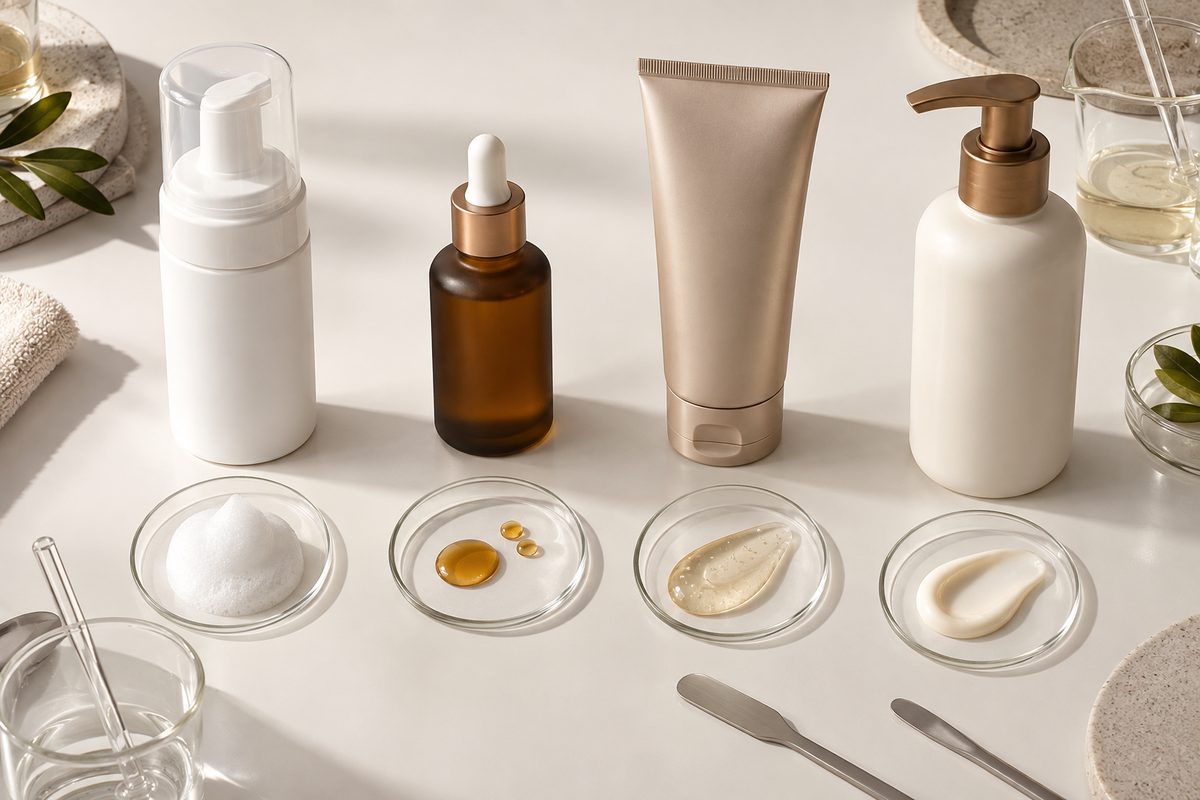
AI-generated editorial comparison of generic formats; actual formula and package performance require project-specific approval.
Mousse: fast application with pump dependency
Mousse can create a distinct application ritual and strong visual content. Its commercial advantage depends on the complete foaming system: base viscosity, surfactant balance, guide color, pump mesh, output per stroke and bottle headspace. A formula that foams in one test pack may not behave the same in another.
Specify target foam density, number of pumps per limb, spread area, collapse time, tack, dry-down, transfer and pump recovery. Test the final bottle upright, after transport simulation and near the expected end of use. Include the mitt in the evaluation if the consumer proposition depends on it.
Drops: adjustable positioning with instruction risk
Drops are compact and can support a customizable routine. The brand must define what the drops are intended to be mixed with, how the dose is measured and how the user should wash hands and avoid restricted application areas. “Add a few drops” is not a reproducible specification.
Evaluate drop mass or volume consistency, formula viscosity, neck and wiper design, bulb recovery, leakage and ingredient compatibility. If the product is positioned for the face, the artwork and directions must still respect destination-market restrictions around eyes, lips and mucous membranes.
Gel: lightweight feel with rheology challenges
Gel can provide visible glide and a lighter after-feel than a conventional lotion. Development work should define whether it is clear, tinted or opaque; how quickly it levels; whether it pills over skincare; and whether it becomes sticky under warm or humid conditions.
The package must dispense the intended amount without stringing, spurting or trapping excessive residue. A squeeze tube can be simple to understand, while a pump may improve dose repeatability; either choice needs compatibility and evacuation checks with the final formula.
Lotion: familiar use with emulsion complexity
Lotion gives consumers a familiar body-care routine and can support a moisturization-led sensory direction. It is not automatically the simplest DHA format. The emulsion, fragrance, color guide, preservative system and package can influence odor, color, viscosity and stability over time.
Approve slip, rub-in, absorption, tack, transfer, streak tendency, pump output and residual product. Do not infer self-tanning performance from the immediate guide color: the delayed DHA reaction and the cosmetic tint are different product attributes.
3. Understand What DHA Does—and Does Not Do
Dihydroxyacetone, or DHA, is a color additive commonly used in sunless tanners. FDA explains that it darkens the skin by reacting with amino acids at the skin surface. That temporary appearance is not sunscreen protection.
In the United States, DHA is permitted for external application but not for the eye area, lips, mucous membranes or inhalation exposure. FDA also requires a warning statement on tanning preparations that do not contain sunscreen. A brand should not imply that a cosmetic self-tanner prevents sunburn or replaces sun protection.
The EU amended its Cosmetics Regulation to allow DHA in self-tanning products at up to 10%. The same amendment uses a different maximum for certain non-oxidative hair-coloring applications. Target market and intended use therefore belong in the formulation brief before a percentage is selected; a supplier's global “standard formula” is not a regulatory conclusion.
Recent peer-reviewed reviews agree that DHA provides little or no meaningful photoprotection and identify remaining evidence limitations. Use that literature to define cautious consumer communication, not to invent safety, efficacy or dermatological claims.
4. Formulate the Complete System
DHA is reactive and can be stability-sensitive. The technical team must evaluate it within the final water phase, pH strategy, humectant system, emulsion or gel network, fragrance, preservative system, guide color and package. A successful raw-material specification is not proof that the finished product will keep its shade, odor, viscosity or performance.
For each prototype, document:
- DHA source and specification, formula concentration and target market.
- Base type, pH specification, viscosity or rheology range and appearance.
- Shade objective, guide-color function and acceptable color change.
- Odor at filling, during development and after the intended wear period.
- Spread, dry-down, tack, transfer, wash-off and packaging output.
- Microbiological strategy, safety substantiation and claims evidence.
Avoid locking the fragrance or color story before stability work. A dark guide color can improve application visibility but may increase transfer concerns. A strong masking fragrance can change the sensory profile without resolving the underlying chemistry.
5. Match Packaging to Formula and Dose
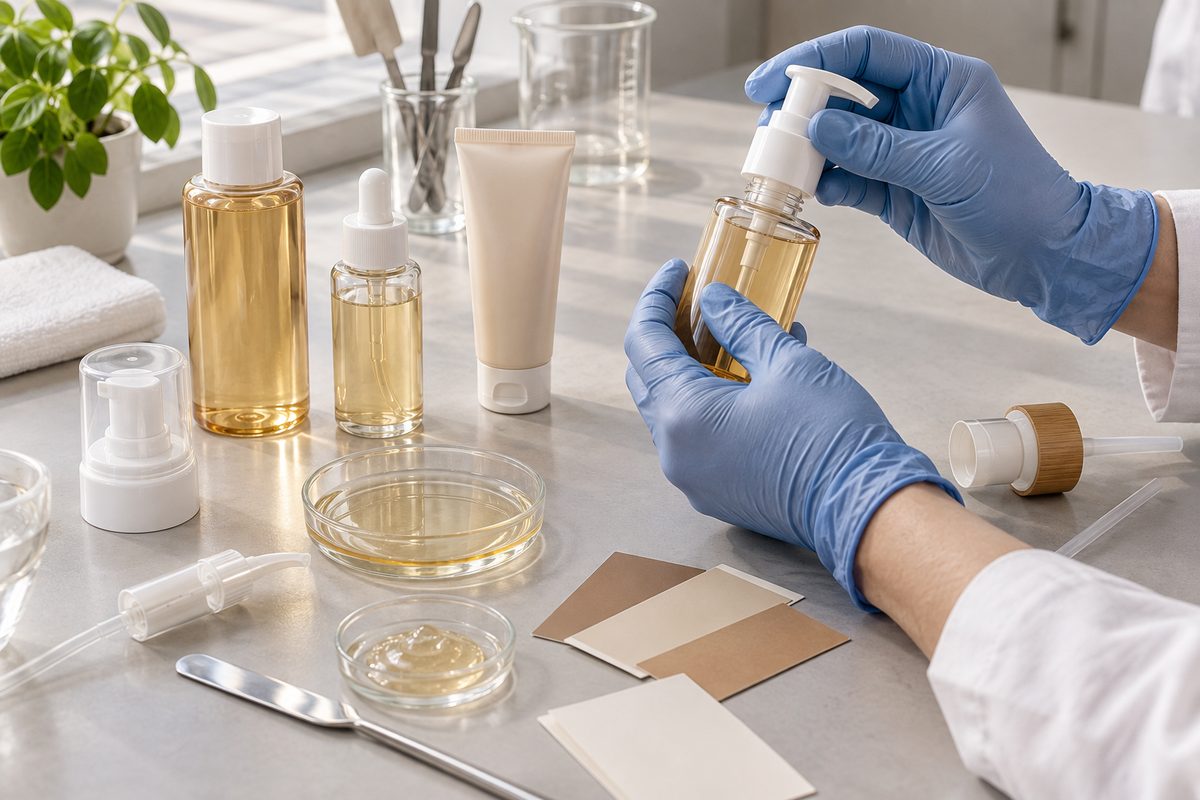
AI-generated editorial illustration of generic compatibility review; it is not an INHI laboratory, employee, test result or certificate.
The primary pack is a functional part of the product. A foamer determines mousse output. A dropper controls dose and air exchange. A tube or pump affects gel break, lotion evacuation and consumer contamination. Decorative choices can also alter lead time and minimums.
Run compatibility and stability work with the intended formula, component materials, closure and decoration. Observe leakage, paneling, swelling, staining, stress cracking, clogging, pump output, drop consistency, color, odor, pH and viscosity. Test use after storage, not only an unused pack at room temperature.
For small launches, stock components plus pressure-sensitive labels or low-setup decoration may reduce commitment. Custom colors, metallization, screen printing, cartons and mitt bundles can introduce independent purchasing minimums. Use INHI's published cosmetic MOQ guide to separate finished-product MOQ from component MOQ.
6. Approve Samples With a Controlled Scorecard
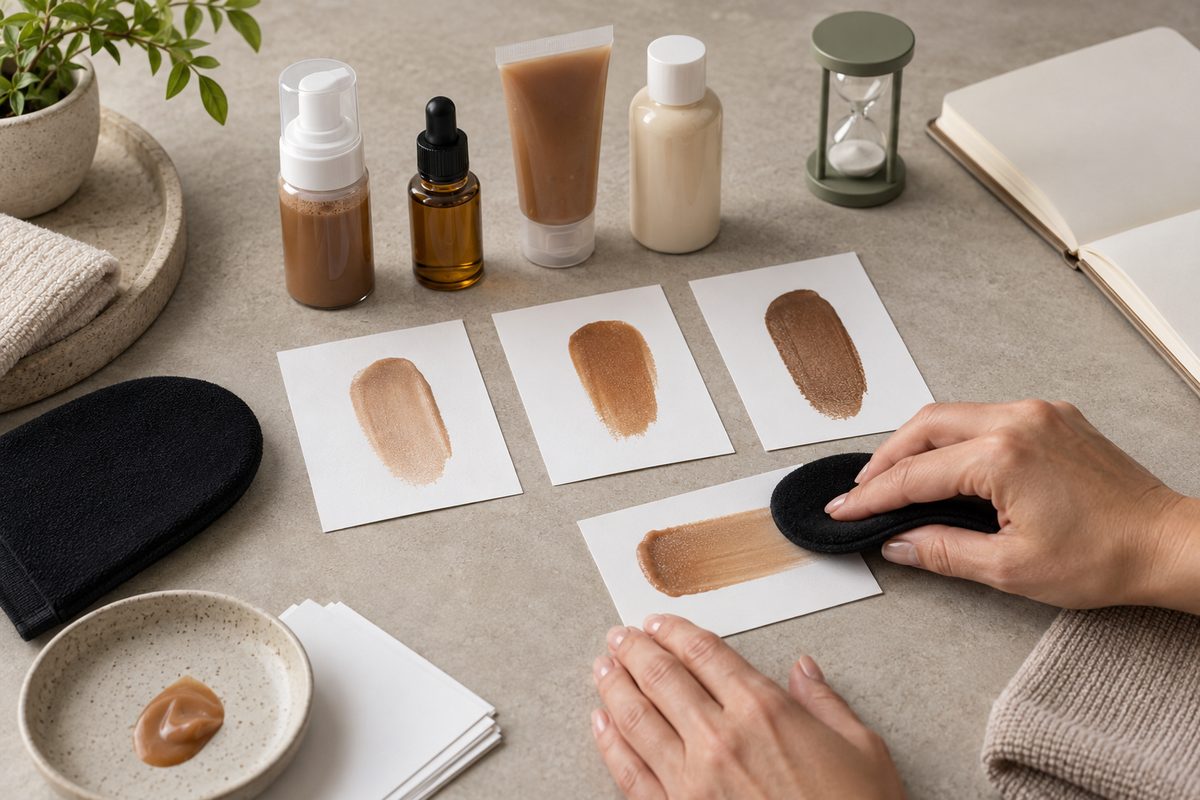
AI-generated editorial illustration of a generic sample-comparison workflow; it does not show an INHI sample room, employee or efficacy result.
Do not approve a self-tanner from a single swatch or immediate appearance. Use the same preparation, dose, applicator, area, timing, lighting and review method for every sample. Record both consumer experience and product behavior.
A practical scorecard can cover application evenness, guide color, spread, odor, dry-down, tack, transfer, developed shade, fade pattern, packaging output and cleanup. Evaluate more than one relevant skin tone with appropriately designed and consented testing; a shade described as “universal” still needs evidence and a defined meaning.
FDA does not prescribe one universal cosmetic test list. The responsible company and qualified technical team should establish suitable safety, stability, microbiological, compatibility, packaging and claims work for the actual product and use. Keep the approved reference, specifications, test responsibilities and change-control rules together.
7. Plan MOQ, Cost and Timeline Without False Precision
There is no responsible universal unit-price table for mousse, drops, gel and lotion. Cost depends on formula route, DHA and other materials, shade variants, primary pack, decoration, carton, mitt or accessories, testing, documentation, freight and quantity. A low-cost bulk formula can be paired with a high-commitment custom component.
INHI publicly states that eligible projects can start from 100 units, eligible samples can be prepared within seven days after a confirmed brief, and qualified inquiries receive an initial response and quotation within 24 hours. Treat those as eligibility and response statements—not guarantees for every self-tanning formula, pump, dropper, decoration, test program or production schedule.
Ask for three separate numbers: finished units, components that must be purchased, and total first-order cash exposure. Ask for a gated schedule covering brief, formula selection or development, packaging confirmation, samples, verification, artwork, production, release and shipping.
[INHI REVIEW REQUIRED: Confirm the exact eligible self-tanning formats, stock packaging, first-order quantity and sample route for this specific project before quoting them to a buyer.]
8. Build Compliance Into the Brief
For U.S. sale, define the responsible person, facility and product-listing responsibilities under MoCRA, safety substantiation, serious-adverse-event handling, label content and color-additive compliance. Claims must remain truthful and non-misleading; a statement that treats disease or affects body structure or function can move the product into drug regulation.
For EU sale, assign the Responsible Person, safety assessment, Product Information File, notification and final label review. Confirm the current DHA restriction and any other ingredient limitations against the finished formula. The same artwork should not be assumed compliant across the United States, EU, UK and Australia.
[INHI REVIEW REQUIRED: Have the brand's qualified regulatory reviewer confirm the final formula, intended application areas, warning statement, directions, claims and market-specific artwork before production release.]
Manufacturer-Side RFQ: What to Send
Send one controlled brief containing the destination market, body or face use, format, target consumer, shade objective, guide-color preference, fragrance direction, first-order quantity, package preference, applicator, benchmark, target landed cost, claims boundary, required documents and launch date.
Ask the manufacturer to return one recommended route and explain whether it is ready-formula, modified or custom. The quotation should identify formula, package, decoration, carton, accessories, samples, verification, documents, surplus components, delivery term and exclusions. This makes mousse-versus-drops a product-development decision instead of a mood-board preference.
Common Mistakes and Procurement Risks
- Selecting a format because it is trending without defining the consumer routine.
- Treating immediate guide color as the final developed DHA result.
- Using vague drop instructions that do not control dose or mixing context.
- Changing a foamer, dropper, tube or pump after formula approval without impact review.
- Quoting a finished-product MOQ while ignoring custom-component commitments.
- Claiming sun protection for a product that is not lawfully formulated and labeled as a sunscreen.
- Omitting restricted application areas and safe-use directions from artwork review.
- Approving only one shade, skin tone, storage condition or application method.
- Treating FDA registration or product listing as approval or certification.
Frequently Asked Questions
Is self-tanning mousse better than lotion?
Mousse can spread quickly and create a distinctive mitt-led routine. Lotion offers a familiar, more cushioned application. The better format is the one that meets the brand's use case after foam or pump output, spread, dry-down, transfer, shade and stability are tested as a complete product.
Can tanning drops be used around the eyes?
Do not assume so. In the United States, FDA states that DHA is not permitted for use in the eye area and is restricted to external application. Directions and artwork must define intended application areas and be reviewed for the destination market.
Do DHA self-tanners protect against sunburn?
No meaningful protection should be assumed. FDA states that sunless tanners without sunscreen do not protect against sunburn and requires a warning statement. Peer-reviewed reviews likewise report minimal or no meaningful photoprotection from DHA color.
What should a brand test before approving a self-tanner?
Use a risk-based program for the final formula and pack. Depending on the product, it can include safety substantiation, stability, microbiological quality, package compatibility, pump or dropper output, application, dry-down, transfer, developed shade, fade, transport and claims evidence.
Can a private label self-tanning project start at 100 units?
INHI publicly states that eligible projects can start from 100 units. Eligibility depends on formula, shade, packaging, decoration, accessories, testing and market needs. Custom foamers, droppers, colors or cartons may carry higher independent minimums.
Conclusion: Approve the Routine and the System
Mousse, drops, gel and lotion are not interchangeable labels. Each creates a different application routine, formulation problem, packaging dependency and sourcing profile. Start with the consumer use case, then approve the formula, dose, pack, evidence, artwork and commercial commitment as one system.
To scope a project, send INHI your target market, preferred format, shade direction, quantity, packaging and launch constraints through Start a Project. Ask for one recommended development route with component-level minimums and a written sample plan.
Sources and References
- INHI Cosmetics, Products, Solutions, Insights and Start a Project — public category, development-route, eligibility, sample and response statements (accessed September 26, 2026).
- U.S. Food and Drug Administration, Sunless Tanners & Bronzers — DHA mechanism, external-use restriction, restricted exposure routes and sunscreen distinction (accessed September 26, 2026).
- U.S. Food and Drug Administration, Required Warning Statement for Tanning Products Without Sunscreen — 21 CFR 740.19 warning requirement (accessed September 26, 2026).
- U.S. Food and Drug Administration, Color Additives Permitted for Use in Cosmetics — DHA listing and external-use limitation (accessed September 26, 2026).
- U.S. Food and Drug Administration, Product Testing of Cosmetics and Cosmetics Labeling Claims — safety responsibility, test-program flexibility and claims boundary (accessed September 26, 2026).
- European Union, Commission Regulation (EU) 2021/1099 and Regulation (EC) No 1223/2009, consolidated through May 18, 2026 — DHA restriction and EU cosmetic-product responsibilities (accessed September 26, 2026).
- European Commission Scientific Committee on Consumer Safety, Opinion on Dihydroxyacetone, SCCS/1612/19, final opinion 2020 — safety assessment supporting specified DHA uses and concentrations (accessed September 26, 2026).
- Garone, M. et al., In search of the perfect tan: Chemical activity, biological effects, business considerations, and consumer implications of dihydroxyacetone sunless tanning products, Journal of Cosmetic Dermatology 21(10), 2022 — DHA chemistry, formulation and consumer considerations (accessed September 26, 2026).
- Wang, J. V. et al., Properties and safety of topical dihydroxyacetone in sunless tanning products: A review, Journal of Cosmetic Dermatology 23(1), 2024 — topical DHA properties, exposure boundaries and evidence limitations (accessed September 26, 2026).
- Google Search Central, Creating Helpful, Reliable, People-First Content and Optimizing for Generative AI Features — source quality, non-commodity content and image guidance (accessed September 26, 2026).