The right eye mask packaging protects a water-rich formula, keeps each patch usable, carries required label information and fits the brand's order quantity and channel. Choose the complete formula–patch–package system, not the prettiest jar or sachet in isolation. Then validate seal, compatibility, hygiene, transport and artwork before production.
Last updated: September 25, 2026
Quick Answer
Use a single-pair sachet when isolation, sampling, travel use or simple dose control matters most. Consider a sealed tray or blister when presentation and shape protection justify more components. Choose a multi-pair jar only when the preservation strategy, opening size, closure, inner seal, tool and consumer handling have been evaluated together. Add a carton when the retail channel, label area or kit structure requires it.
There is no universally best format. The best choice is the lowest-complexity pack that protects the approved product, communicates the required information and survives the intended supply chain.
Eye mask packaging decision table
| Format | Strongest use case | Main technical questions | Common commercial constraint |
|---|---|---|---|
| Single-pair sachet | Samples, travel, subscriptions and individually controlled pairs | Laminate barrier, fill amount, pair orientation, seal width, tear notch and leak limit | Printed-film run and converting setup may exceed the finished-product minimum |
| Sealed tray or blister | Premium presentation and shape protection | Cavity fit, lidding-film compatibility, peel force, headspace and secondary seal | Tray tooling, lidding material and assembly add separate minimums |
| Multi-pair jar | Repeated-use retail pack with lower pack count per pair | Closure torque, inner seal, opening diameter, tool, pair count, preservation and in-use hygiene | Jar, lid, liner, tool and decoration each create component commitments |
| Sachets in a carton | Multipacks, retail display and larger information panel | Count control, insertion order, carton fit, scuff resistance and tamper evidence | Carton print quantity and assembly labor can bind the MOQ |
1. Treat the Package as Part of the Product
An eye mask is not just serum plus two crescent patches. Its primary package controls exposure to air, moisture loss, contamination, handling and physical distortion. The same hydrogel or serum-loaded patch can behave differently in a foil sachet, formed tray or frequently opened jar.
Start by defining the commercial use case: one pair per trial, five individually wrapped pairs, or a jar of repeated-use pairs. Then lock patch material and dimensions, gel or serum amount, application instructions, target market, retail channel, claims boundary and expected storage conditions. Package selection comes after those inputs because they determine barrier, size, label area and user interaction.
For a wider review of formula, patch material and sourcing decisions, use INHI's published private label eye mask manufacturer guide. This article focuses on the package itself.
2. Compare Sachets, Trays, Jars and Cartons
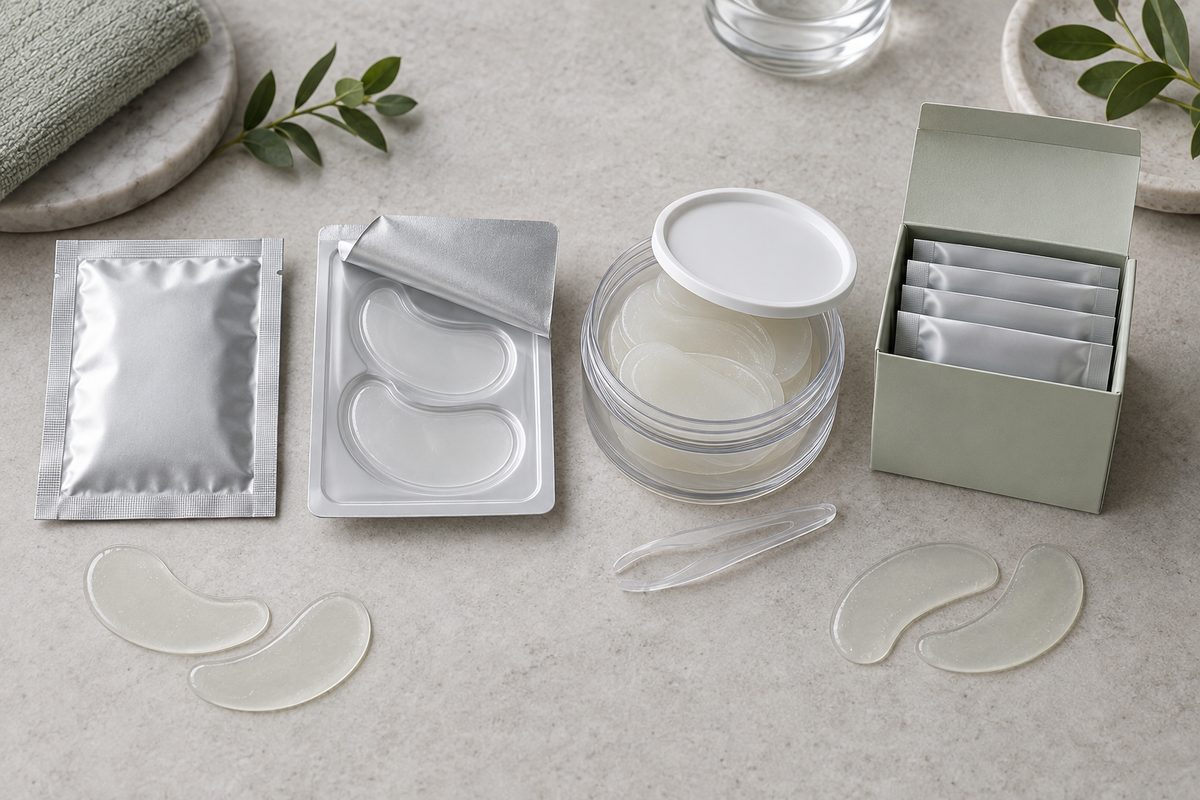
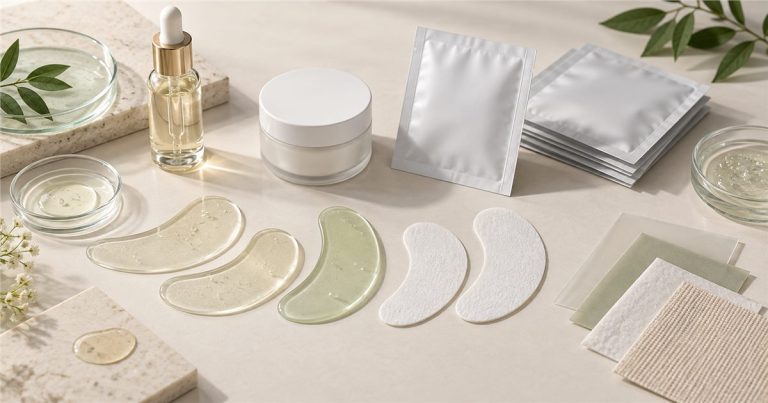
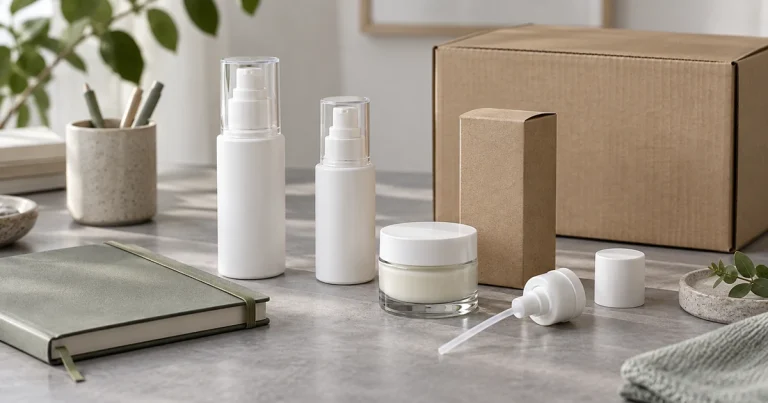
AI-generated editorial comparison of generic formats; actual materials, dimensions and components require project-specific approval.
Single-pair sachets
A sachet isolates one pair until opening and can support sampling, travel and subscription packs. It also makes unit count clear. Specify the laminate structure, external dimensions, seal width, tear notch, print area, pair orientation, fill quantity and acceptable leakage rate. A vague request for a “foil pouch” is not a packaging specification.
Sachets can look simple while carrying a high converter minimum. Stock film with a label or short-run print route may be practical for validation; custom rotogravure or other high-setup printing can require a larger material commitment. Ask whether the quotation includes only finished units or also surplus printed film, setup waste and storage.
Sealed trays and blisters
A formed cavity can protect patch shape and present each pair neatly. The trade-off is a larger bill of materials: tray, lidding film, seal process and often an outer carton. Define cavity dimensions, material, peel force, headspace, opening tab, seal area and whether the user can remove the patch without tearing or excessive gel loss.
Do not assume a premium-looking tray is automatically a better barrier. Barrier performance and seal integrity depend on the actual material structure and closing process.
Multi-pair jars
A jar can hold many pairs in one retail unit and support a distinctive shelf presentation. It also exposes the remaining contents whenever the consumer opens the pack. FDA notes that contamination can be affected by consumer use, including dipping fingers into a jar, and by packaging that does not adequately protect the product.
Specify pair count, opening diameter, jar and lid materials, liner or inner disc, tamper-evident seal, closure torque, spatula or tweezers, tool storage and directions. Evaluate whether patches separate cleanly, remain submerged or adequately wetted, and can be removed without damaging the rest. “Includes tweezers” is incomplete unless tool material, fit, cleanliness and retention are controlled.
Cartons and kits
A carton provides space for instructions, ingredients and market-specific information, protects decorated primary packs and can organize multipacks. It also introduces board specification, print method, finish, insert, count control, scuffing and assembly work.
Define the exact sale configuration. “Five-pair box” might mean five sachets, one five-pair jar, or a tray system. Quotations are not comparable until the contained units, components and assembly sequence match.
3. Select Barrier and Seal Around the Final Formula
Water-rich cosmetics can lose mass, change appearance or interact with packaging. A peer-reviewed cosmetic-storage study found measurable differences between formulations held in different container materials; it supports the general principle that packaging choice can affect product quality, not a claim that one material is always superior.
For eye masks, discuss:
- Water-vapor and oxygen barrier: relevant to moisture retention, oxidation-sensitive ingredients and long distribution routes.
- Sealability: the laminate or lidding material must form a repeatable seal on the selected equipment without damaging the product.
- Chemical compatibility: look for changes in color, odor, pH, viscosity, gel strength, tack, patch dimensions, package swelling, delamination or corrosion.
- Migration and sorption risk: packaging substances can migrate into a product, while fragrance, preservative or other formula components can be absorbed by or interact with the pack.
- Light protection: clear packaging improves visibility but may not suit every formula or claim strategy.
The EU Cosmetics Regulation's safety-report framework specifically calls for relevant packaging-material characteristics, including purity and stability. That is why a generic material certificate cannot replace verification with the intended formula, patch and package.
4. Match Hygiene Controls to Consumer Use
Single-use sachets limit repeated contact with unopened pairs. A jar creates a different in-use scenario because the closure is opened repeatedly and a hand or tool approaches the remaining product. Packaging does not replace an appropriate preservation strategy, microbiological specifications or production controls.
A 2020 peer-reviewed study evaluated more than 800 packages and proposed a method for grading protection against microbial contamination. The practical lesson is not to accept unstandardized words such as “protective jar” as proof. Define an in-use scenario and verify the complete system.
For a jar project, decide how the tool is removed, stored and cleaned; how long the lid may remain open; and what directions reduce foreseeable misuse. For a sachet, control punctures, channel leaks, product in the seal area and opening edges.
5. Validate Compatibility, Seals and Distribution
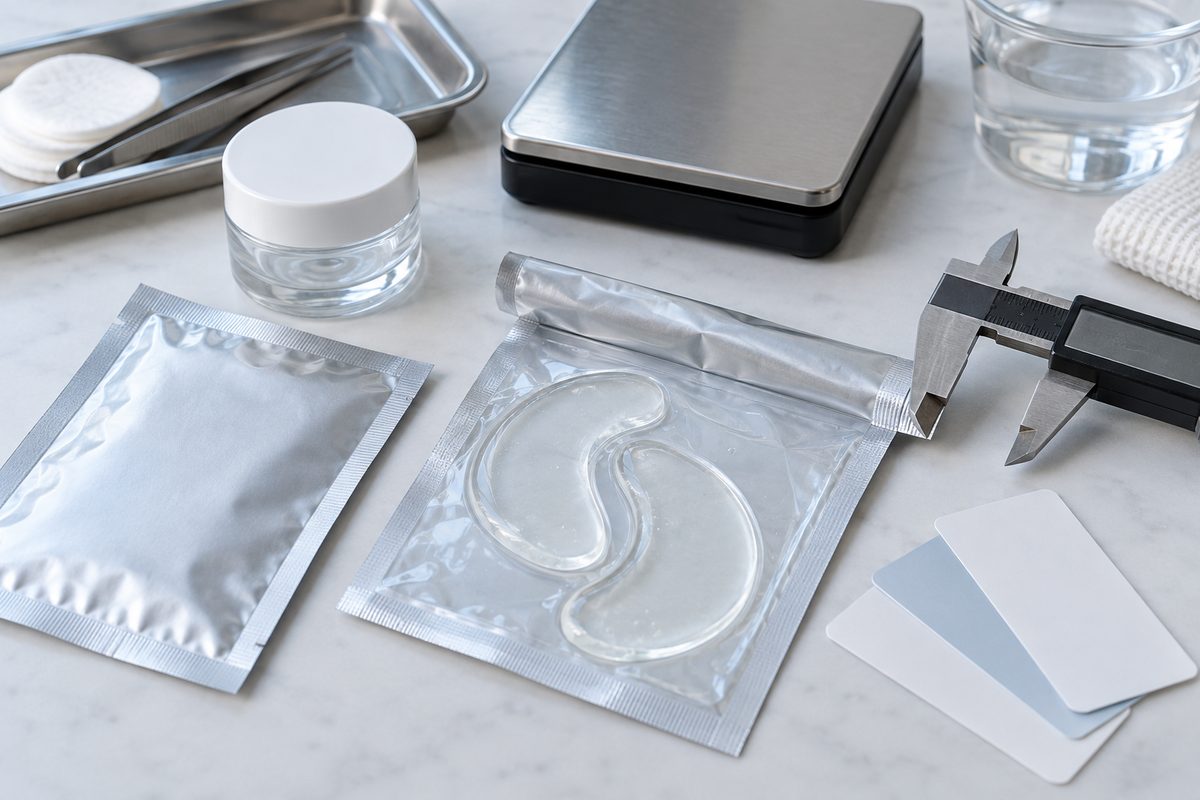
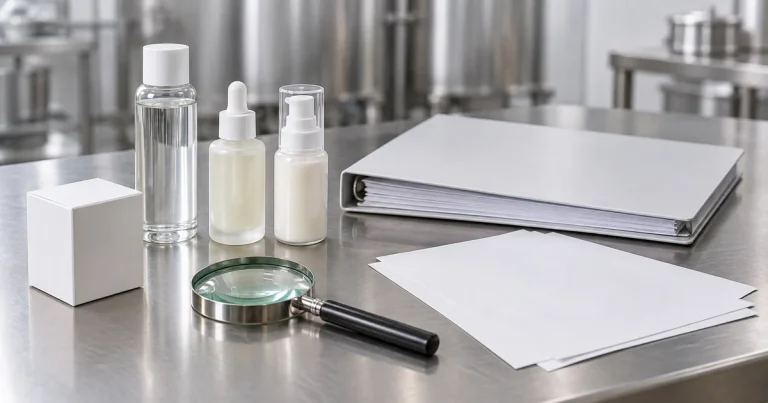
AI-generated editorial illustration of a generic review step; it is not an INHI laboratory, certificate or test result.
FDA does not publish one universal cosmetic test list. The brand and qualified technical team should define a program appropriate to the formula, intended use, pack, market and risk. A practical plan may cover:
- Compatibility and stability: observe the product and package together under justified conditions and intervals.
- Seal verification: define seal width, appearance, strength or peel behavior and leak-test method.
- Fill and count controls: set tolerances for pair count, gel or serum amount and pack weight.
- Functional use: confirm opening, patch removal, separation, application and reclosure where relevant.
- Microbiological protection: align preservation and packaging with intended consumer handling.
- Transit testing: challenge retail packs and shipper cases for compression, vibration, puncture, rubbing and temperature exposure relevant to the route.
Approve a production-equivalent sample rather than a handmade presentation sample. Any change to laminate, jar resin, liner, seal temperature, fill amount, patch substrate or component supplier should trigger a documented impact review.
6. Design Artwork Around Legal Information, Not Around Empty Space
For U.S. cosmetics, FDA's labeling guide covers product identity, net quantity, marketer information, ingredient declaration, prominence and other required statements. The outer container can carry information that will not fit on a small sachet, but required content and placement still need qualified review for the actual sale configuration.
ISO 22715:2006 remains current after confirmation in 2022 and specifies packaging and labeling requirements for cosmetics under applicable national rules. For EU projects, assign the Responsible Person and safety/PIF work before artwork freeze. Regulation (EU) 2025/40 on packaging and packaging waste applies from August 12, 2026, with many detailed obligations and later transition dates; destination-specific advice is necessary before making recyclability or environmental claims.
Do not print “recyclable,” “biodegradable,” “hypoallergenic,” “clinically proven” or similar claims because a component supplier used the term. Evidence must match the finished package, product, disposal system, claim wording and market.
7. Separate Finished-Product MOQ from Component MOQ
Eye mask packaging cost is driven by more than container type. Ask for separate lines for primary pack, lidding or film conversion, decoration, carton, insert, tool, assembly, testing, freight and unused printed components. One “unit price” can hide different assumptions.
INHI's public Products and Solutions pages describe eye mask formula, patch, sachet and carton coordination. The public Insights hub states that eligible ready-formula, custom-formula and selected custom-packaging projects can start from 100 units, eligible samples can be prepared within seven days after a confirmed brief, and qualified inquiries receive an initial response and quotation within 24 hours. These are eligibility and response statements, not universal promises for every custom jar, film, tray, decoration or production schedule.
Use the cosmetic MOQ guide to compare the binding minimum across formula, patch, package, print and carton. A low finished-unit target does not cancel a higher custom-component minimum.
8. Use a Packaging Approval Flow
- Lock the brief: market, channel, format, pair count, target price, quantity and claims boundary.
- Shortlist systems: choose the lowest-complexity sachet, tray, jar or carton route that can meet the brief.
- Confirm component availability: identify stock and custom parts, tooling, decoration route and binding minimums.
- Build production-equivalent samples: use the intended formula, patch, primary package and closure process.
- Approve verification: agree on compatibility, stability, microbiological, seal, transit and claims work.
- Freeze specifications: record materials, dimensions, tolerances, approved references and change-control rules.
- Release artwork: use the final formula, net contents, responsibilities and market requirements.
- Inspect production: verify incoming components, print, seal, fill, count, appearance, coding, carton and shipper criteria.
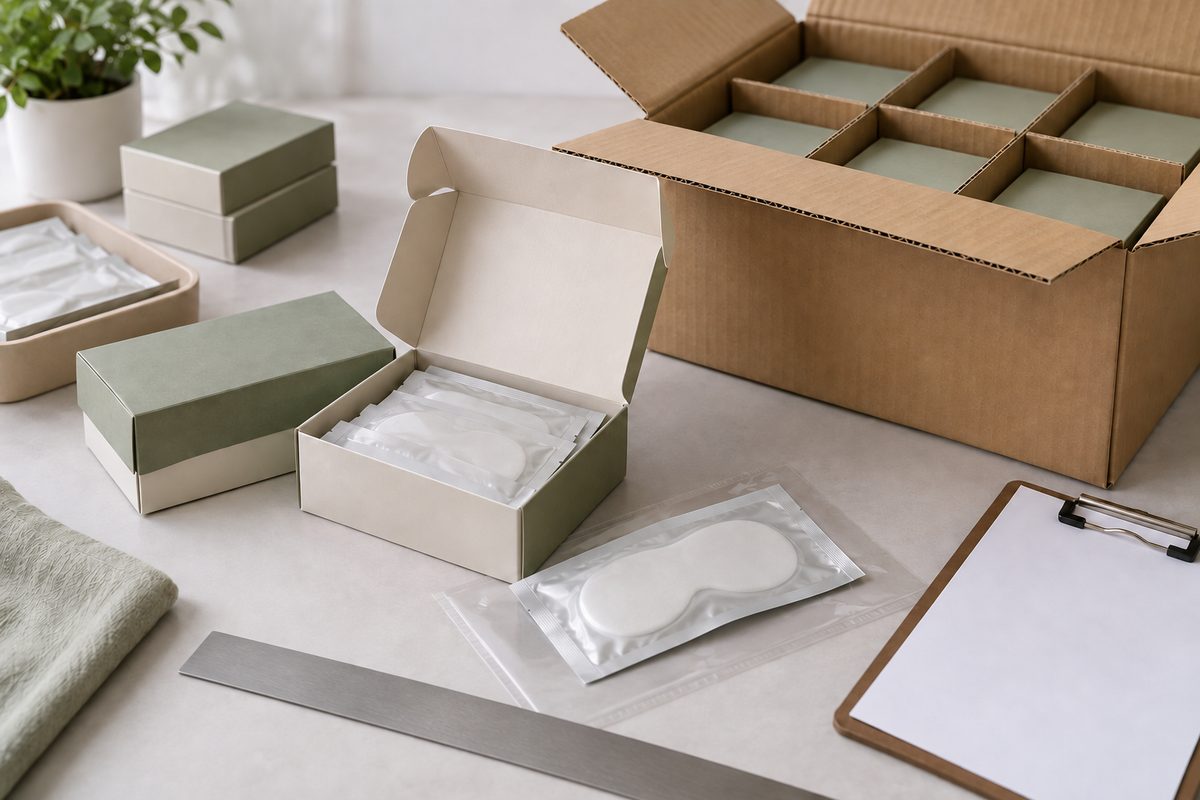
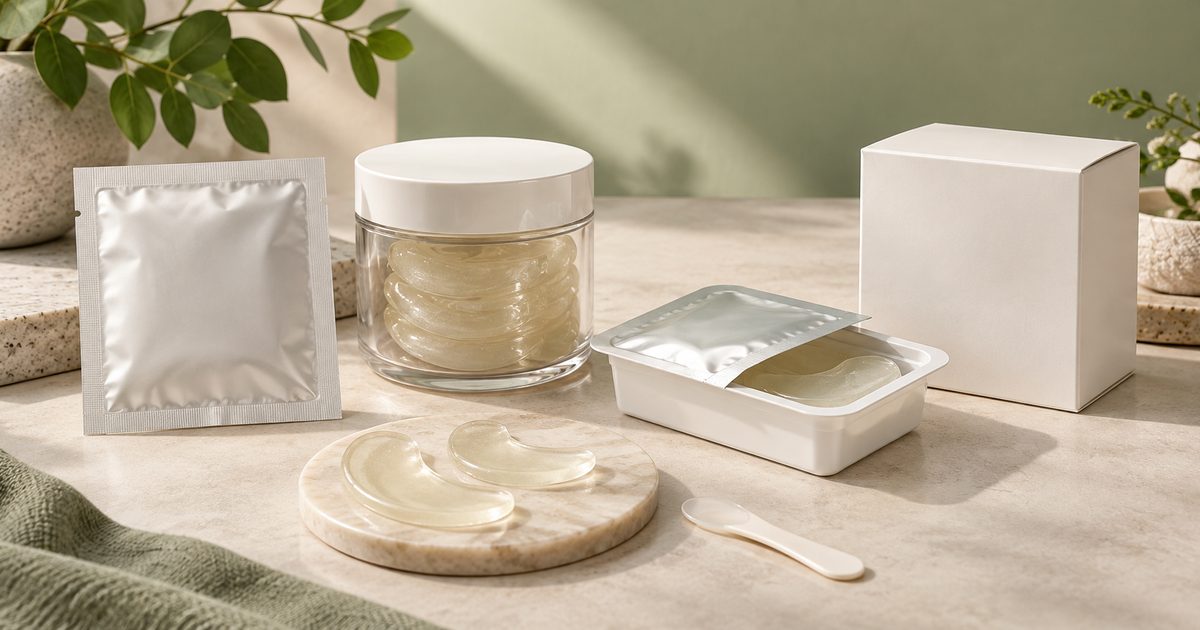
AI-generated editorial illustration of generic case-pack review; it does not show an INHI shipment, customer order or marketplace facility.
Manufacturer-Side RFQ: What to Send
Send the manufacturer one controlled packaging brief: target market, patch and formula route, pair count, primary-pack preference, retail configuration, first-order quantities, decoration, required label area, target landed cost, test/document needs and launch date. Attach reference images, but mark which features are mandatory and which are flexible.
Ask the quotation to state component material, size, print method, included tooling, sample type, testing exclusions, surplus ownership, change-control process and delivery term. This turns a visual preference into a comparable procurement specification.
Common Packaging Mistakes and Procurement Risks
- Choosing a jar before evaluating repeated opening, tool handling and preservation.
- Approving the formula in glass, then assuming a sachet laminate or plastic jar is equivalent.
- Comparing one-pair and multi-pair quotes without normalizing pair count and fill amount.
- Treating the finished-product MOQ as the minimum for printed film, trays, lids and cartons.
- Freezing graphics before ingredients, net contents, responsible-party details and directions are final.
- Using sustainability language without finished-pack evidence and destination-market review.
- Omitting seal, leakage, count, scuff and shipper-case acceptance criteria.
- Assuming a sample window is the full production and logistics timeline.
Frequently Asked Questions
Are sachets better than jars for eye masks?
Sachets isolate individual pairs and simplify dose control. Jars can reduce the number of primary packs and create a different shelf presentation, but they require more attention to repeated use, tools, closure, preservation and remaining-product protection. The better format depends on the product and use case.
What film should an eye mask sachet use?
There is no universal laminate. Specify the formula, patch, fill, target shelf life, light and barrier needs, seal equipment, opening behavior, decoration and distribution route. The converter and technical team should recommend a structure, then verify it with the actual product.
Can custom eye mask packaging start at 100 units?
INHI publicly states that eligible projects can start from 100 units, subject to project feasibility. Stock packaging and low-setup decoration are more likely to fit a small run. Custom film, trays, colors, molds, printing and cartons can carry higher independent minimums.
What packaging tests should a private label brand request?
Request a risk-based plan for the final formula–patch–package system. Depending on the project, it may include compatibility and stability observations, microbiological protection, seal and leak checks, fill/count controls, opening and use tests, and transport evaluation. Ask which work is included, excluded or owned by the brand.
Does a carton replace labeling on the sachet or jar?
Not automatically. Required information depends on the market and sale configuration. FDA distinguishes statements that apply to inside and outside containers, while other jurisdictions have their own rules. Obtain qualified review of the final artwork rather than assuming the carton solves every space constraint.
Conclusion: Approve a System, Not a Component
Eye mask packaging should be selected as a complete commercial and technical system. Control the formula, patch, barrier, seal, closure, tool, label, carton and shipper together; then approve evidence and specifications before buying custom components.
For a project-specific route, send INHI your target market, pair count, pack preference, quantities, claims and launch constraints through Start a Project. Request one recommended packaging system with component-level minimums and a defined sampling plan.
Sources and References
- INHI Cosmetics, Products, Solutions, Insights and Start a Project — public category, eligibility, sample and response statements (accessed September 25, 2026).
- U.S. Food and Drug Administration, Cosmetics Labeling Guide — U.S. cosmetic label and package requirements (accessed September 25, 2026).
- U.S. Food and Drug Administration, Product Testing of Cosmetics — safety responsibility, product testing and consumer-use contamination (accessed September 25, 2026).
- U.S. Food and Drug Administration, Microbiological Safety and Cosmetics — preservation, packaging, shipping, storage and consumer-use contamination factors (accessed September 25, 2026).
- European Union, Regulation (EC) No 1223/2009 on Cosmetic Products, consolidated through May 18, 2026 — safety report, packaging-material characteristics, PIF and market responsibilities (accessed September 25, 2026).
- European Union, Regulation (EU) 2025/40 on Packaging and Packaging Waste — lifecycle, sustainability and packaging obligations applicable from August 12, 2026, subject to provision-specific dates (accessed September 25, 2026).
- International Organization for Standardization, ISO 22715:2006 Cosmetics — Packaging and Labelling — current standard confirmed in 2022 (accessed September 25, 2026).
- Martin, S. et al., Development of a standardized method to evaluate the protective efficiency of cosmetic packaging against microbial contamination, International Journal of Cosmetic Science 42(3), 2020 (accessed September 25, 2026).
- Gliszczyńska-Świgło, A. et al., The Influence of Packaging on Cosmetic Emulsion during Storage Assessed by FT-NIR Spectroscopy and Color Measurements, Journal of Cosmetic Science 69(4), 2018 (accessed September 25, 2026).
- Google Search Central, Creating Helpful, Reliable, People-First Content and AI Features and Your Website — source quality and non-commodity content guidance (accessed September 25, 2026).