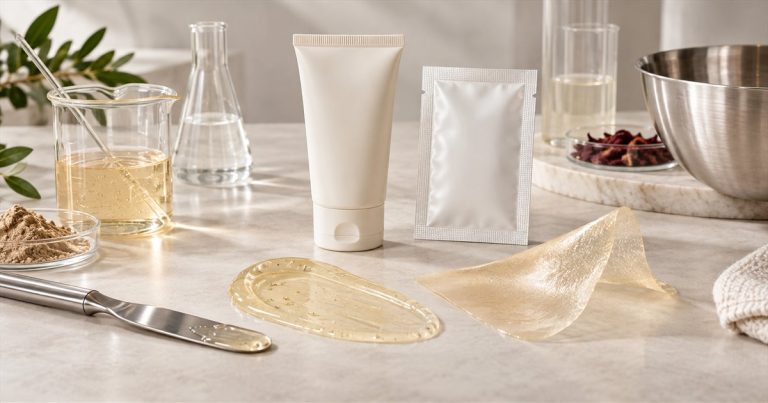
A sheet mask manufacturer should quote one complete product system: serum, fabric, mask shape, serum load, sachet laminate, seal, carton, testing and target-market files. Choosing each item separately can produce a mask that dries too quickly, folds in the pouch, leaks in transit or cannot support the intended claims. Lock the use case first, then sample the final combination.
Quick Answer: What Should You Send a Sheet Mask Manufacturer?
Send a controlled brief with the destination market, target consumer, claims boundary, formula route, fabric type, face fit, serum weight per sachet, sachet and carton format, first-order quantity, target price and launch date. Ask the manufacturer to identify which decision creates each minimum order, test requirement and lead-time dependency.
INHI publicly lists custom face masks among its product-development categories and coordinates formula, packaging, documentation and manufacturing through a specialist network. Its published starting point is 100 units for eligible projects, not a guarantee that every fabric, custom sachet or carton is feasible at 100 units. Review INHI's face-mask product development options before preparing the brief.
Sheet Mask Decision Table
| Decision | Lower-complexity route | More customized route | Buyer acceptance check |
|---|---|---|---|
| Fabric | Existing stock substrate and die line | Custom fiber blend, weight, texture or face shape | Fit, edge quality, strength, serum pickup and unfolding |
| Serum | Eligible proven base with conservative cosmetic claims | Adjusted sensory profile, appearance, fragrance or active direction | pH, viscosity, tack, odor, color and compatibility |
| Serum load | Existing validated fill range | New wetness target or unusual pack size | Net contents, distribution, drip, residual serum and seal area |
| Sachet | Stock structure with practical print or label route | Custom laminate, finish, tear feature or shape | Seal integrity, barrier, opening, print and transit leakage |
| Carton | Standard size or no carton where legally and commercially suitable | Custom structure, inserts or multi-pack | Count, artwork, scuffing, barcode and assembly |
| Evidence | Existing files reviewed against the final SKU | New stability, compatibility, microbiological or claims work | Named protocol, test article, result, date and responsibility |
The finished-unit MOQ is only one number. Fabric rolls, die cutting, printed film, cartons, formula batches and assembly can each have a separate minimum. The practical starting quantity is the highest binding minimum in the approved specification.
Start With the Commercial Brief, Not a Trending Ingredient
Channel changes the specification. A single sachet for Amazon needs leakage resistance and clear pack information; a DTC multi-pack also needs count control and carton presentation. Define retail price, destination market, consumer, use time, after-feel, fragrance and claims before selecting formula, fabric and packaging. “Hydrating and refreshing” is a cosmetic direction; disease-treatment or structural claims can create a different regulatory problem.
Use INHI's beauty product development insights to frame quantity, packaging and approval decisions before sampling.
Choose the Fabric as a Functional Component
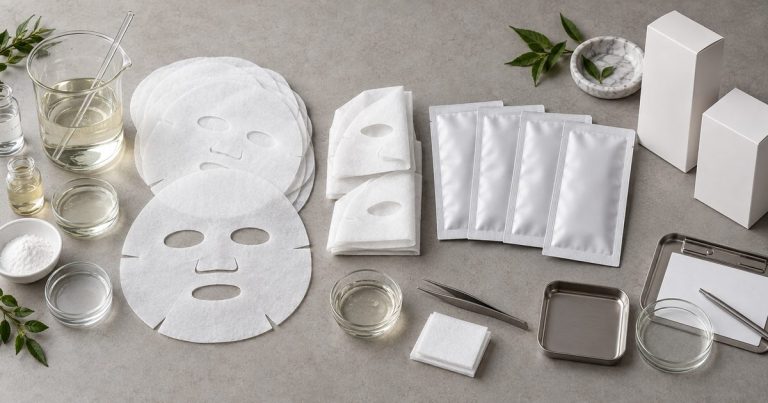
“Sheet mask fabric” is not one standardized material. Composition, basis weight, thickness, fiber structure, stretch, wet strength and die line affect serum loading, unfolding and fit. A 2025 peer-reviewed review describes different fabrication and physical properties across material systems; that supports product-specific comparison, not a universal “best fabric” claim.
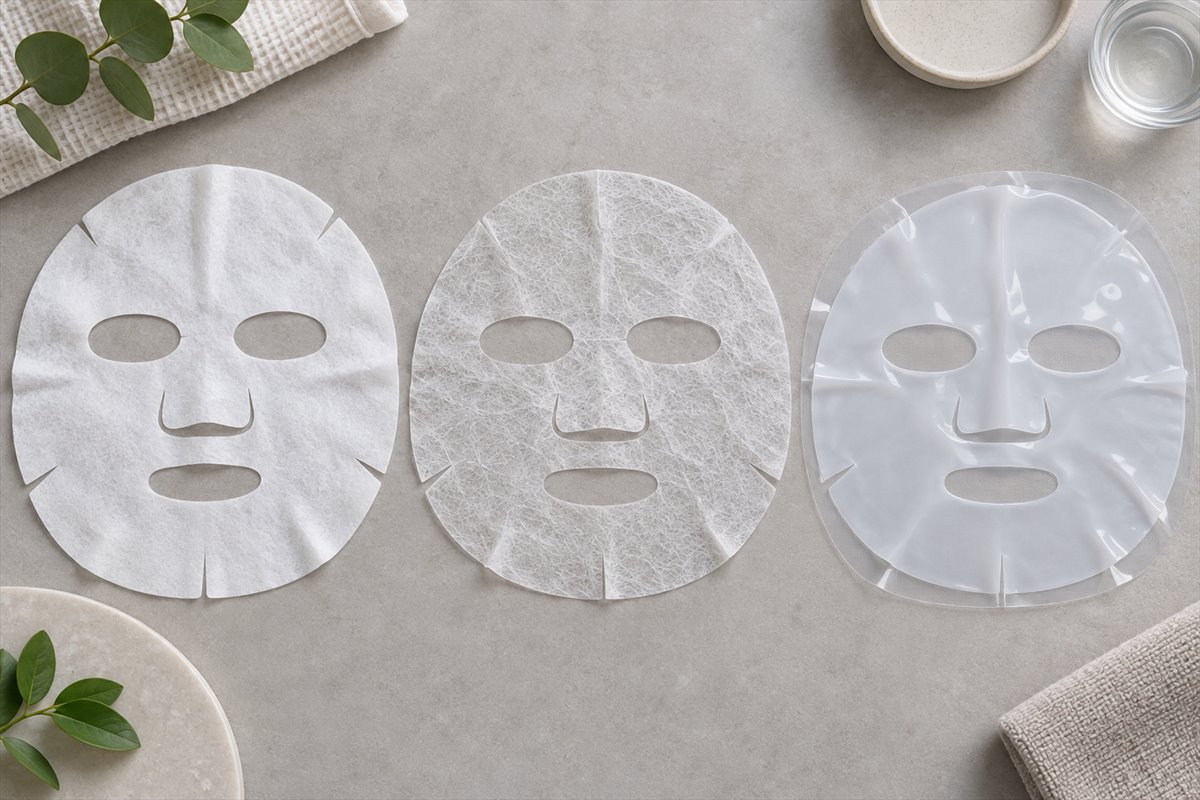
AI-generated educational comparison; material appearance is illustrative and not a supplier specification.
Nonwoven and cellulose-based sheets
Nonwoven and plant-derived cellulose sheets can support practical private-label programs, but material names alone are inadequate. Ask for fiber composition, basis weight, wet strength and any sustainability evidence. Two “cellulose” sheets may differ in thickness, softness, serum release and stretch.
Bio-cellulose membranes
Bio-cellulose can create a thin, conformable format but may fold onto itself or require carrier layers. Confirm material identity, thickness, presentation method and serum load. Do not claim biodegradability or environmental superiority without evidence for the final material and disposal conditions.
Fit, die line and handling
A fabric choice is incomplete without the face pattern. Review openings, coverage, slits and symmetry on representative users. Approve both dry dimensions and saturated handling because materials can stretch or distort. The sheet should unfold without tearing, release from any carrier film and stay in place for the labeled use time; these are experience checks, not proof of clinical benefit.
Develop the Serum and Fabric Together
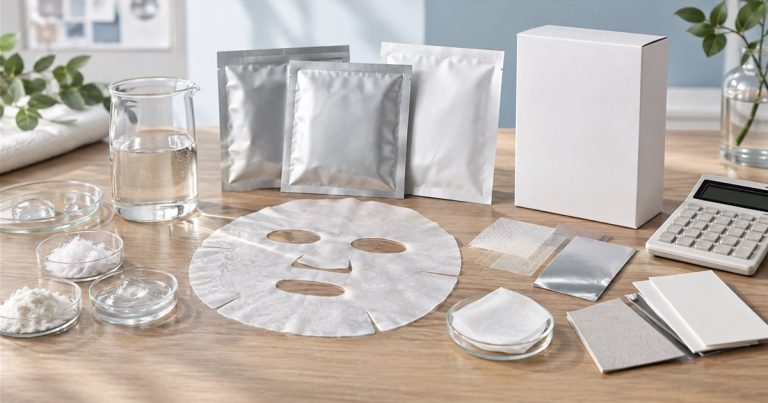
The serum must remain compatible with the fabric, sachet and intended use. Set targets for viscosity, pH, appearance, fragrance, tack, slip and after-feel. A very thin serum can drip or migrate into the seal area. A viscous serum may distribute slowly or remain unevenly loaded. A colored or botanical-rich formula can make material variation and package staining more visible.
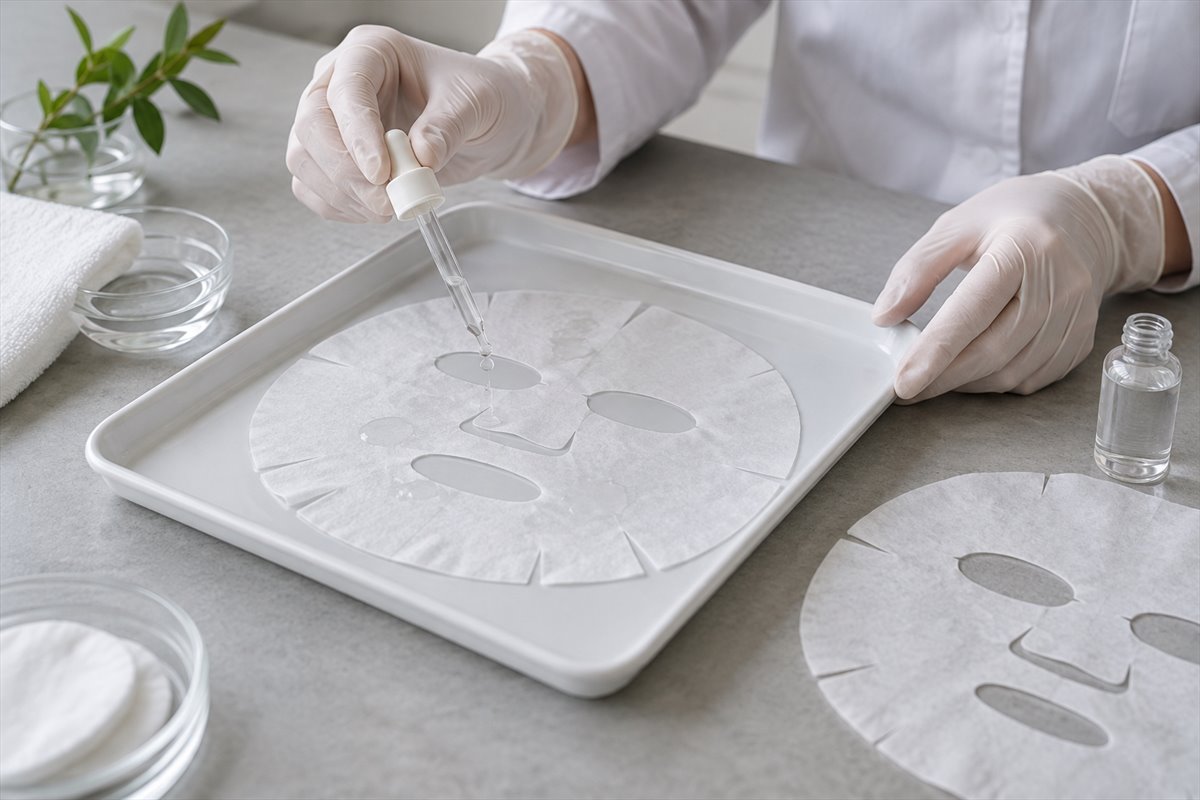
AI-generated editorial illustration of a generic development review; not an INHI laboratory, test result or customer formula.
Headline ingredients are development directions, not finished-product evidence. Confirm supplier documents, concentration, solubility, pH compatibility and claim support. FDA states that the marketer is responsible for safety under labeled or customary use, and MoCRA requires records supporting adequate safety substantiation.
Use time also belongs in the specification. Research on facial sheet masks has found that exposure changes with material and duration, while a 2024 randomized study reported more dryness and redness with prolonged use in its test conditions. Those studies do not establish one universal application time; they show why directions should be justified for the final formula-and-fabric system.
Specify Serum Load and Net Contents Separately
“Serum weight” and “net contents” are not always the same commercial or regulatory expression. Define target fill, finished-sachet net quantity, tolerance, fabric weight and treatment of residual liquid. Check distribution, drip, remaining serum and storage orientation using a stated sampling method and acceptance range—not “looks wet enough.”
Sachet Decisions: Barrier, Seal and Opening
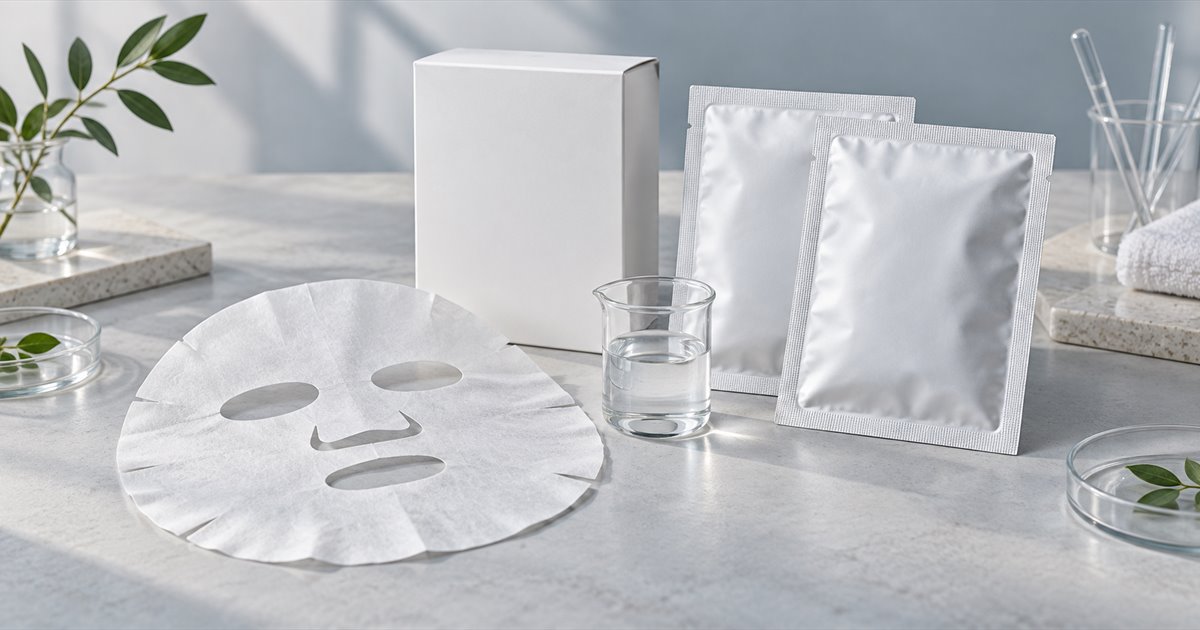
The sachet protects a water-rich cosmetic through storage and shipping. Select the laminate with the formula, expected shelf life, decoration and destination conditions in mind. Define film structure, thickness, opacity, finish, print method, seal width, tear notch, corner shape, fill orientation and coding area.
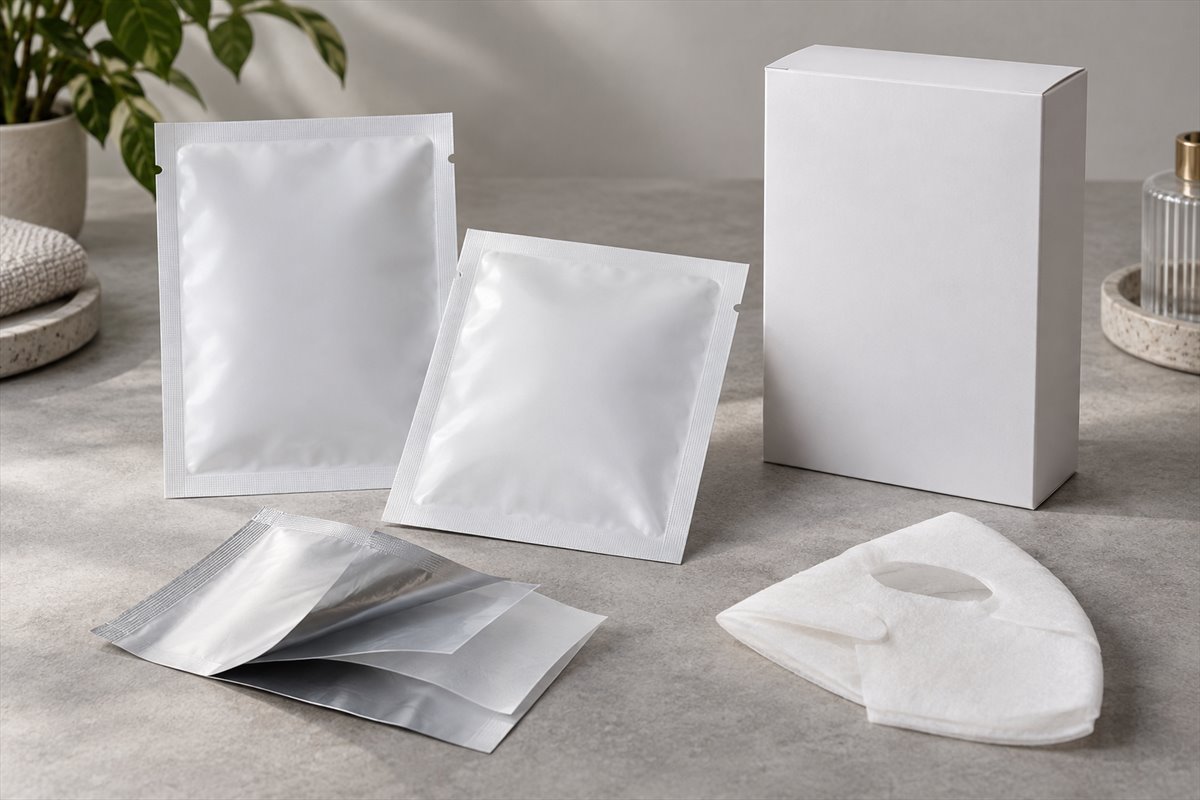
AI-generated packaging illustration; not an INHI package, approved component or production sample.
Seal integrity is a system result. Serum on the seal area, folded fabric, wrinkles, particles, temperature, pressure and dwell time can all affect the finished pouch. Agree on leak inspection, seal appearance, burst or peel testing where appropriate, storage orientation and transit checks. A visually attractive sachet is not acceptable if consumers cannot open it cleanly or if seals fail during distribution.
Before final artwork, confirm print area, registration tolerance, code position and printer limits. A flat mockup does not reveal folds, seals or tear-notch interference.
Carton Decisions: Information, Count and Channel
A carton protects sachets and adds label space, but also creates a converter minimum, proofing, assembly and freight volume. Specify sale unit, count, board, finish, opening, insert, barcode and batch-code position.
FDA's cosmetics labeling guidance states that retail cosmetic labeling generally includes product identity, net quantity, ingredient declaration and the marketer's name and place of business, with required information placed prominently and not misleadingly. The outer carton and immediate sachet do not automatically carry identical information in every market, so assign regulatory review before approving print-ready files.
Cost, MOQ and Lead Time: Quote the Same System
There is no defensible universal sheet-mask price or production lead time. Cost changes with formula, fabric, mask size, serum load, sachet laminate, printing, carton, tests, quantity, freight and delivery term. Ask every supplier to separate:
- Formula use or development.
- Fabric, carrier layers and die cutting.
- Serum fill and finished-unit conversion.
- Sachet film, printing and setup.
- Carton, inserts and assembly.
- Sampling, testing and documentation.
- Inspection, freight, duties and taxes.
- Tooling, surplus printed components and storage.
INHI states that eligible ready-formula, custom-formula and selected custom-packaging projects can start from 100 units. It also states that eligible samples can be prepared within seven days after a confirmed brief and that qualified inquiries receive an initial response and quotation within 24 hours. These are eligibility and response conditions—not a guarantee for a particular sheet-mask fabric, printed sachet, carton or full-production schedule.
Request milestone dates for brief confirmation, sample issue, formula approval, packaging proof, testing, artwork approval, component arrival, production, release and shipping. Ask which change resets each milestone.
Testing and Quality Controls for the Final SKU
Testing must represent the final formula, fabric, fill, sachet and storage conditions. Depending on product and market, the plan may cover stability, compatibility, microbiological quality, preservative effectiveness, seal integrity, transport and claims. Production controls should address incoming materials, serum specifications, mask orientation, fill, seals, coding, carton count and release. ISO 22716:2007 remains current, but it does not replace the buyer's final specification or legal responsibilities.
For the EU, the 18 May 2026 consolidated Cosmetics Regulation requires an EU Responsible Person, GMP, safety assessment, Product Information File and notification before market placement. The U.S. and EU systems assign responsibilities differently, so the destination market must be known before formula and artwork approval.
Manufacturer-Side Development Flow
- Confirm the commercial brief. Record market, channel, consumer, claims, quantity, target price and launch date.
- Choose the development route. Select an eligible proven formula, controlled modification or custom route.
- Screen fabric and serum together. Compare fit, handling, saturation, drip, release and after-feel.
- Lock the mask pattern and fill. Approve dimensions, openings, slits, serum target and tolerances.
- Develop the sachet and carton. Confirm component availability, structure, print route and coding.
- Approve final-system samples. Use the intended fabric, formula, fill and packaging—not stand-ins.
- Complete testing and files. Match protocols and documents to the final SKU and market.
- Approve artwork and specifications. Freeze revisions before component production.
- Produce, inspect and release. Record incoming, in-process and finished-product checks.
- Review the first run. Track leaks, folding, fit feedback, complaints and reorder assumptions.
Common Sourcing Mistakes and Procurement Risks
- Choosing fabric by marketing name without a material specification.
- Approving the serum before testing it with the selected substrate and sachet.
- Comparing quotes with different mask sizes, serum loads, films or carton counts.
- Treating the finished-product MOQ as the only minimum.
- Using a flat artwork mockup without marking seals, folds, notches and code areas.
- Approving sustainability or efficacy language without evidence for the final SKU.
- Assuming “microbiologically tested” identifies the protocol, sample and result.
- Treating a sample window as the full production lead time.
- Failing to define who owns tooling, excess film, cartons and unused components.
Questions to Ask a Sheet Mask Manufacturer
- Which formula, fabric, die line and packaging combinations are feasible at my planned quantity?
- What minimum applies separately to serum, fabric, die cutting, printed film and cartons?
- What tolerances apply to dimensions, serum load, net contents, seals and visual defects?
- Which tests are included, which are optional and what exact final SKU will be tested?
- How are fabric substitutions, formula changes and packaging-supplier changes controlled?
- Which files will I receive for the target market, and which responsibilities remain with my brand?
- What approvals or changes restart sampling, component lead time or production scheduling?
- Who owns tooling and surplus printed materials, and how long are they stored?
Frequently Asked Questions
What is the best fabric for a sheet mask?
There is no universal best fabric. The right substrate depends on serum compatibility, fit, wet strength, sensory target, handling, claims evidence, packaging and budget. Compare approved samples using the same formula, mask pattern and application conditions.
How much serum should a sheet mask contain?
There is no single correct amount. Mask area, fabric pickup, viscosity, desired wetness, sachet dimensions and labeled net contents all matter. Set a target and tolerance through final-system sampling rather than copying a competitor's headline number.
Can a custom sheet mask start at 100 units?
INHI states that eligible projects can start from 100 units. Actual feasibility depends on the formula, fabric, die line, sachet, printing, carton and process. Custom printed components can impose a higher binding minimum even when the finished-product route starts lower.
Does a sheet mask need a carton?
Not always. The answer depends on retail presentation, protection, required label space, multi-pack count and destination-market rules. A carton can add useful space and structure but also adds cost, minimums, assembly and freight volume.
How long does sheet mask manufacturing take?
Separate sampling from the complete project schedule. Formula changes, fabric sourcing, printed packaging, testing, artwork revisions, production booking and shipping each have their own dependencies. Use milestone dates tied to written approvals rather than one unsupported total.
Which documents should a brand request?
Request files that match the final product and market, such as ingredient and product specifications, COA, SDS/MSDS, test reports, batch and packaging specifications, artwork records and regulatory support files where applicable. A document title alone does not prove that it covers the final formula, fabric and package.
Conclusion: Request One Comparable Sheet Mask Quote
A usable sheet-mask quotation starts with one controlled specification. Fix the market, claims boundary, serum route, fabric, die line, serum load, sachet, carton, quantity and evidence requirements, then ask suppliers to price the same system and disclose every separate minimum.
Send that brief through INHI's Start a Project form and request one recommended formula–fabric–packaging route with quantity-break pricing and named approval milestones. This is the single next step for assessing feasibility; it does not replace brand-side safety or legal review.
Sources and References
- INHI Cosmetics, Products — public scope for custom face masks and formula-and-packaging development. Accessed September 17, 2026.
- INHI Cosmetics, Solutions — public development routes, eligible 100-unit starts and project flow. Accessed September 17, 2026.
- INHI Cosmetics, Insights — public MOQ, sample and quotation conditions. Accessed September 17, 2026.
- U.S. Food and Drug Administration, Modernization of Cosmetics Regulation Act of 2022 — safety substantiation, registration, listing and adverse-event duties. Accessed September 17, 2026.
- U.S. Food and Drug Administration, Product Testing of Cosmetics — marketer responsibility for safety and FDA's test-position statement. Accessed September 17, 2026.
- U.S. Food and Drug Administration, Summary of Cosmetics Labeling Requirements — product identity, net contents, ingredient declaration and responsible-party labeling. Accessed September 17, 2026.
- European Union, Regulation (EC) No 1223/2009, consolidated text of 18 May 2026 — Responsible Person, GMP, safety assessment, PIF and notification requirements. Checked September 17, 2026.
- International Organization for Standardization, ISO 22716:2007 Cosmetics — Good Manufacturing Practices — current guidelines for production, control, storage and shipment. Accessed September 17, 2026.
- Saeed, H.A.M. and Yang, H., The versatile world of cosmetic facial masks in skincare: Fabrication, properties, and future directions, Journal of Drug Delivery Science and Technology 108 (2025), 106895 — peer-reviewed review of mask materials and fabrication. Accessed September 17, 2026.
- Li, L. et al., Short-term skin reactions and changes in stratum corneum following different ways of facial sheet mask usage, Journal of Cosmetic Dermatology (2024) — randomized study of mask type and application duration. Accessed September 17, 2026.
- Google Search Central, Guide to Optimizing for Generative AI Features — people-first, non-commodity content and useful visual guidance. Accessed September 17, 2026.
Last updated: September 17, 2026