Choosing a private label eye mask manufacturer requires one controlled specification: serum formula, patch material, patch shape, pack format, target market, claims and first-order quantity. Hydrogel, nonwoven and bio-cellulose-style patches behave differently; sachets and jars create different filling and use risks. Compare quotes only after those decisions are fixed.
Quick Answer: What Should You Specify First?
Start with the commercial use case, not an ingredient wish list. Define whether the product is a single-use sachet, a multi-pair jar or part of a kit; then choose the patch material and serum as a compatible system. Ask the manufacturer to quote the same specification at several quantities and separate formula, patch, filling, decoration, testing, cartons and freight.
INHI's public product page lists private label eye masks with serum, patch material, sachet and carton coordination. Its published minimum is an eligible project starting point of 100 units, subject to the formula, material, packaging and process—not a promise that every custom eye-patch configuration is available at 100 units. Review the private label eye mask category before sending a brief.
Eye Mask Sourcing Decision Table
| Decision | Lower-complexity route | More customized route | What can create a separate minimum |
|---|---|---|---|
| Serum | Proven hydrating base with conservative cosmetic claims | Adjusted texture, sensory profile, appearance or ingredient direction | Raw-material pack size, test scope and claim evidence |
| Patch material | Existing hydrogel or stock fabric shape | Alternative substrate, thickness, color, texture or custom die line | Material roll, casting batch, die-cut setup and scrap |
| Pack format | Stock foil sachet with label or practical print route | Custom printed sachet, carton, tray or coordinated jar system | Film converter, printing plates, cartons and components |
| Fill configuration | One pair per sachet | Multiple pairs in a jar or kit | Filling method, seal validation, count control and assembly |
| Testing | Existing evidence reviewed against the final specification | New or expanded compatibility, stability, microbiological or claims work | Formula change, substrate change, pack change and destination market |
| Best use | Fast validation and controlled first launch | Differentiated repeatable SKU with demand evidence | Forecast, channel requirements and working capital |
The binding MOQ is the highest unavoidable minimum among the formula, patch material, sachet film, decoration, carton and assembly process. A finished-product MOQ alone does not reveal that constraint.
Build the Product Brief Around the Consumer Experience
An eye patch is a system, not simply a serum placed under the eyes. The user notices whether the pair separates cleanly, conforms to the face, stays in position, feels wet without dripping, removes without tearing and fits back into the package only when the format is designed for reuse.
Specify the target user, application time, desired finish, fragrance position, patch color, shape, pair count, retail channel and target price. Add the destination market and claims boundary. “Hydrating and refreshing” is a different development brief from language that implies treatment of a disease, structural change or a guaranteed long-term result.
For a quote-ready request, use a structured cosmetic manufacturer RFQ rather than sending a mood board alone.
Formula Decisions: Serum, Gel Matrix and Claims
Start with function and sensory targets
For a serum-loaded fabric patch, define viscosity, slip, tack after removal, fragrance, color, pH target and the amount of serum per pair. A thin serum may migrate in the sachet or drip during use; an overly viscous serum may load unevenly or release poorly from the substrate. The manufacturer should assess the chosen formula with the actual patch and package, not only in a beaker.
Hydrogel patches are different because the gel matrix is itself part of the delivery format. Polymer system, water content, thickness, elasticity, surface tack and serum phase affect handling and fit. Changing an ingredient can therefore change more than the ingredient list: it can affect casting, gel strength, appearance and pack compatibility.
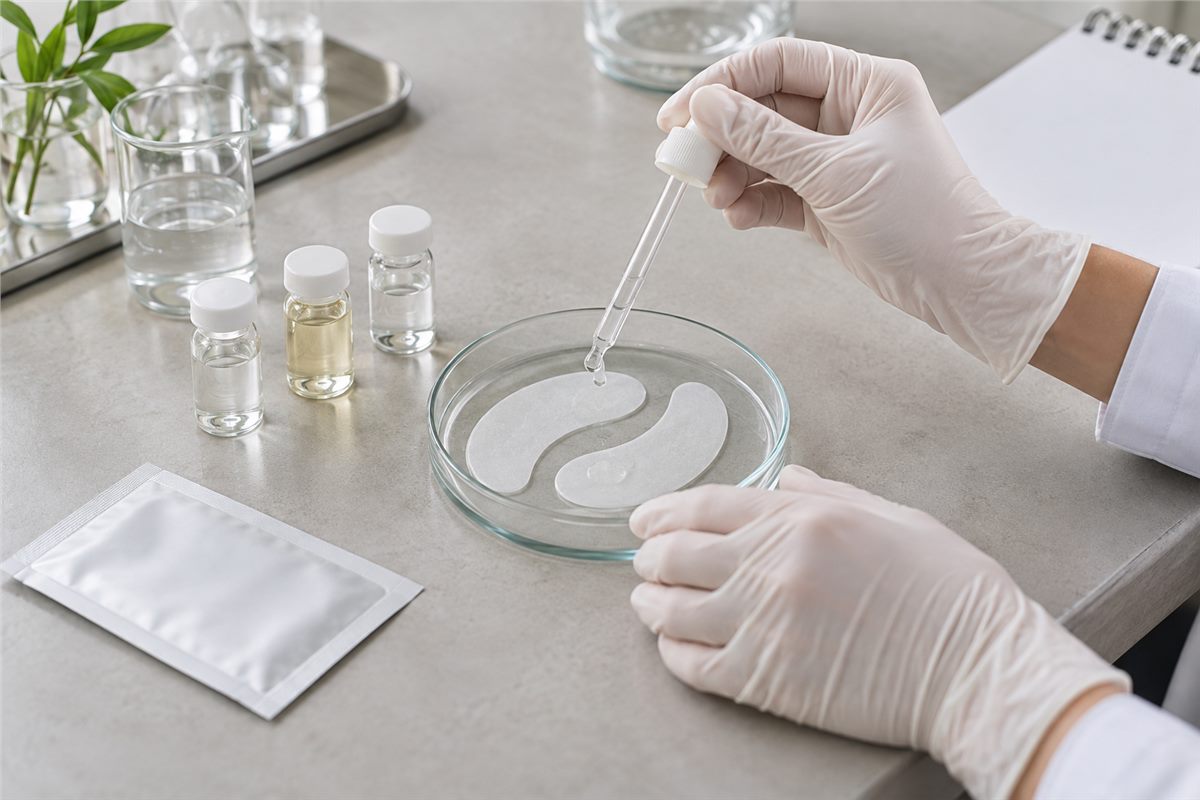
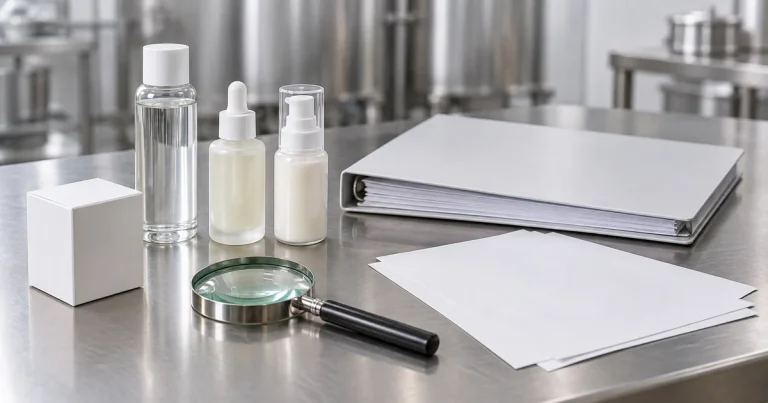
AI-generated editorial illustration of a generic development review; not an INHI laboratory, test result or customer formula.
Treat headline ingredients as evidence questions
Hyaluronic acid, caffeine, niacinamide, peptides and botanical extracts are common concept directions, but the name of an ingredient does not establish the finished product's performance. Confirm concentration range, solubility, compatibility, supplier documentation and whether the final claim is supported under the intended conditions of use.
Avoid turning a cosmetic brief into an unapproved therapeutic claim. In the United States, intended use communicated through labels, websites and advertising can affect whether a product is regulated only as a cosmetic or also as a drug. “Reduces the appearance of dryness” and “treats eczema” are not equivalent claims.
Patch Material: Hydrogel, Nonwoven or Bio-Cellulose-Style?
Patch material changes appearance, conformance, serum handling, unit cost, waste profile and consumer perception. A 2025 peer-reviewed review of cosmetic facial masks describes materials including cellulose, hydrogel and other polymer systems and highlights moisture retention, adherence and delivery as material-dependent properties. That literature supports comparing physical functions; it does not prove that one commercial patch is universally superior.
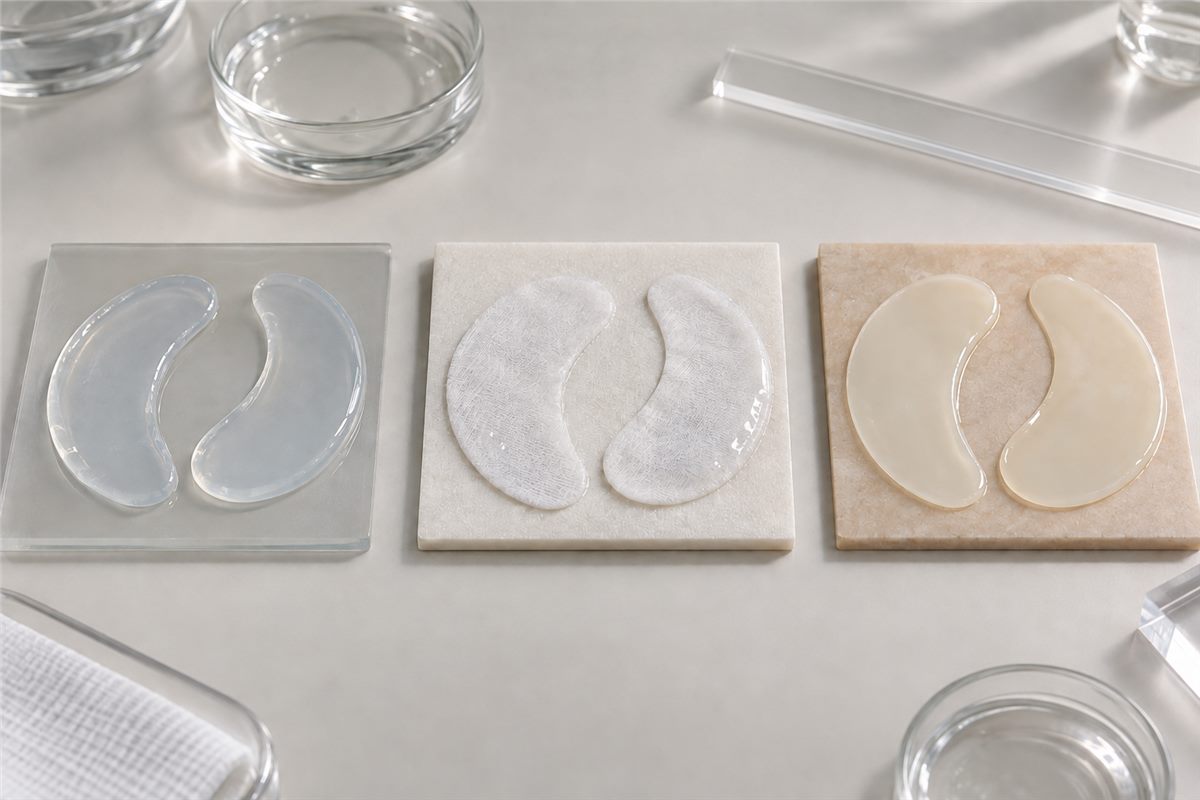
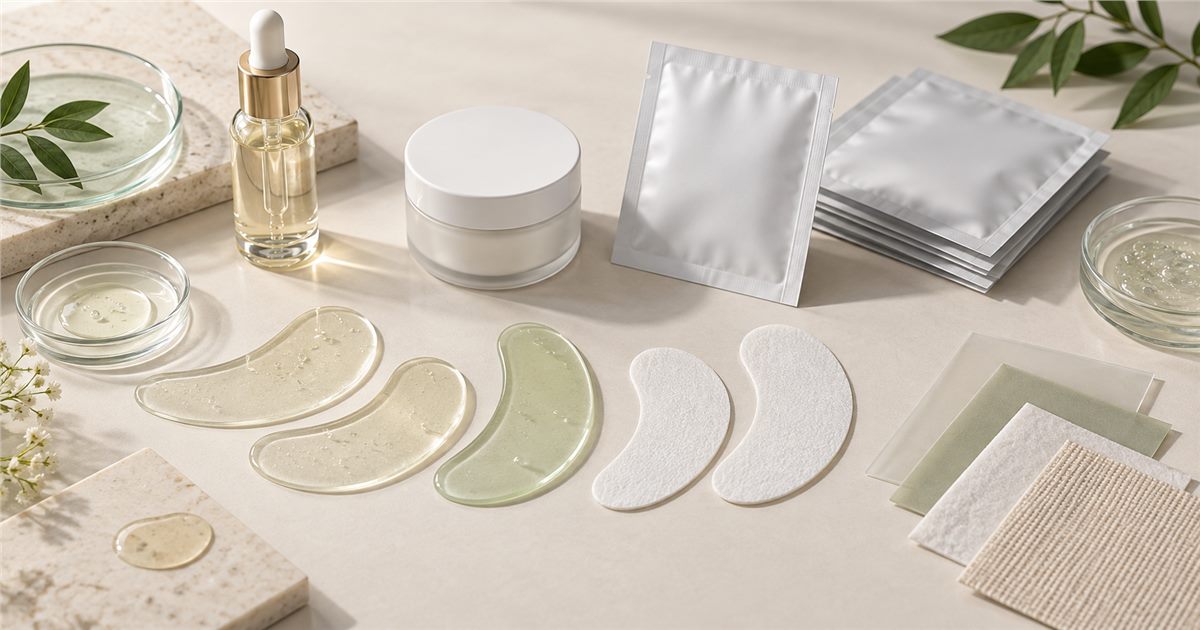
AI-generated educational comparison; material appearance is illustrative and not a supplier specification.
Hydrogel patches
Hydrogel offers a translucent, premium appearance and close skin contact. It can also expose formulation and process sensitivity: thin edges may tear, patches may slide if the surface is too wet, and shape or thickness can change the feel. Ask for tolerances on pair weight, dimensions, thickness, color and visible defects.
Nonwoven fabric patches
Nonwoven material can be practical for serum loading, flexible shapes and a lower-complexity launch. The buyer should evaluate fiber feel, edge quality, linting, opacity, serum pickup and release, and whether the material folds or distorts inside the sachet. “Nonwoven” is a broad category, so request the material specification rather than accepting the name alone.
Bio-cellulose-style membranes
Cellulose-based membranes can provide a thin, conformable feel and distinctive positioning. They may require careful handling because wet membranes can fold onto themselves or be difficult to separate. Confirm actual material identity, origin, thickness, handling method and disposal language; do not use “biodegradable” or sustainability claims without evidence that matches the finished product and market.
Packaging: Sachet, Jar or Kit
Single-use sachets
A sachet isolates one pair, supports sampling and limits repeated consumer contact with the remaining product. Key specifications include film structure, seal width, tear notch, print area, pair orientation, fill amount, headspace and leak acceptance. The formula, patch and laminate must be evaluated together because the package is part of the stability and compatibility system.
Multi-pair jars
A jar can create a strong shelf presence and lower packaging per pair, but it adds component and use questions. Define pair count, inner lid, spatula or tweezer, opening diameter, closure torque, seal or liner, instructions and how the user removes one pair without damaging the rest. Repeated opening and handling also make preservation, hygiene directions and in-use evaluation important project discussions.
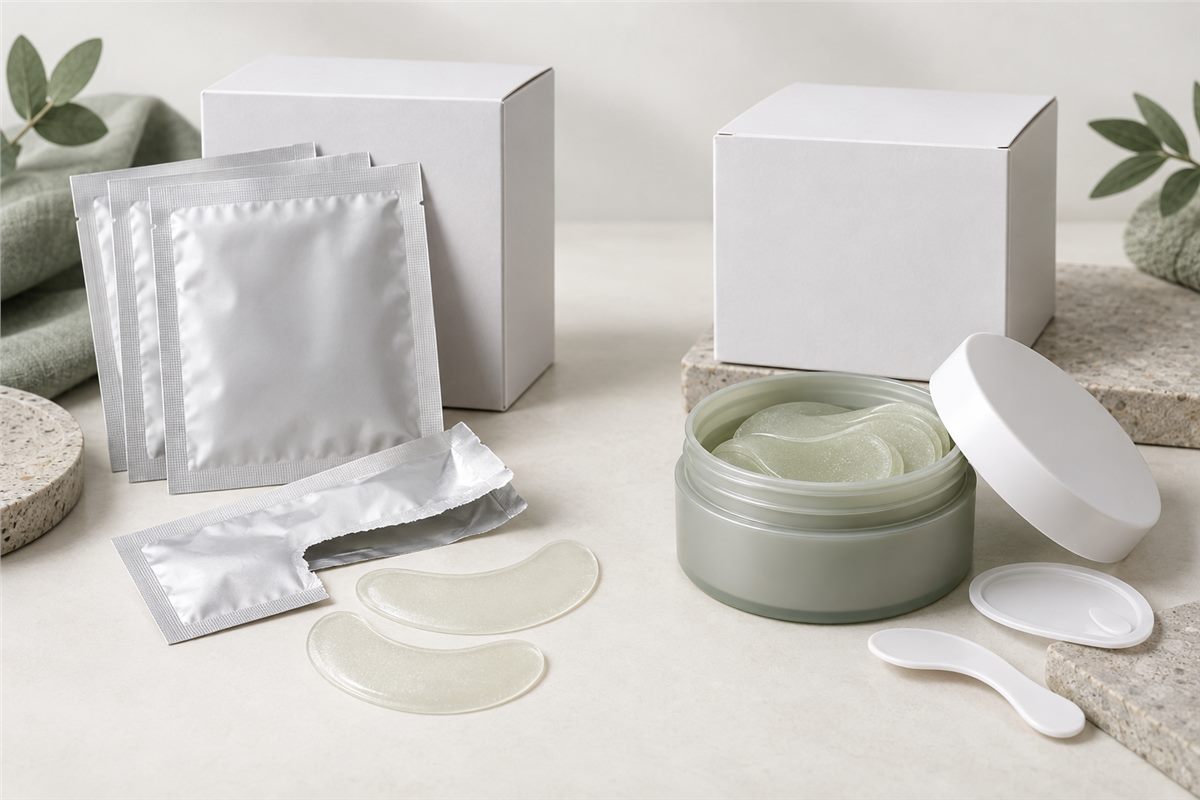
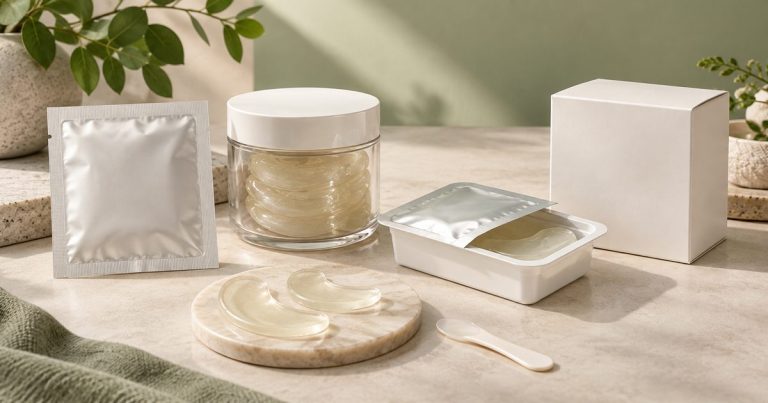
AI-generated packaging comparison; not an INHI package, approved component or production sample.
Cartons and kits
Cartons can provide space for required information, instructions and a stronger retail presentation, but they add a converter MOQ, artwork approval and assembly step. For kits, specify every component, count, insertion order and acceptance criterion. A “five-pair box” should identify whether it contains five printed sachets, a jar of five pairs or another configuration.
MOQ, Cost and Lead Time
There is no reliable universal price for a private label eye mask because two quotes at the same finished quantity can contain different serum, substrate, pair weight, sachet laminate, print method, carton and test scope. Request a cost breakdown for:
- Formula use or development.
- Patch material, shape and pair count.
- Serum or gel weight per unit.
- Sachet, jar, tools and closure components.
- Printing, labels, cartons and assembly.
- Sampling, testing and documentation.
- Freight, duties, taxes and the named delivery term.
- Surplus printed components, scrap allowance and storage.
INHI publicly states that eligible ready-formula, custom-formula and selected custom-packaging projects can start from 100 units, eligible samples can be prepared within seven days after the brief is confirmed, and qualified inquiries receive an initial response and quotation within 24 hours. These are eligibility statements, not a production lead-time guarantee. A specific project schedule begins only after formula, patch, packaging, artwork, testing and commercial terms are defined.
For quantity planning, compare the same controlled specification using the framework in the low-MOQ cosmetics manufacturing guide.
Manufacturing and Approval Flow
- Confirm the brief. Lock market, channel, claims, quantity, benchmark and target price.
- Select the development route. Choose a proven formula, controlled modification or custom development.
- Choose the patch and pack together. Confirm material, shape, fill configuration and component availability.
- Review samples. Record serum feel, patch handling, fit, dimensions, weight, color, fragrance and packaging function.
- Define verification. Agree on stability, compatibility, microbiological, packaging and claims work appropriate to the final specification.
- Approve artwork and specifications. Use revision-controlled files and physical references where needed.
- Produce and release. Confirm incoming materials, in-process controls, finished-product criteria, retained samples and release documents.
- Review the first run. Track leakage, damaged patches, complaints, repeat purchase and reordering assumptions.
ISO 22716 remains current and provides guidelines for production, control, storage and shipment of cosmetic products. It is a useful GMP framework, but a standard reference does not replace project-specific specifications or legal responsibilities.
Compliance and Testing Are Final-Specification Decisions
For U.S. cosmetics, FDA states that the responsible person must maintain records supporting adequate safety substantiation. MoCRA also establishes facility registration, product listing and serious-adverse-event duties, with limited small-business exemptions and exceptions. Eligibility depends on the responsible person, facility and product; a low order quantity alone does not establish an exemption.
Retail cosmetics generally require an ingredient declaration, product identity, net contents and the marketer's name and place of business. Required statements must be prominent and labeling must not be false or misleading. Because under-eye products are used near a sensitive area, the final safety assessment, directions and warnings should reflect customary use and reasonably foreseeable misuse.
For the European Union, the consolidated Cosmetics Regulation requires a Responsible Person, good manufacturing practice, a safety assessment, Product Information File and notification before placing the product on the market. Packaging artwork should not be finalized before regulatory responsibilities and required label content are assigned.
Common Sourcing Mistakes
- Asking for “hydrogel patches with caffeine” without shape, pair weight, pack type, market or claims.
- Comparing quotes with different patch materials or fill amounts as though they are equivalent.
- Approving the serum before testing it with the final patch and package.
- Treating a custom sachet minimum as if it were the finished-product minimum.
- Using sustainability, hypoallergenic or performance claims without suitable evidence.
- Approving artwork before receiving final ingredient, responsible-party and net-content information.
- Ignoring leak rate, folded patches, pair-count errors and user handling in acceptance criteria.
- Assuming a sample timeline is the same as the full production timeline.
Questions to Ask a Private Label Eye Mask Manufacturer
- Which serum, patch and packaging combinations are eligible at my planned quantity?
- What minimum applies separately to the gel or fabric, die cut, sachet film, print run, jar and carton?
- What are the pair-weight, dimensions, serum-fill and defect tolerances?
- Which stability, compatibility, microbiological and packaging checks are included or excluded?
- Who owns the formula, artwork, tooling and unused printed components?
- Which documents are supplied for my target market, and which remain the brand's responsibility?
- What events restart sampling, testing or the lead time?
- How will changes to formula, substrate, film or component supplier be controlled?
Frequently Asked Questions
What is the best material for private label eye masks?
There is no universal best material. Hydrogel emphasizes translucency and close contact; nonwoven fabric can simplify serum-loaded formats; cellulose-based membranes can offer thin conformance. The right choice depends on sensory target, handling, formula compatibility, pack format, evidence and budget.
Can private label eye masks start at 100 units?
INHI publicly states that eligible projects can start from 100 units. Actual eligibility depends on the chosen formula, patch material, packaging, decoration and process. Custom films, colors, shapes or cartons may carry their own higher minimums.
Are sachets better than jars?
Sachets isolate individual pairs and work well for sampling, travel and controlled dosing. Jars can support multi-pair presentation but require more attention to component function, handling, instructions and in-use hygiene. “Better” depends on channel, price position and user behavior.
How long does eye mask development take?
Separate the sample window from the project timeline. Formula changes, patch sourcing, custom printing, compatibility or stability work, artwork revisions and shipping can each add time. Ask for milestone dates tied to explicit approvals instead of one unsupported total.
Which documents should a brand request?
Request documents that match the final formula, patch, package and target market. Depending on responsibilities and market, this may include the ingredient list, formula and finished-product specifications, COA, SDS/MSDS, test reports, batch records, packaging specifications and regulatory support files. Document names alone do not prove suitability.
Conclusion: Send One Controlled Eye Mask Brief
A strong private label eye mask project begins with one controlled decision set: target market, claims boundary, serum route, patch material, pair count, packaging format, first-order quantity and launch date. Do not ask a manufacturer to price undefined “premium” features; ask which configuration is practical at each quantity and why.
Use INHI's Start a Project form to send that brief and request one recommended formula-patch-packaging route with quantity-break pricing. This is the single next step for evaluating feasibility; it is not a substitute for brand-side legal and safety review.
Sources and References
- INHI Cosmetics, Products — Private Label Eye Masks — public category scope for serum, patch material, sachet and carton coordination. Accessed September 16, 2026.
- INHI Cosmetics, Solutions — public development routes, eligible 100-unit starts and project flow. Accessed September 16, 2026.
- INHI Cosmetics, Insights — public MOQ, sample and quotation statements. Accessed September 16, 2026.
- U.S. Food and Drug Administration, Modernization of Cosmetics Regulation Act of 2022 — safety substantiation, registration, listing, adverse events and exemptions. Accessed September 16, 2026.
- U.S. Food and Drug Administration, Summary of Cosmetics Labeling Requirements — ingredient declaration, product identity, net contents and truthful labeling. Accessed September 16, 2026.
- U.S. Food and Drug Administration, Eye Cosmetic Safety — contamination, safe-use and eye-area considerations. Accessed September 16, 2026.
- European Union, Regulation (EC) No 1223/2009 on Cosmetic Products, consolidated text — Responsible Person, GMP, safety assessment, PIF and notification. Current consolidated version checked September 16, 2026.
- International Organization for Standardization, ISO 22716:2007 Cosmetics — Good Manufacturing Practices — current guidelines for production, control, storage and shipment. Accessed September 16, 2026.
- Saeed, H.A.M. and Yang, H., The versatile world of cosmetic facial masks in skincare: Fabrication, properties, and future directions, Journal of Drug Delivery Science and Technology 108 (2025), 106895 — peer-reviewed review of mask materials and physical properties. Accessed September 16, 2026.
- Google Search Central, Guide to Optimizing for Generative AI Features — people-first, non-commodity content and relevant image guidance. Accessed September 16, 2026.
Last updated: September 16, 2026