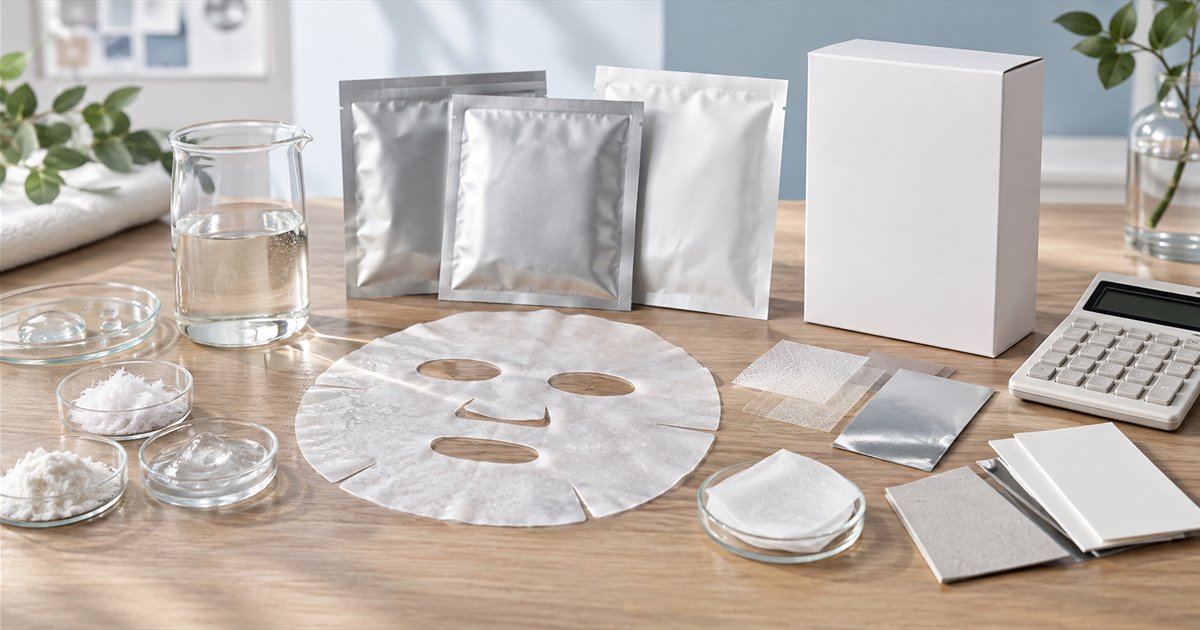
Sheet mask manufacturing cost is the total of formula, substrate, sachet, carton, conversion, testing, quality control and delivery—not one universal price per piece. A usable quote must define the final specification, quantity, market and delivery term. Compare suppliers on landed cost per saleable unit and disclose every one-time charge, minimum and excluded service.
Last updated: September 21, 2026.
Quick Answer: What Determines Sheet Mask Manufacturing Cost?
The main cost drivers are the serum route, mask substrate, serum load, sachet laminate and printing, carton format, order quantity, testing scope and delivery term. Stock components may reduce setup work; custom formulas, fibers, die lines, printed film or unusual cartons can create separate minimums and non-recurring charges.
Use this planning formula:
Landed cost per saleable mask = variable unit cost + allocated one-time costs + allocated testing/compliance costs + freight, duty and handling + expected quality loss.
The denominator should be saleable units received, not simply units ordered. A low ex-factory price can be a poor commercial result if it excludes tooling, testing, outer cases, inspection, freight or unusable units.
INHI publicly lists sheet-mask concepts within its custom face-mask product scope. This confirms the category direction, not a fixed sheet-mask price. A project-specific quotation still needs a controlled brief covering formula, substrate, packaging, evidence, quantity and destination.
Sheet Mask Cost Stack
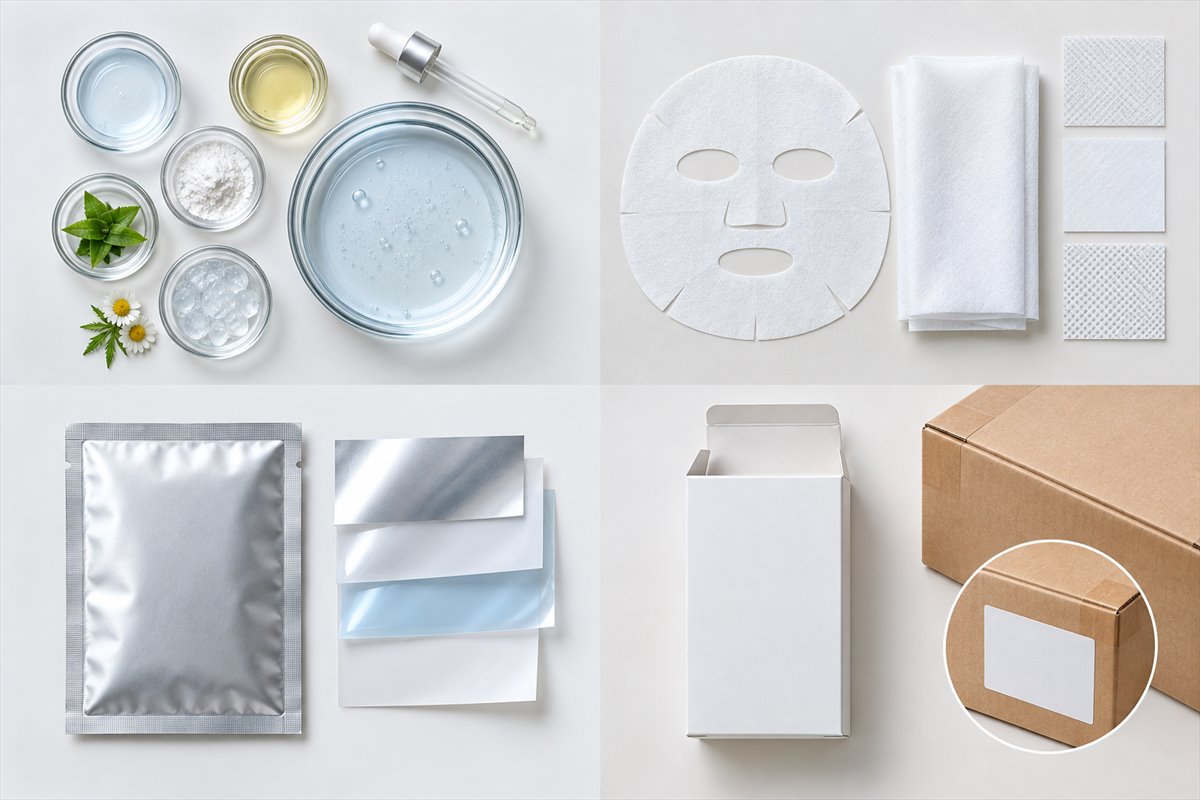
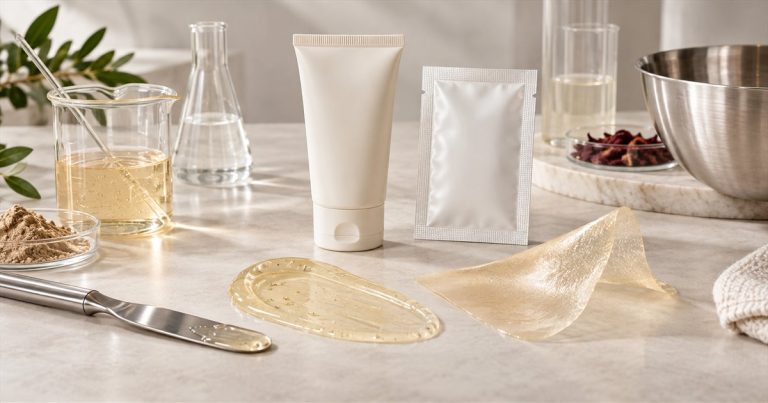
AI-generated educational flat lay; components are illustrative and not supplier specifications or approved INHI materials.
| Cost block | What it may include | Questions that make the quote comparable |
|---|---|---|
| Formula and serum | Base formula, ingredients, fragrance, color, development, scale-up and serum fill weight | Is the formula stock, modified or custom? What fill target and tolerance are quoted? |
| Mask substrate | Fiber or membrane, basis weight, dimensions, die cutting, folding and carrier layers | Is the material in stock? Is the die line existing? Are carriers or custom fibers required? |
| Primary package | Sachet laminate, dimensions, seal area, tear feature, printing plates or cylinders and coding | Is film stock or custom printed? Which artwork setup and print minimums apply? |
| Secondary and transit pack | Carton, insert, multipack, case pack, labels, dividers and shipping cases | Is a carton necessary? What pack-out, barcode and case configuration are included? |
| Conversion and quality | Mixing, impregnation, filling, sealing, assembly, in-process checks, release and retained samples | Which tolerances and inspection standard govern acceptance? |
| Evidence and market files | Stability, compatibility, microbiology, safety assessment, claims support, label review and required product files | Which tests are included, who owns the report and does it cover the final SKU? |
| Delivery | Export packing, inspection, freight, insurance, duty, tax, customs and local handling | Which Incoterm and destination apply? What is excluded from the quoted amount? |
The categories overlap. For example, a heavier serum load affects formula consumption, sachet dimensions, sealing conditions, finished weight and freight. Costing the serum independently from the package can hide those dependencies.
1. Formula Route Changes Both Cost and Risk
Ready formula
An eligible existing formula can reduce development work and may use established raw-material and process specifications. It is not automatically ready for every claim, substrate, package or target market. Confirm the exact INCI, sensory profile, evidence, restrictions and change-control status.
Modified base
Changing fragrance, color, viscosity or a highlighted ingredient can look minor commercially but create new stability, compatibility, sourcing or label work. Ask the manufacturer which change triggers a new sample, test, raw-material minimum or production validation.
Custom formula
Custom development may add research, sample rounds, scale-up and new evidence. The correct question is not whether development is “free,” but which work is embedded in the production price, which fee is separate, what happens after revisions and who controls the final specification.
FDA states that a manufacturer or distributor is responsible for ensuring a marketed cosmetic is safe under labeled or customary use, and that the agency does not prescribe one test list for every cosmetic. Appropriate testing therefore depends on the product and evidence gaps, not a generic certificate bundle. See FDA’s Product Testing of Cosmetics.
2. Substrate, Shape and Serum Load Form One System
Nonwoven fiber type, basis weight, wet strength, absorption and finish affect price and processing. Bio-cellulose and hydrogel routes introduce different material, handling and carrier requirements. Custom face shapes or dimensions can add die work and material minimums.
Serum load must be specified with a target and tolerance. More liquid is not automatically better: it can change drip, residue, seal cleanliness, labeled net contents and shipping weight. Sample the substrate, formula, fold, load and sachet together.
For a detailed material decision framework, compare the sheet-mask fabric, serum and packaging system and the hydrogel, bio-cellulose and nonwoven format guide. Those decisions should be locked before suppliers are asked to quote the same SKU.
3. Sachet and Carton Choices Can Set the Binding MOQ
A sheet mask is a high-liquid-load product in a sealed flexible package. The sachet structure must support the formula, barrier target, seal process, opening experience, print and distribution conditions. A stock pouch with a label or lower-setup print route can have a different commercial threshold from custom-printed rollstock.
Ask for separate minimums for film, print setup, substrate, formula batch and cartons. The finished-product MOQ is usually the highest binding minimum in the approved system, not the lowest number mentioned in a sales conversation.
A carton adds print area, protection and retail presentation, but also adds artwork, minimums, assembly, case volume and freight. If a carton is not legally or commercially required, compare a sachet-only route against a carton route using the same delivery and channel assumptions.
4. MOQ Changes Cost Allocation, Not Just Purchase Quantity
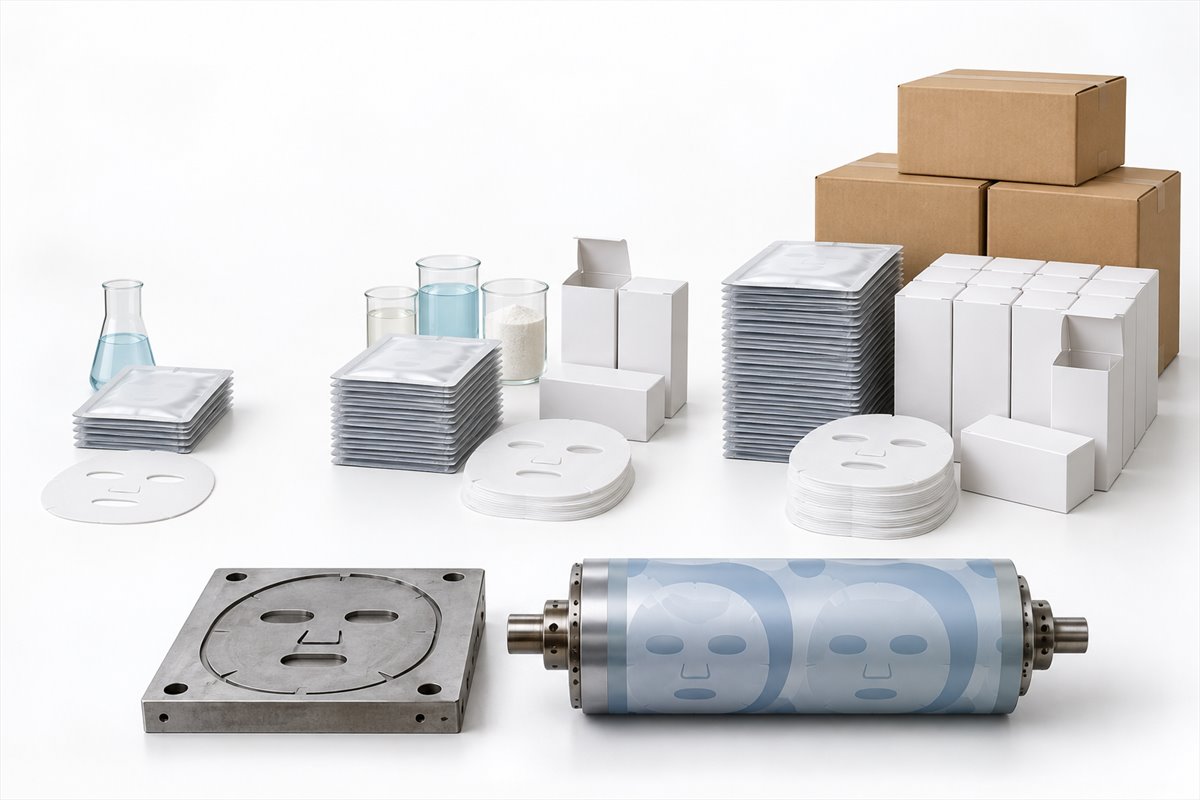
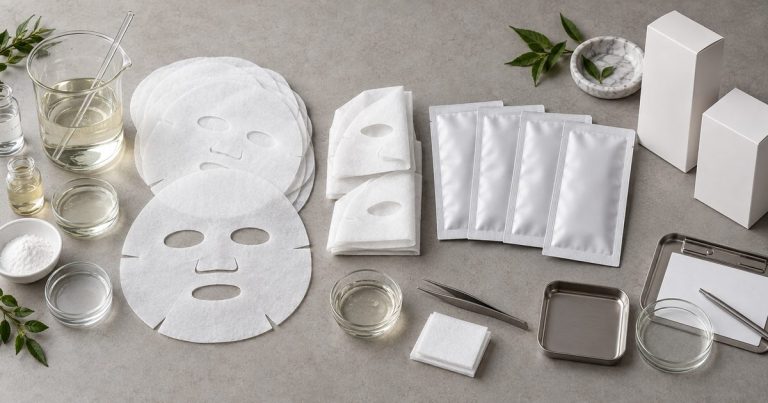
AI-generated educational illustration; quantities and equipment are conceptual, not an INHI line, quotation or production record.
Some costs vary with every unit: substrate, serum, sachet, carton and assembly. Others are incurred once or in steps: sampling, artwork setup, tooling, print cylinders, test programs and freight bookings. Increasing quantity spreads fixed costs over more units, but it also increases cash exposure, storage, expiry risk and the cost of a weak product-market fit.
Use quantity breaks that support a decision, such as a pilot quantity, expected first commercial order and realistic reorder. Require the same specification at every break. If a supplier changes material, print method or test scope between quantities, the price comparison is no longer like-for-like.
INHI’s public project guidance says eligible ready-formula, custom-formula and selected custom-packaging projects can start from 100 units. It also states that eligible samples can be prepared within seven days after the brief is confirmed and that qualified inquiries receive an initial response and quotation within 24 hours. These are eligibility and response statements, not guarantees that every custom substrate, printed sachet, carton or completed production run fits those thresholds.
5. Testing, Documentation and Claims Are Real Budget Lines
For the United States, current FDA guidance under MoCRA says required facilities register and renew biennially, while the responsible person lists each marketed cosmetic product and updates the listing annually. FDA also says registration or listing is not product approval and does not issue certificates proving compliance. These duties and any applicable exemptions should be assigned before the quote is accepted.
Label work also belongs in the budget. FDA’s Cosmetics Labeling Guide covers identity, net contents, business information, ingredient declaration and safety-substantiation considerations. Claims that imply treatment, prevention or an effect on body structure or function can change the U.S. regulatory category.
For the European Union, the current consolidated Cosmetics Regulation requires a Responsible Person, safety assessment, Product Information File, good manufacturing practice and pre-market notification. The PIF must include the cosmetic product safety report, manufacturing method/GMP statement and, where justified, proof of claimed effect. These are not interchangeable with a supplier’s COA or SDS.
ISO 22716:2007 remains current and provides GMP guidelines for production, control, storage and shipment of cosmetic products. A quote should state the manufacturing site and quality system that apply to the actual project; a logo on a presentation is not a substitute for scope and current evidence.
6. Compare Quotes With One Controlled RFQ

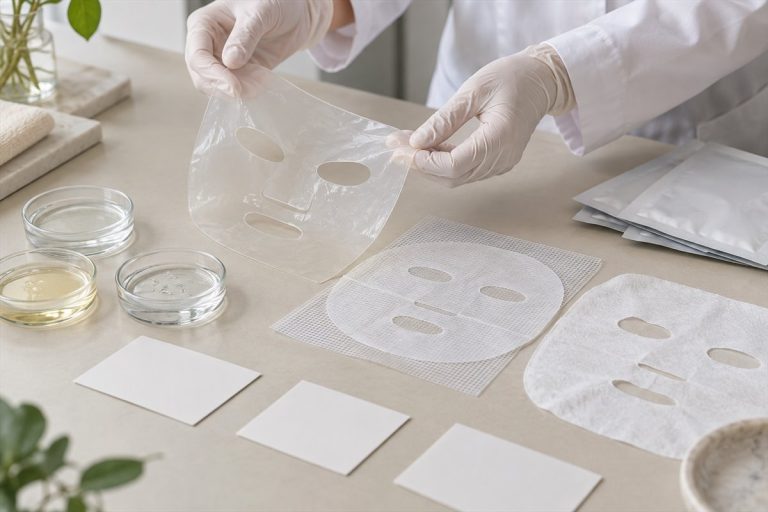
AI-generated editorial illustration of a generic supplier review; not an INHI laboratory, employee, customer formula or test result.
Send every supplier the same data set:
- Destination market and responsible-party assumptions.
- Target consumer, channel, retail price and claims boundary.
- Formula route and any prohibited or required ingredients.
- Substrate composition, basis weight, dimensions and die line.
- Serum load, sachet size, laminate, print and carton configuration.
- Quantity breaks, reorder forecast and target delivery date.
- Required samples, tests, quality limits and documents.
- Delivery address and requested Incoterm.
Then normalize each response.
| Quote field | Supplier A | Supplier B | Decision rule |
|---|---|---|---|
| Saleable finished units | Use expected accepted units, not only ordered units | ||
| Variable unit price | Confirm identical formula, load, substrate and pack-out | ||
| One-time development/setup | Allocate across the intended first run, not an imaginary lifetime volume | ||
| Testing and market files | Name every included report and the final SKU it covers | ||
| Surplus printed components | Record ownership, storage period and disposal terms | ||
| Inspection and quality loss | Define tolerances, defect handling, remake or credit process | ||
| Freight, duty and local fees | Compare at the same destination and delivery term | ||
| Total landed cost per saleable unit | Use the same formula and exchange-rate date |
Manufacturer-Side Process From Brief to Final Cost
- Freeze the commercial brief. Market, channel, price position, quantity and launch window come first.
- Select one feasible product route. Match formula, substrate, shape, load and package rather than pricing isolated parts.
- Build and approve the final-system sample. Record sensory, fit, unfolding, drip, seal and pack-out acceptance.
- Define the evidence plan. Assign test articles, protocols, laboratories, reports, ownership and timing.
- Lock artwork and specifications. Do not print before label copy, codes, tolerances and approvals are controlled.
- Issue a complete quotation. Separate unit, one-time, optional and excluded charges; list every MOQ and validity period.
- Confirm production and delivery gates. Component arrival, production booking, inspection, release and freight follow written approvals.
Common Costing Mistakes and Procurement Risks
- Comparing one supplier’s ex-works price with another supplier’s delivered price.
- Accepting a “per piece” price without confirming substrate, serum load, sachet laminate, carton and case pack.
- Treating a 100-unit eligible route as proof that every custom component also has a 100-unit minimum.
- Printing artwork before formula, label copy, die line and target-market review are locked.
- Assuming a COA, SDS, registration number or product listing equals FDA approval.
- Testing a formula in one package, then changing the substrate, load or sachet without assessing the final system.
- Ignoring surplus printed film, obsolete cartons, storage fees, exchange rates and inspection costs.
- Dividing total spend by ordered units instead of accepted saleable units.
Frequently Asked Questions
Is there an average sheet mask manufacturing cost per piece?
An average without a controlled specification is not a dependable budget. Formula, substrate, serum load, printing, carton, quantity, tests and delivery can change simultaneously. Request quantity-break pricing for one fixed SKU and calculate landed cost per saleable unit.
What is usually the largest cost driver?
There is no universal largest driver. For one project it may be a premium substrate; for another it may be custom printed film, a small quantity, testing, freight or serum ingredients. Ask the supplier to separate major blocks and identify the binding minimum.
Does a higher MOQ always reduce total risk?
No. It may reduce allocated setup cost per unit, but it increases cash, inventory, storage and demand risk. Choose a quantity that produces credible market learning without forcing an uneconomic component route.
Can a stock formula make a sheet mask inexpensive?
It can reduce some development work, but substrate, load, packaging, printing, testing, documents and delivery still matter. Confirm that the exact formula and evidence are suitable for the final SKU and market.
Which tests should be included in the quote?
The answer depends on formula, packaging, claims, market and existing evidence. Define safety substantiation, stability, compatibility, microbiology, packaging integrity and claims work with qualified advisers. Require every report to identify the tested product and method.
Should freight be included when comparing manufacturers?
Yes. Compare the same destination and delivery term. Sheet masks contain liquid and often ship in cartons or multipacks, so serum load, pack-out and case volume can materially affect delivered economics.
Conclusion: Request One Comparable Sheet Mask Cost Model
A useful sheet mask manufacturing cost is not a headline price. It is a transparent model tied to the approved formula, substrate, load, sachet, carton, evidence plan, quantity, quality limits and delivery term.
Send INHI one controlled brief through the Start a Project page and request a single recommended formula–substrate–packaging route with quantity breaks, one-time charges, included evidence and delivered-cost exclusions. That is the only reliable next step for turning a concept into a decision-ready quote.
Sources and References
- INHI Cosmetics, Products — public face-mask scope and development routes. Accessed September 21, 2026.
- INHI Cosmetics, Insights — public eligible MOQ, sample and quotation-response statements. Accessed September 21, 2026.
- INHI Cosmetics, Sheet Mask Manufacturer Guide — formula, fabric, sachet, carton and MOQ decision framework. Accessed September 21, 2026.
- U.S. Food and Drug Administration, Registration & Listing of Cosmetic Product Facilities and Products — current MoCRA registration, renewal, listing and non-approval statements. Accessed September 21, 2026.
- U.S. Food and Drug Administration, Product Testing of Cosmetics — safety responsibility and product-specific testing position. Accessed September 21, 2026.
- U.S. Food and Drug Administration, Cosmetics Labeling Guide — U.S. labeling and safety-substantiation guidance. Accessed September 21, 2026.
- European Union, Regulation (EC) No 1223/2009, consolidated text of 18 May 2026 — Responsible Person, GMP, safety assessment, PIF and notification requirements. Checked September 21, 2026.
- International Organization for Standardization, ISO 22716:2007 Cosmetics — Good Manufacturing Practices — current guidelines for production, control, storage and shipment. Accessed September 21, 2026.
- Google Search Central, Creating Helpful, Reliable, People-First Content — content-quality and sourcing guidance. Accessed September 21, 2026.