To start a face mask brand on Amazon, define one commercially clear hero SKU, prove the label and claims are compliant, validate formula–packaging compatibility, model every Amazon and logistics cost, and secure any category approval before committing to production. A successful launch is a sequence of evidence gates—not simply a listing, logo and large first order.
Editorial illustration: a generic launch-planning scene, not an INHI facility, client project or Amazon interface.
Last updated: September 24, 2026
Quick Answer
The lowest-risk route is to start with one mask format, one target customer and one defensible cosmetic benefit. Before paying a production deposit, complete a landed-margin model, confirm who will act as the U.S. “responsible person,” review the final label, identify the safety and quality evidence required for the product, and check the live Seller Central approval flow. Then approve a production-equivalent sample, packaging and claims together.
Amazon and U.S. regulatory readiness are separate. FDA listing is not approval, while Seller Central may request different evidence.
Launch readiness table
| Gate | Evidence to have before advancing | Primary owner | Stop condition |
|---|---|---|---|
| Product-market fit | Defined user, format, use occasion, target price and claim territory | Brand | The product is still “for everyone” |
| Commercial viability | Landed COGS, Amazon fees, fulfillment, returns, advertising and overhead model | Brand | Contribution margin only works before ads or returns |
| Formula and pack | Production-equivalent sample, specifications, stability/microbiology plan and pack compatibility | Brand + manufacturer | Formula, substrate and primary pack have not been tested together |
| U.S. compliance | Final artwork review, responsible-person decision, safety substantiation file and MoCRA analysis | Brand + qualified counsel/consultant | Claims or label responsibility are unresolved |
| Amazon readiness | Category-approval result, identifier plan, listing assets and fulfillment classification | Brand | Seller Central requires documents you cannot supply |
| Production release | Approved golden sample/artwork, quality limits, inspection and release criteria | Brand + manufacturer | Deposit is requested against an unfrozen specification |
1. Choose One Hero Mask, Not a Catalogue
“Face mask” is not one manufacturing specification. A nonwoven sheet mask combines a substrate, liquid essence and heat-sealed sachet. Hydrogel adds gel structure and mold or cutting decisions. Peel-off mask manufacturing behaves more like a film-forming bulk formula in a tube, jar or sachet. Wash-off cream and clay masks introduce different viscosity, filling and primary-pack compatibility questions.
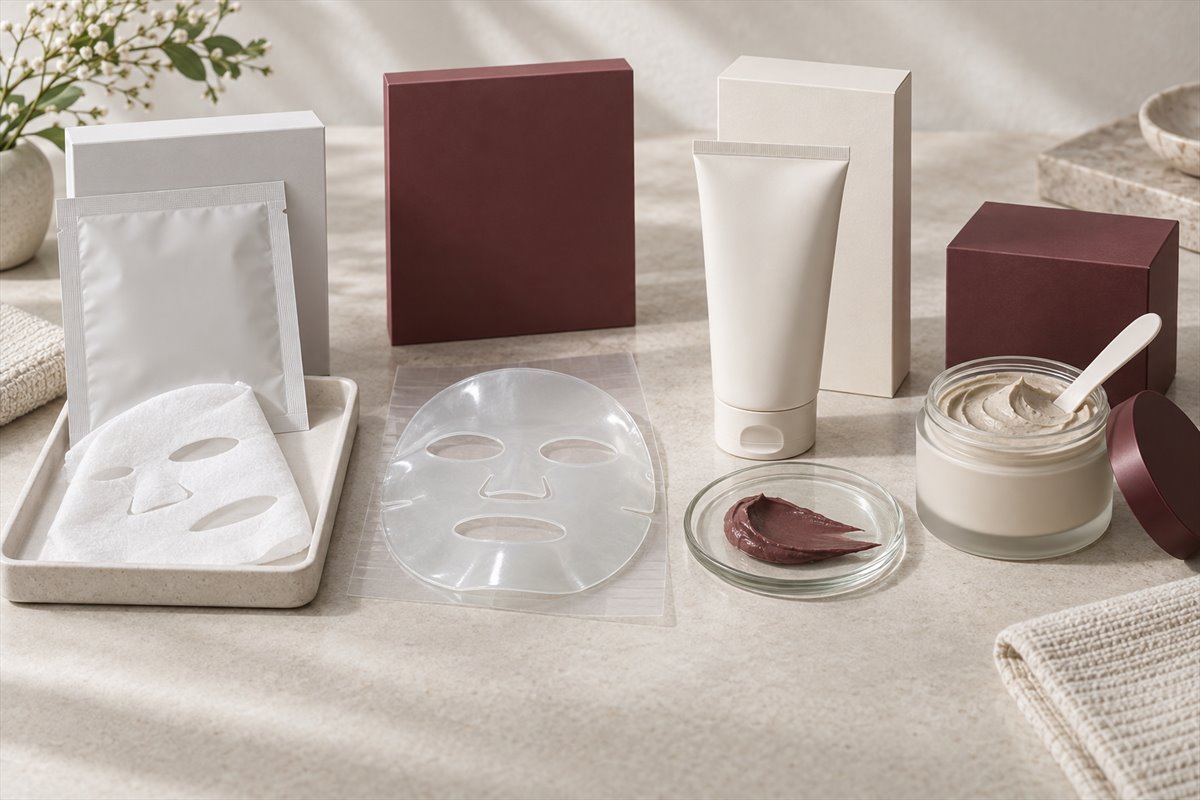
Editorial illustration comparing format and packaging directions; it does not depict an INHI product line or customer order.
For a first Amazon SKU, specify:
- Target user and use occasion: for example, a travel-friendly hydration step after cleansing.
- Format and fill: substrate or bulk type, dimensions, essence or fill weight, pack count and secondary carton.
- Sensory target: texture, slip, fragrance direction, residue and expected wear or rinse time.
- Claim territory: cosmetic appearance or conditioning claims that can be supported, rather than disease-treatment or structure/function claims.
- Retail price and channel constraints: fees, fulfillment dimensions, leakage risk and shelf-life handling.
Use this brief to control sampling, testing, quotations, artwork and listing copy. Otherwise, the Amazon page may promise something the approved formula or label does not support.
2. Build the Unit Economics Before Setting the MOQ
Start with the selling price and work backward. A useful contribution-margin model is:
Selling price − referral fee − fulfillment cost − landed product cost − prep/inbound cost − expected returns/damage − advertising − channel overhead = contribution margin
On Amazon’s U.S. pricing page checked on September 24, 2026, the Professional plan is $39.99 per month and the Individual plan is $0.99 per item sold. For Beauty, Health and Personal Care, the referral fee is 8% at $10 or less and 15% above $10, with a $0.30 minimum. Fulfillment and storage depend on measured size, weight, inventory age and program, so use Amazon’s live calculator.
The manufacturer’s unit price is only one line. Include formula, substrate or primary packaging, printing, carton, testing, inspection, freight, duty, customs, Amazon prep, labels and launch samples. Add a stressed case with higher ad spend and unsellable returns.
INHI’s public site currently describes eligible ready-to-label, custom-formula and packaging projects starting from 100 units. Treat that as an entry eligibility statement, not a universal MOQ for every formula, component or decoration. The binding MOQ is the highest minimum among formula batch, substrate, primary package, print method and carton supplier.
3. Freeze Formula, Packaging and Evidence Together
A sample that feels good is not yet a production release. For a water-rich sheet or hydrogel mask, plan for microbiological quality, preservation, stability and formula–packaging compatibility. The exact program depends on formula, pack, use, market and risk; FDA does not prescribe one universal test list.
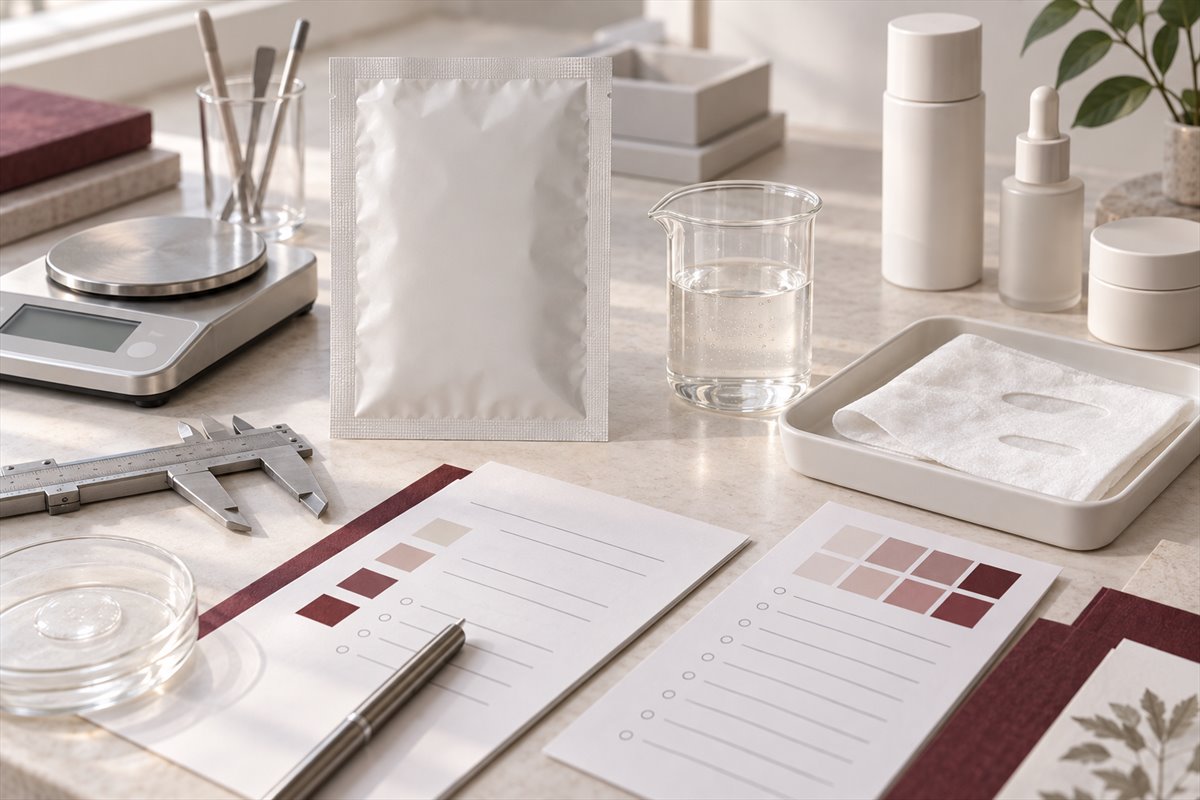
AI-generated editorial illustration of a generic review step, not a test result, certificate or INHI laboratory.
Define production acceptance through specifications, batch coding, fill tolerance, seal integrity, visual limits and an agreed inspection standard. Map these controls through a documented face mask manufacturing process. A COA, SDS, ingredient list and stability report answer different questions; none is a universal Amazon or FDA “approval certificate.”
Approve a production-equivalent pack. Foil structure, seal width, notches, carton fit and liquid load affect leakage and presentation. Assess whether any later pack change requires new verification.
4. Assign U.S. Regulatory Responsibility Before Artwork
For cosmetics sold in the United States, the final label generally needs a product identity and net quantity on the principal display panel, plus required business information, ingredient declaration and necessary directions or warnings on the information panel. Exact placement and wording depend on the product and pack, so the brand should arrange a qualified review of the production artwork.
MoCRA adds operational duties. FDA says covered facilities register biennially and the responsible person lists marketed cosmetic products and updates them annually; exemptions can apply. The label must provide domestic contact information for adverse-event reports. Serious adverse events received in the United States generally must be reported to FDA within 15 business days, including certain follow-up information.
FDA’s September 9, 2026 update says it does not issue certificates verifying cosmetic facility registration or product listing; neither is an endorsement.
Claims are another gate. Disease-treatment or structure/function statements can move a product into drug territory. The FTC requires objective claims to be truthful, non-misleading and supported before dissemination; supplier decks are not finished-product substantiation.
5. Check Amazon Approval Before Ordering Inventory
Amazon’s current beauty-selling guide notes that some products or categories require approval. The application may request retail or distributor invoices, product photos, safety certifications, GMP evidence, certificates of analysis, MoCRA documentation or a business license. The actual requirements shown in your account and for your ASIN are controlling, so open Catalog → Add Products and record the requested evidence before the purchase order becomes non-cancellable.
Build an application file with final-unit photos, ingredient and warning panels, business details, lot codes, commercial invoices and requested evidence. Amazon states beauty products should be new, unused, sealed, clearly coded and labeled in English with required identifying and safety information.
If trademark protection matters, sequence it early. Amazon Brand Registry generally requires a registered or pending trademark and matching branding permanently affixed to product or packaging. It does not replace compliance or category approval.
6. Build a Claims-Safe, Search-Useful Listing
The listing should help a shopper decide while staying inside the approved evidence. Communicate format, pack count, cosmetic purpose, material or texture and important use conditions. Do not turn ingredients into unsupported outcome claims.
Create the page from the same approved source file used for artwork. Check every number, material, ingredient highlight, direction and warning against the finished specification. If a claim appears in an infographic, A+ module, video, ad or influencer brief, it still needs appropriate support.
Images should show the exact sale configuration and explain supported dimensions, contents, application or texture. Google’s people-first guidance favors useful, experience-backed content over search-engine-first pages.
7. Choose Fulfillment Around the Formula and Pack
FBA can simplify Prime-eligible fulfillment; FBM provides more direct inventory control. The right choice depends on unit economics, dimensions, temperature sensitivity, shelf-life controls, leakage risk, replenishment speed and whether Amazon classifies any ingredient or finished product as dangerous goods.
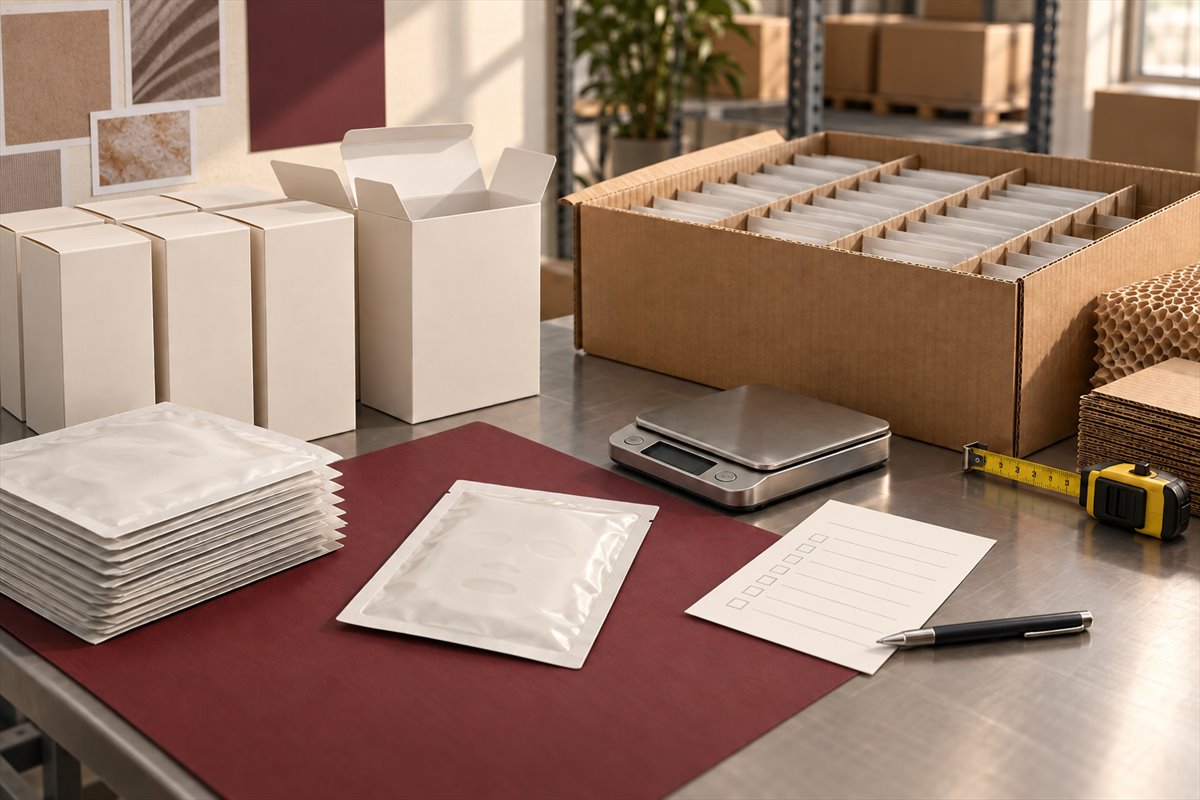
Editorial illustration of generic fulfillment preparation; it does not show an Amazon facility or an INHI shipment.
Before inbound shipment, verify current prep and labeling instructions. Test units and cartons for compression, rubbing, puncture, seal stress and liquid migration; record case quantity, traceability and inspection criteria.
Set reorder triggers from sell-through, production, inspection, freight, customs and Amazon receiving—not only factory lead time. INHI’s public Start a Project page says eligible samples can be available within seven days after brief confirmation and an initial quotation within 24 hours. These are early-development milestones; sourcing, testing, artwork, approval, production and logistics remain project-specific.
8. Use a Gate-Based Launch Timeline
Use approval gates instead of a universal launch-time promise:
- Brief gate: user, format, pack, claim territory, retail target and order quantities agreed.
- Sample gate: production-representative sample and sensory criteria approved.
- Evidence gate: test plan, safety substantiation, specifications and required documents complete or scheduled.
- Artwork gate: U.S. label and Amazon content reviewed against the same formula and pack.
- Account gate: category approval, identifier and fulfillment requirements confirmed in Seller Central.
- Production gate: golden sample, artwork, quality limits, inspection and release responsibilities signed off.
- Inbound gate: finished goods inspected, correctly coded and accepted into the chosen fulfillment path.
- Launch gate: listing live, inventory available, claims consistent, ad budget controlled and adverse-event/customer-feedback workflow active.
This sequence exposes uncertainty while decisions remain reversible.
Manufacturer-Side RFQ: What to Send
Send one structured request covering market, formula or reference texture, format, dimensions, fill weight, pack count, substrate or primary pack, decoration, quantities, target landed cost, destination, claims, tests/documents and launch date. Mark fixed and flexible items.
Ask quotations to separate formula, pack, printing, carton, testing, samples, tooling, inspection and freight assumptions. Compare quotes only after normalizing those inclusions.
INHI publicly presents ready-to-label, custom-formula and full-service routes plus a face-mask product category. Use the manufacturer insights hub to frame questions, then confirm exact format, components, MOQ, tests, timing and documents for each project.
Common Launch Mistakes and Procurement Risks
- Ordering for a target retail price without modeling channel fees. A small referral-fee or fulfillment change can erase margin.
- Treating a prototype as a production specification. Lock substrate, formula, fill, sachet structure and seal criteria together.
- Paying a deposit before Seller Central document discovery. The application may expose an evidence gap after inventory is committed.
- Changing artwork and listing copy independently. Maintain one approved claims-and-specification source.
- Buying custom packaging at a mismatched MOQ. Component and decoration minimums can exceed the formula minimum.
- Ignoring leakage and shelf-life handling. Simulate parcel distribution and confirm live fulfillment rules.
Frequently Asked Questions
Do I need FDA approval to sell cosmetic face masks on Amazon?
Cosmetics generally are not preapproved by FDA, but the product, label, facility and responsible person may have applicable legal duties. A product making drug claims can be regulated differently. Amazon can impose separate category, document and fulfillment requirements.
Does Amazon require a COA for every face mask?
Do not assume a universal rule. Amazon says an application may request a COA or other safety/compliance documents. Follow the current request presented for your product and account, and make sure any COA matches the relevant formula or lot.
What is a practical first MOQ?
There is no universal number. Calculate the highest minimum created by formula batch, mask substrate or pack, printing and carton supply, then compare it with the sell-through and cash-flow risk. INHI publicly states that eligible project routes can start at 100 units, subject to confirmation for the specific project.
Should I use FBA or FBM for face masks?
Use a margin and risk comparison. FBA may improve operational convenience; FBM may give more control over temperature, shelf-life or fragile packs. Confirm current fees, size/weight, dangerous-goods status, leakage controls and service requirements before deciding.
Conclusion: Release Evidence Before Inventory
The strongest Amazon face mask launch is commercially narrow and operationally documented: one clear product, one frozen specification, supported claims, compliant artwork, verified marketplace requirements and a margin model that survives real fees and returns. Keep each gate reversible until its evidence is complete.
For a project-specific feasibility review, send INHI your target format, market, pack, claims, quantities and launch constraints through Start a Project. INHI can confirm the applicable development route, component constraints and next sampling step; final compliance decisions remain the brand’s responsibility.
Sources and References
- Amazon, How to Sell Beauty Products on Amazon (February 17, 2026; accessed September 24, 2026).
- Amazon, Selling Plans and Referral Fees (accessed September 24, 2026).
- Amazon, Amazon Brand Registry Requirements (August 8, 2025; accessed September 24, 2026).
- U.S. FDA, Registration and Listing of Cosmetic Product Facilities and Products (updated September 9, 2026; accessed September 24, 2026).
- U.S. FDA, Cosmetics Labeling Guide (accessed September 24, 2026).
- U.S. FDA, Cosmetics Labeling Claims (accessed September 24, 2026).
- U.S. FDA, Product Testing of Cosmetics (accessed September 24, 2026).
- U.S. FDA, Microbiological Safety and Cosmetics (accessed September 24, 2026).
- U.S. FDA, Updated Instructions for Serious Adverse Event Reporting (accessed September 24, 2026).
- Federal Trade Commission, Health Products Compliance Guidance (accessed September 24, 2026).
- Google Search Central, Creating Helpful, Reliable, People-First Content (accessed September 24, 2026).
- INHI Cosmetics, Products, Solutions and Start a Project (accessed September 24, 2026).
INHI Review Required
- [INHI REVIEW REQUIRED: Confirm the selected formula, mask format, component availability, project-specific MOQ, testing scope, documents and production timing before quoting a buyer.]
- [INHI REVIEW REQUIRED: Confirm which legal entity will be the U.S. responsible person and obtain qualified review of final U.S. label, MoCRA applicability and marketed claims.]